
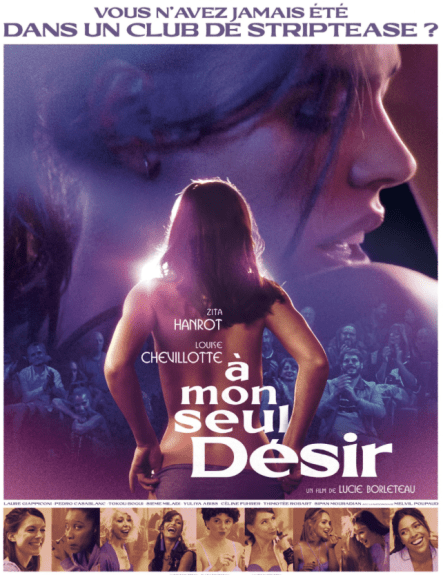
‘My French Film Festival‘ is back online, offering the chance to watch French films that have not (may never) get a UK release. The Festival runs until February 19th and for less than £8 you can watch up to nine features and nine shorts virtually anywhere in the world either direct from the Festival or from local partners. In the UK that means MUBI, BFI Player or Alliance Françaises. The Festival is backed by Unifrance, the agency promoting French films worldwide.

My first film this year is available on MUBI as well as direct from the festival. My Sole Desire is a very interesting film which so far has had little coverage outside the festival circuit. The opening of the film is certainly arresting as a stripper in a club speaks to camera asking “Have you ever been to a strip club? You’ve thought about it but didn’t dare?” The question then seems to be addressed to a young woman in a side street in Paris who decides to take up the challenge and enters the club ‘À mon seul désir’ through red doors that lead to the basement. “Do I want to watch this?” was my first reaction. I was wary but I persevered because I’d enjoyed both the two previous features from Lucie Borleteau. They both got a UK release. Fidelio – Alice’s Journey (France 2014) struggled to find an audience but Chanson douce (Lullaby, France 2019) was aired on the BBC and available on iPlayer for a lengthy period. It generated a fair amount of traffic on this blog. I was confident that this new film would be at least a worthwhile watch while wondering how it would handle a narrative about striptease.

I noticed later that the French poster uses colours similar to those used for Hustlers (US 2019), the Hollywood film that proved a worldwide hit. Starring Jennifer Lopez, Hustlers is introduced on its IMDb entry like this: “Inspired by the viral New York Magazine article, Hustlers follows a crew of savvy former strip club employees who band together to turn the tables on their Wall Street clients.” I haven’t seen the American film but I know that attitudes to nudity, sexuality and women’s desire tend to be different in Anglo-American and French cultural discourses. Lucie Borleteau’s film, with a script co-written by herself and Clara Bourreau, turns out to be a form of romantic drama with distinct fantasy elements. It isn’t a thriller or a social realist exposé of the sex industry. But it is carefully researched and rather beautifully presented. Crucially, it begins from the belief that although the world can be a dangerous place, women should not imprison themselves and should have the confidence to explore whatever they wish. Too often, Borleteau argues, strippers (and presumably other sex workers) are seen as either victims, forced into the business or ‘bewitchers’ of men. In reality it is more complicated than that. Some women become sex workers simply for the money, some might choose the work because they enjoy specific aspects of it. Some might have multiple motivations. The protagonist Manon (Louise Chevillotte) enters the club simply to find out what happens and to challenge herself. She is surprised to find that after watching a show she can ‘have a go’ herself. It goes well. She doesn’t look back and becomes a ‘dancer’.

The club is a small community of women. The only man is the owner-manager (?) Pablo (Pedro Casablanc). It is a diverse group of women, some older, some younger, mostly white but also Black and Maghrebi. Most are friendly towards Manon, who adopts the name ‘Aurore’. But there is at least one rather bitchy and unpleasant woman. The venue has a small performance space with a maximum of twenty to thirty punters – mostly men but a few women and again a diverse range of ages and ethnicities. The women strip completely but also act out short scenarios, sometimes two or three of them working together. They also interact with the audience who sit quite close to the ‘action’. ‘Private Dances’ are offered in a separate small space which is monitored by Pablo or the other women via a video camera. There might be a certain amount of intimate contact with the client, but the dancers don’t offer sexual services as such.
The narrative becomes a voyage of (self) discovery for Manon and the genre repertoire changes when Manon is attracted to another of the dancers, Mia. The ensuing romance will continue through the rest of the narrative. The fantasy elements arise in two ways. First is the question as to whether the mostly joyful experience of the striptease/dancing and the possibility of a similar experience of high-class prostitution away from the club (a form of ‘call girl’ service) are at all plausible. Not everything runs smoothly but somehow Manon and the other women escape from those experiences which are negative without any real damage. The second fantasy element is more playful: Manon discovers that she can see people stripped of their clothes in any kind of situation.

Manon is a character clearly created by the director to carry through the idea of a woman wholly able to liberate herself from the prisons into which society pushes young women. I have seen Louise Chevillotte before in one of last year’s MFFF titles, Le monde après nous (France 2021). She was good in that film, but her presentation of Manon goes up another level. She is believable as a dancer but she isn’t the expected kind of striptease artist. She isn’t ‘voluptuous’ or glamorous but she has an interesting face that makes her beautiful to anyone prepared to look. Manon also has an advantage. As the narrative develops, we learn more about her academic background which has given her a confidence that some of the other ‘girls’ have had to develop in different ways. Mia is rather different. She is more extravert but also possibly more vulnerable. She is trying to enter drama school and her performance skills are well developed. She’s played by Zita Hanrot, who I’ve also seen before in Fatima (France-Canada 2015). Manon and Mia make a great pair, but as in all romances there are setbacks. Mia too has a back story. The third leading character is Elody (Laure Giappiconi). It is she who asks the question at the beginning of the film and who later helps Manon to earn more money away from the club. This latter part of the narrative reminds me of Elles (France 2011), the film by Malgorzata Szumowska in which Juliette Binoche as an investigative journalist looks into high-end prostitution featuring university students.
I noted that the cinematographer was a man, Alexis Kavyrchine, which surprised me given the nature of the film story and the large number of women who are nude in many scenes. Most of the crew are women but later I realised that Kavyrichine had shot Lucie Borteleau’s previous film so she was confident working with him. In a long interview in the press pack, Borteleau tells us that she worked with her casting person Colia Vranici who used the CNC guidelines on sexual and ‘gender-based’ violence, vetting each of the extras as well as carefully selecting actors. A ‘stripping workshop’ was set up and some professional sex workers appear as part of the troupe in the club. Music is important in the film. I’m let down by my lack of knowledge about contemporary French popular music but a lot of thought has gone into the music. Overall this is a well thought out film project.
There isn’t much evidence so far of what audiences have made of the film but I have been saddened by the poor responses on American websites like IMDb to Borleteau’s earlier work. This is a worthwhile and enjoyable film like her earlier two films. I recommend it. Film students might like to think about it in terms of the ‘female gaze’ in a setting usually more focused on the ‘male gaze’. Here’s a festival trailer for the Tartuff film festival in Estonia:
 itp Global Film