
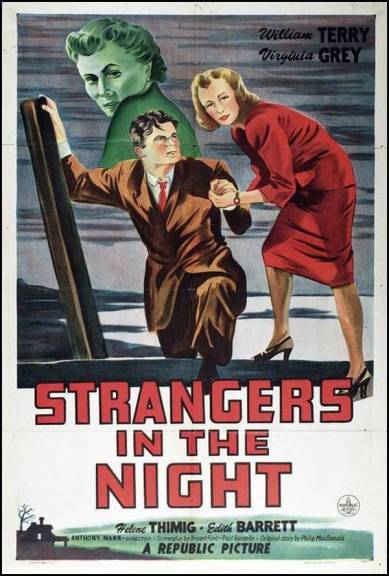
I’ve recently started to research the early career of the Hollywood filmmaker Anthony Mann and one of the first of his films that I found was this ‘B’ picture from Republic which runs for just 56 minutes. Mann is more than just an ‘interesting’ director and over the next few months I hope to cover a range of his films. He’s best remembered for his psychological Westerns starring James Stewart in the 1950s but also as the director of epics such as El Cid (US-Spain 1961) towards the end of his career. However, Mann began his film career, after time spent as actor/producer and director on stage productions, on ‘B’ pictures for both the majors and the smaller independents in 1942. One of these, a studio sometimes referred to by the majors as a ‘Poverty Row’ producer, was Republic for which Mann made five films in all. In 1944 this odd little mystery film came as a respite from the musical comedies and comedy-dramas he had previously been stuck with. He wasn’t happy working on any of his low budget films at this time but this film turned out to be the beginning of a more consistent pattern of crime/mystery type films which would later help to see Mann classified as a director of films noirs.
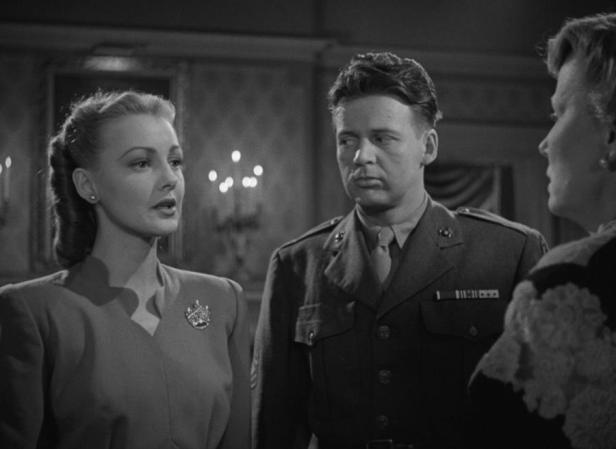
Republic made its money mostly from Roy Rogers and other Western ‘B’s and for Strangers in the Night it allocated only around two weeks of shooting. In this case, the narrative required one main set, some stock footage, some back projection and a model train crash. The narrative begins somewhere in the South Pacific with a wounded man in a field hospital. This is Sgt Johnny Meadows (William Terry) who has acquired a donated book sent by the Red Cross to read during his recuperation from a back wound. A copy of Houseman’s A Shropshire Lad has the address of a ‘Rosemary Blake’ in California. He doesn’t know Rosemary but when he recovers enough to get home leave he decides to visit the address in the book. On a train from San Francisco he meets a young woman amazingly reading A Shropshire Lad. We already know who the young woman is – Dr. Leslie Ross (Virgina Grey), who is taking over a practice in the small town where Rosemary lives. We’ve already seen how Leslie is received in the house by the fierce mother of Rosemary, Mrs Helen Blake (Helen Thimig), an older woman with a walking stick who doesn’t hold with female doctors. We’ve also met Mrs Blake’s ‘companion’, the meek Ivy (Edith Barrett).
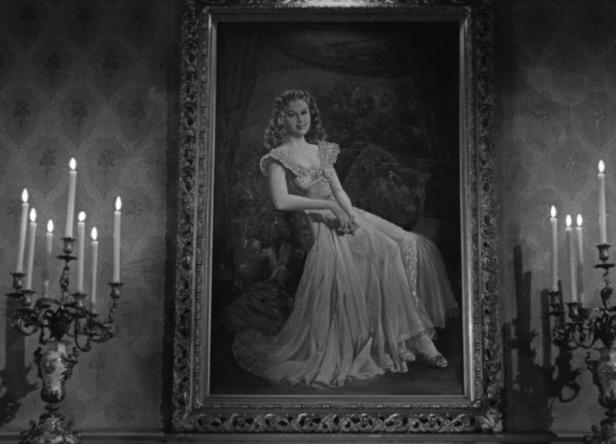
Before Johnny and Leslie can make any progress in getting to know each other the train derails and Leslie is busy tending to wounded passengers. This has so far taken only 11 minutes. What kind of a story have we got here? The idea of the anonymous book donation is part of a long history of similar practices but the young female doctor is a more recent innovation here representing the increased movement of women into employment in wartime with so many men sent overseas. Characters like Leslie Ross as confident young women were starting to appear more frequently in ‘B’ pictures during wartime – another example might be the young nurse sent to a Caribbean island in the Val Lewton-produced RKO ‘B’, I Walked With a Zombie. I don’t want to spoil the narrative – you can find the film on an Olive Films Blu-ray in the US and online – but the obvious question is how will Leslie and Johnny discover Rosemary’s story. Leslie has already seen a large painting of the beautiful Rosemary that hangs over Mrs Blake’s fireplace in the rather grand house on top of a cliff on the coast. (The long shot of the house is another model.)
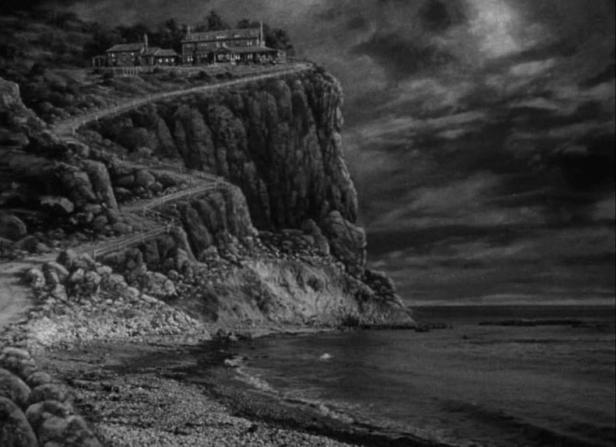
Rosemary’s story constitutes the mystery and her fierce mother provides the thrills. I won’t spoil the narrative but you can probably guess the story behind the mystery. The best things about the film are the performances and the use Mann makes of the ‘big house’ set. Helene Thimig was an Austrian actor, married to Max Reinhardt until his death in 1943. She does formidable very well. Edith Barrett was a supporting player in a number of ‘A’ features and better class ‘B’s such as I Walked With a Zombie (1942). Virginia Grey had been contracted at Metro, appearing in ‘B’s and ‘A’ features in a career that started as a 10 year-old in 1927. She would go on to have 140 appearances in film and TV. William Terry in the lead was the least experienced of the quartet and he had quite a short career. Overall, however, Anthony Mann at least had actors who could learn lines and deliver them as requested. I don’t mean to be condescending. Mann himself said that in his early career in ‘B’ productions he was sometimes faced with actors who couldn’t do simple tasks. On this production he had no such worries and he had a script with input by Philip MacDonald who had worked on scripts for John Ford (The Lost Patrol, 1934) and Hitchcock (Rebecca, 1940) and later would provide the source novel for Circle of Danger (UK 1951)

The visual promise of the set of the cliff-top house was fulfilled by Mann’s work with Reggie Lanning, a vastly experienced cinematographer, especially on ‘B’ shoots. They do manage to create angles and lighting set-ups which enhance the mood and Max Alvarez argues that the best sequence in the film is a 1 minute 33 second single take in which the camera tracks towards Thimig as she announces the great ‘reveal’ to Johnny and Leslie. This is also special because , as Alvarez points out, Thimig shifts from her gothic melodrama mode to something more “eloquent and touching”. After that, however, the final scenes are likely to provoke laughter in most audiences. Strangers in the Night is a sort of crime/mystery film but perhaps more likely to be seen as a gothic melodrama. It isn’t a film noir but there are elements in common with noir pictures. Anthony Mann achieved something with a tiny budget and a very short shooting schedule. There was already some evidence of what he might achieve with a bigger budget and more time to use it intelligently.

Source
Alvarez, Max (2014) The Crime Films of Anthony Mann, Jackson: University Press of Mississippi
 itp Global Film
I enjoyed this brief Gothic Noir from Anthony Mann. I think theres a Hitchcockian feel to the story, which is not surprising as the original story was by Philip Mcdonald, a Hollywood based British writer and screenwriter, who worked on Hitchcock’s “Rebecca” ( he also worked on Val Lewton’s production of “The Body Snatcher”). The importance of the portrait also makes me think of “Laura”, which was released a few weeks before “Strangers In The Night”.
LikeLiked by 1 person
Yes, it’s a remarkable film suggesting more than might be expected from, as you say, a ‘brief Gothic Noir’.
LikeLike