

It’s time to get back to Ozu – what could be better on a grey January day? Ozu Yasujiro was a prolific director with over 50 films made over just 35 years. But he had two stints of military service between 1937 and 1940 and again between 1942 and 1945. At the end of the Pacific War in 1945 he was in Singapore and he had to wait until 1947 for his next feature. Because of this, he made only two entertainment features during the whole wartime period (i.e. 1937-45). As David Bordwell points out in his magisterial book on Ozu, there has long been an interest in the extent to which Ozu in this film and the following 1942 feature There Was a Father conformed to the wartime ideologies of the military authorities in Japan.
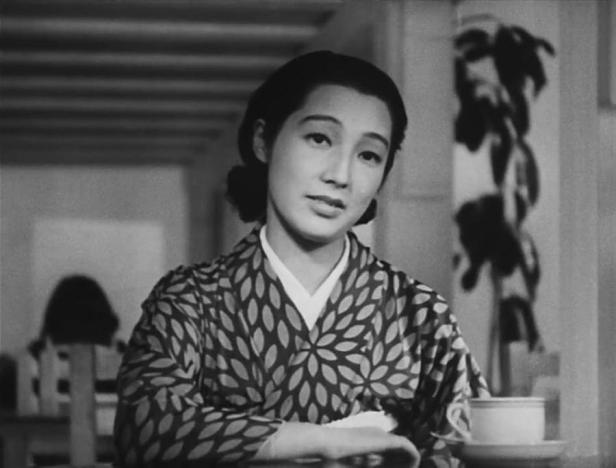

The Toda Family film opens with a long sequence in which the large family assembles for a photograph in the grounds of a huge Western-style stately mansion. The occasion is father’s 69th birthday and the family are forced to wait for the younger son to get dressed in his formal attire. The family photo session is completed successfully but a short time later (there is no attempt to signify the precise time passing), the father of the family is taken ill and dies after enjoying a day out and possibly drinking too much sake. The family gathers again and later the father’s will reveals that his business affairs had gone badly in the last few years and he was deeply in debt when he died. The large family home and his books and art treasures must all be sold to meet the immediate debt repayments and, as tradition demands, the widow and her youngest daughter Setsuko, not yet married, must be taken in by the eldest son. Soon it becomes apparent that this arrangement is unlikely to suit everyone and the remainder of the narrative will work though what happens within the family.
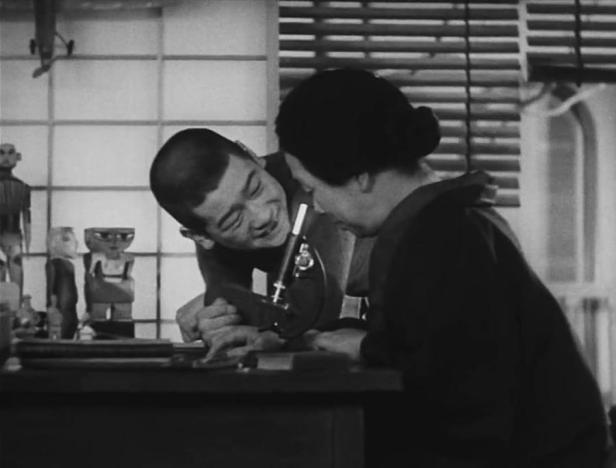
What’s most noticeable about the film is that the focus in the narrative is on the oldest and the youngest characters. The first question is how will mother and Setsuko fare in the household of the oldest son? Not very well is the answer and they find themselves moving, with their maid and a collection of house plants plus a large mynah bird in a cage, from the oldest son to the eldest daughters’s house and then to the family summer house by the sea rather than face going to the third sibling’s home and face the same sense that they are not really wanted. During all this time the youngest son Shojiro has taken himself off to Tianjin in Northern China where, in the Occupied city, Japanese business is thriving. But all is not doom and gloom for Setsuko and Mrs Toda. Setsuko meets her friend Tokiko, an ‘ordinary’ young woman who has a job in Tokyo unlike the Toda sisters who, as the daughters of a business man, are not supposed to work outside the home. Tokiko discourages Setsuko from becoming a ‘working woman’. Meanwhile Mrs Toda is appreciated as a companion by her grandson Ryokichi, a lively and inquisitive young man who is bunking off school because he is being bullied. The three married couples carry on as if nothing has happened, inviting friends over in one case and asking mother and Setsuke to go out so as not to be in the way.
The climax of the narrative is the one year anniversary of the death of the family patriarch. Shojiro is late again to the formal occasion but this time he has a genuine excuse because rough seas have delayed his return from China. What follows is for me quite a surprise since, ignoring the social niceties, Shojiro turns on his older siblings and calls out their disgraceful treatment of his mother and Setsuko. It’s a thrilling display of firm authority and the miscreants are chastened. In one sense of course, this is order restored and the new patriarch takes the reins. He is going to find an appropriate husband for Setsuko and he will take his mother and sister back to China. I realise that I have outlined the whole plot but as in most of Ozu’s films the narrative pleasure is in the subtle presentation of the interaction between characters rather than the working out of the plot.

It’s important to note that in Saburi Shin and Takamine Mieko, Ozu cast two of most attractive rising young stars of Japanese cinema. The Brothers and Sisters of the Toda Family was Ozu’s first big hit with audiences and it helped him gain a long-term contract with Shochiku. Saburi would star in a later Ozu picture, Flavour of Green Tea Over Rice in 1952. By then he had lost some of his youthful good looks and was, ironically a childless married man making a long overseas trip. Takamine Mieko would go to make over 140 film appearances.
I do need to be careful in approaching this title simply because I have only seen one or two films from Ozu’s work before 1937. Even so, I think that this film is clearly ‘transitional’, partly because of its position as a product of the wartime years and specifically the increased spread of the war after Pearl Harbour.To return to Bordwell’s analysis of the film’s ideological intent, I feel slightly disadvantaged by the subtitles on the BFI print. I didn’t spot what Bordwell calls the ‘Teutonic’ references (he’s critiquing an analysis by Joan Mellen). But these don’t seem to be very important. The two clearest issues are connected to Ozu’s focus on the wealthy middle-classes in Tokyo and on the patriarchal nature of the narrative. The military authorities were controlling film scripts and they didn’t want films to focus on the wealthy but instead to present ‘ordinary people’ doing their bit for the war effort. I suspect that’s true of all the belligerent nations in the Second World War. Ozu is very clever in his presentation of the script he wrote with Ideka Tadao. He presents an extravagant lifestyle but satirises it at the same time. On the other hand the extravagance doesn’t run much further than too much sake and shop bought cakes, half of which are not eaten. It is interesting that official pressure to present characters in Japanese dress/hairstyles etc., rather than Western modes, cuts both ways.The more dynamic characters such as Shojiro and Tokiko are shown in Western dress when working but Japanese style at home. When Tokiko comes to visit at the summer house she is wearing a kimono. This kind of contradiction also occurs in relation to questions of patriarchy. Shojiro is certainly in charge at the end of the narrative when he berates his older siblings and takes charge of his mother and Setsuko. He is the one character who, despite being ‘away in China’, develops as a character over the course of the narrative. I think he embodies a familiar theme for Ozu in his later films – in one sense he represents the re-establishing of the patriarchy but he is often paired with young women who look towards the freedom and assertiveness that will come in the post-war years. It could be argued that this is the main driver of Ozu’s narratives in the 1950s. The Brothers and Sisters of the Toda Family also looks forward to the issues of the breakdown of the internal family relationships in Tokyo Story.
Shojiro is, because of his Chinese migration, also the most direct link to the war. He extols the possibilities of life in Occupied China and says he will take mother and Setsuko there. Ozu had been posted to China in 1937. I suspect he knew differently about what the Occupation meant but he was unable to speculate even if he would have wanted to do so.
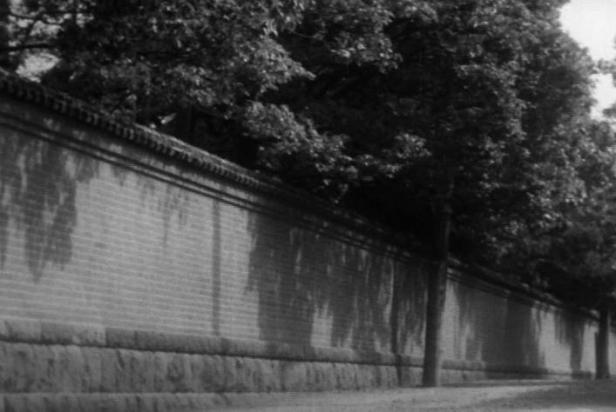
This film also feels ‘transitional’ in formal terms. Although most scenes are shot on studio sets, there are some location shoots, including pillow shots like that above. The cinematography is by Atsuta Yûharu, early in his working relationship with Ozu. He would go on to shoot most of Ozu’s films from this point and here could be seen as exploring some of the distinctive features of Ozu’s later style. As an indicator of what is to come, I should point out that a seemingly youthful Ryu Chishu appears in this film as a friend of Shojiro. In the succeeding films by Ozu he is often the leading (older) male figure.
I watched a print of the film rented from BFI Player in the UK (which also distributes the film as a DVD extra on its 2010 Blu-ray of Tokyo Story). It has not been restored and is rather rough around the edges, but it didn’t prevent me enjoying the film.
Reference
Bordwell, David (1988) Ozu and the Poetics of Cinema, London: BFI and Princeton University Press
 itp Global Film