
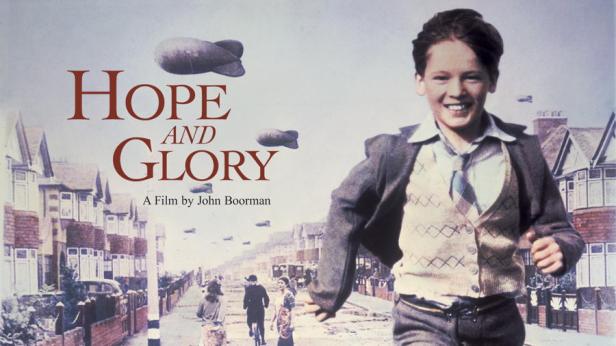
Hope and Glory is one of the best British ‘Home Front’ films set during the Second World War. If you’ve never seen it, try and catch it on iPlayer in the UK where it is free for the next three to four weeks. It looks like it is widely available on other streamers in other territories. It’s the work of one of the best UK filmmakers of the last 60 years, John Boorman (who has actually lived in Ireland for much of that time) and it is very much autobiographical. The narrative is presented from the perspective of a young boy of eight when war is declared in 1939. (Boorman was born in January 1933.) We follow what he experiences over the next couple of years with the director providing a brief voice-over at the beginning and the end of the narrative.

In 1987 the UK film industry was still struggling to recover from its lowest point and this film was a hit with both audiences and critics. It received five Oscar nominations but didn’t win in any category. However, it did figure in many awards lists in the UK and the US. I suspect that its major achievement – a delicate balance between comedy and a detailed presentation of life in London during 1940 – was also what made the Academy voters hesitate. It’s interesting to read reviews on IMDb which was still a few years away in 1987 and most of the comments come from US archive reviews or audiences watching the film in the early 2000s. ‘Home Front’ narratives are very different in the US and the stance taken by young boys who find the bombing exciting rather than terrifying is perhaps hard to handle. I checked Monthly Film Bulletin‘s review for September 1987 and Charles Barr writes a typically perceptive and knowledgeable response. He link’s Boorman’s autobiographical presentations on film with Michael Powell’s autobiography (the first volume of which came out in 1986) and suggests that the two filmmakers represent ‘the two great risk-taking romantics of British cinema’.
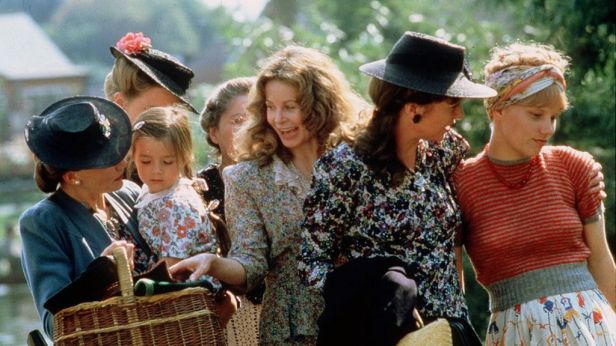
The key to the film’s success in making its narrative work is the treatment of two locations. When the narrative begins the family of the young Bill (Sebastian Rice-Edwards) is living in one of the relatively recently built semi-detached houses in suburban London. The family is lower middle-class and the father Clive (David Hayman) has a car. Mother Grace (Sarah Miles) is a ‘stay at home mum’ looking after Bill and his younger sister Sue (Geraldine Muir). Bill also has an older 15 year-old sister, Dawn, played with great gusto by Sammi Davis. Boorman was able to construct the whole suburban street on an open space at a Surrey airfield. This allowed him to burn down houses. The second set was Grace’s parents’ house constructed on the banks of the Thames close to Shepperton Studios. This is where the family is located after their house was destroyed. Here Bill began to enjoy his time with his cantankerous grandfather played by Ian Bannen.

Home front films usually focus on the women whose husbands are away. Bill’s dad was a young man in the First World War and he feels it’s his duty to join up again. This was his choice, with two young children I don’t think he would be called up until later in the conflict. Grace finds herself alone but she has friends (and her sisters). The small boy’s view of what goes one is a different perspective and includes what for him is a happy time rummaging about in the bombed houses on the street. This is in stark contrast to those German and Japanese films in which living in the rubble following Allied air raids is much tougher – because society has crumbled along with the houses. Boorman is using poetic licence here since this suburban street will be hit by stray bombs rather than a sustained attack as in areas close to the docks or factories. It’s important that we realise that this is Bill’s perspective. It’s awful for people who lose their loved ones and their home, whether the bombing was intentional or not but to Bill it is fascinating to find chunks of still warm shrapnel.
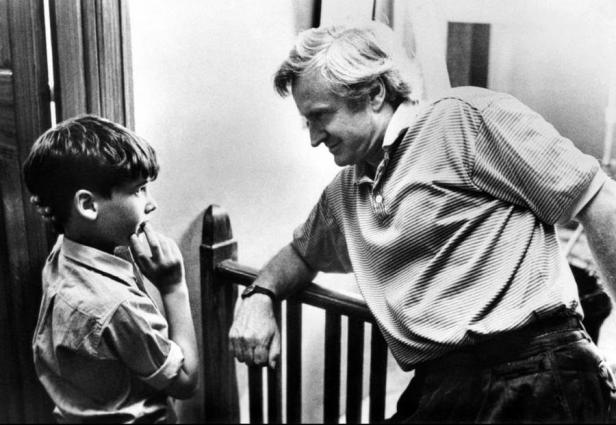
There are obvious comparisons to other Home Front films, including Yanks (UK 1979). In that film it is the arrival of the Americans en masse later in the war that provokes the story but here it is a Canadian soldier who meets Dawn and proves very persistent. The film is faithful to Boorman’s own memories and is therefore very English, as noted by some American critics. The narrative device, employed as a metaphor for how Bill ‘comes of age’ is provided by cricket. Before he joins up, dad teaches Bill about the ‘googly’, the disguised ball bowled by a spinner which ‘spins the other way’ and can fool even the most experienced batter if they are unable to ‘read’ the ball as it leaves the bowler’s hand. When dad returns, Bill after practising with his grandad, bowls his dad with the perfect googly. He’s seen a lot and he recognises the ball that is a ‘wrong un’. It isn’t the only thing Bill learns. There is a fair bit of sexual activity in the film, witnessed by both Bill and his young sister spying on Dawn. At one point Bill is employed in pencilling in a seam on her calves and the backs of her thighs to represent Dawn’s non-existent nylon stockings.

To return to Barr’s reference as a romantic, Hope and Glory isn’t a straightforward realist account. Instead it is peppered with examples of the interior world of young Bill and all the almost magical things that happen to him day by day. On one occasion, a German pilot is forced to bale out of his aircraft over Bill’s street. The pilot is played by Boorman’s son Charley and he sits calmly lighting a cigarette in the midst of a ruined house as everyone crowds around him and his parachute. Later on the Thames, Bill and Sue are hoping to catch a fish for the family supper when a stray bomb explodes in the river and dozens of dead fish float to the surface. Sue is often Bill’s companion and in recent times when we worry about small children ‘playing out’ it must be something of a shock to see her accompanying Bill (whether he wants her there or not). One of the best examples of Boorman’s imaginative storytelling is when he is able to effortlessly take us from Bill’s dreams directly into his real world experience. Credit must go also to DoP Philippe Rousselot and editor Ian Crafford. The imagination of the generation of boys and girls born just before the war wasn’t always so productive and dynamic of course. Many children were terrified and traumatised by war but it’s worth considering how much childhood experience of wartime informed the radicals of the 1960s social revolution twenty years later.

John Boorman did eventually get round to making a sequel to Hope and Glory but not until more than more than twenty-five years later. Bill re-appears in Queen and Country (UK 2014) as a National Serviceman in a very different military situation, but with the family still down by the Thames in Shepperton. The sequel did not have the success of Hope and Glory but I think it is well worth exploring. John Boorman should be more celebrated and it is his birthday this week so do try and see at least one of his films.
Original trailer:
 itp Global Film