
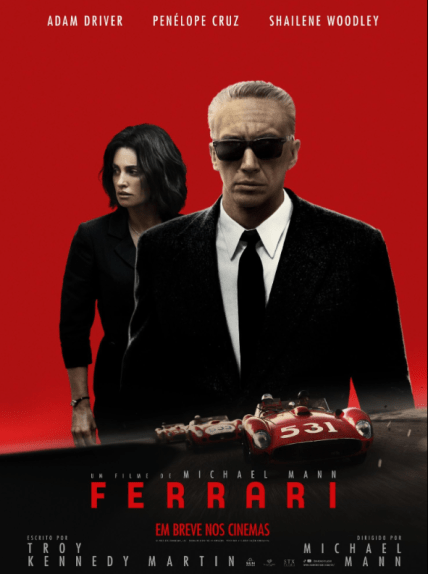
This is an odd film, but that isn’t necessarily a criticism. I found myself engrossed for the whole 130 minutes. This was despite not being that interested in motor racing and not knowing anything much about Enzo Ferrari. It’s also odd because it is a strange mix of genres. It isn’t a biopic as such (it focuses almost entirely on just one year of Enzo’s life even if we learn something about previous isolated moments), nor is it a sports movie. In fact, I don’t think it is a genre film at all. It’s more of an art movie with these genre elements woven through it to create dramatic tension complementing the drama of Ferrari’s family life – and yes, it’s a melodrama as well. Finally, on a personal note, I found I was rediscovering my childhood self. I was amazed to realise that I remembered the leading racing drivers of the time (1957) – Juan Fangio, Stirling Moss, Mike Hawthorn. At that point Stirling Moss was arguably one of the most famous sportsmen in the UK. Looking back at the records of the time, motor racing was an incredibly dangerous sport. Many drivers were killed in crashes, several of which also killed spectators.
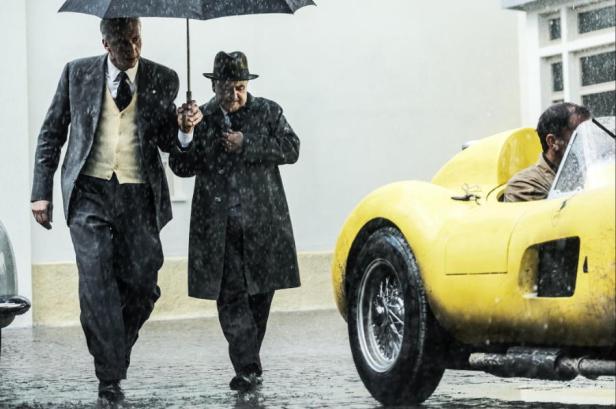
In 1957 Enzo Ferrari was 59 and at a crisis point in his life with his company in severe financial difficulties. He had two problems. In order to become financially stable he needed to find an investor who would provide funding to expand the production of sports cars and through their sale to fund Ferrari’s real passion, running his motor racing operation. To do this he needed the co-operation of his wife Laura who owned half the business. He was living partly with Laura and partly with his mistress Lina with whom he had a son, Piero. Laura knew he slept around but she didn’t know about the son. She would not agree to a new ownership arrangement without extracting promises and conditions from her husband. The way to attract an investor was to win the famous Mille Miglia, the ‘1,000 mile’ road race around Italy starting and ending in Brescia with a midway point in Rome. While he struggled to build a team of drivers and fund the cars, Enzo was still grieving for his son ‘Dino’ who died from a form of muscular dystrophy in 1956. Laura grieved just as much but in her own way.

Michael Mann had first become interested in this project in the mid-1990s with the producer Sydney Pollack. It is based upon a book by Brock Yates, Enzo Ferrari: The Man, the Cars, the Races, the Machine (1991). A screenplay was written by Troy Kennedy Martin, the Scottish TV and film writer who died in 2009. (Both Pollack and Martin died before the film went into production and are thanked in the credits.) Mann’s previous film was Blackhat in 2015. It was a commercial failure but had the support of critics. Personally, although I was a big admirer of Mann’s early work from The Jericho Mile (1979) onwards, I gave up on him after 2009’s Public Enemies. Having said that, I still find much to admire in his work as a filmmaker – I don’t know much about his TV work and wasn’t a fan of Miami Vice (2006) as a film. Ferrari is the first of Mann’s films not involving a Hollywood major studio but it still managed to attract funding for a budget of $95 million from a variety of sources. At the moment it doesn’t look likely to make a profit. The budget is perhaps key here. Where has all that money gone? Presumably much went on the filming (58 days), especially of the racing. The cars were hand-built and CGI must have been used for the spectacular crashes. Or perhaps it was simply that there wasn’t enough control over the major decisions on a daily basis. I’ve never seen a credit list with so many producers. I counted over fifty producers, co-producers, executive producers and line producers – even a ‘consulting producer’, whatever that is. That kind of list is never a good sign.

Mann himself made several important decisions about the production. After a long development period the casting process produced Adam Driver as Enzo, Penélope Cruz as Laura Ferrari and Shailene Woodley as Lina. Mann decided to shoot the film in Italy and to focus on the home of Ferrari in Modena, Emilia-Romagna. But he decided the film would be in Italian-accented English. Personally, I found this a problem and I had some difficulty following dialogue exchanges. I would have preferred it in Italian with subtitles. (The English-speaking actors could be dubbed into Italian). Mann’s films are always outstanding in terms of visual style and use of music and in this case the photography is by Erik Messerschmidt (who is American), music is by Daniel Pemberton and editing by Pietro Scalia. The film is beautifully made and that probably explains my rapt attention even if at times I wasn’t completely sure what was happening (because of my hearing difficulties).
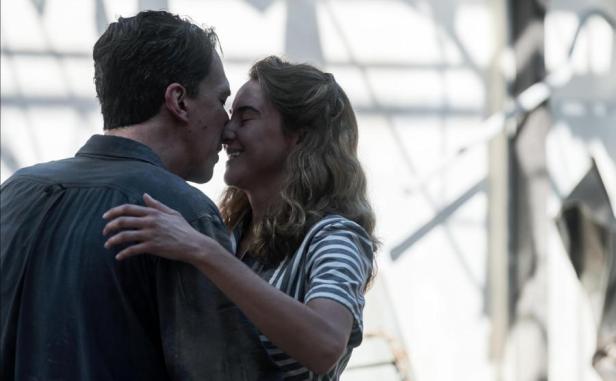
The main problem with the film for some mainstream audiences will be the pacing and the narrative which has some flashbacks. I wonder how much the younger North American audience knows about international motor racing? Those driver’s names won’t mean much I suspect and Italian motoring history isn’t likely to be well known either. The racing sequences are certainly thrilling if not terrifying and the crashes are spectacular (and gruesome). Italy is very beautiful and at times I thought of Italian films like those of Visconti and Bertolucci. But the narrative is also concerned with the melodrama. Adam Driver is unrecognisable as Enzo with grey hair and a small paunch and he’s very good in the role. But he loses out to Penélope Cruz at every turn. She’s the best thing in the film even with her uncombed hair and clumsy walk (wearing shoes with orthopaedic lifts). I’m not sure about Shailene Woodley. She looks familiar but I haven’t seen anything else she has been in. I think her role must have been quite difficult to play since Cruz got all the best scenes. Several aspects of the real story have been tweaked. For instance Ferrari’s new driver is Alfonso de Portago (played by the Brazilian actor Gabriel Leone). He was very well known at the time both as a racing driver and as a ‘playboy aristocrat’ who featured in many sports. His girlfriend at the time of the Mille Miglia was the Hollywood star Linda Christian who had just divorced Tyrone Power. There is a reference to this in the film (Christian is played by Sarah Gadon) but Portago appears like a meek but determined driver rather than the celebrity figure he was. Perhaps this is deliberate. To present him ‘as is’ would take something away from the presentation of Ferrari himself. There is also something odd about the events depicting Peter Collins, the young English driver who was thought to be quite close to Enzo.
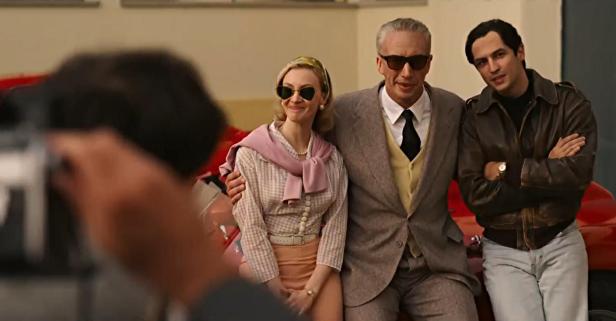
David Pemberton’s score is something I ‘felt’ rather than noticed. I think that means it worked very well for the narrative. I mention this because Mann’s films evoke passionate interest in his soundtracks – Wikipedia has a page devoted to the Ferrari soundtrack. I did notice perhaps the most stunning use of music in the film which presented the melodrama and is discussed by Mann on a YouTube video (see below). In it Enzo visits the opera for a performance of Verdi’s La traviata and during one of the duets we see him in the audience, then the lovers on the stage and then Laura and Lina both listening to the aria on their own. Laura is at home listening to a record (?) or perhaps a live broadcast. (Mann uses live broadcasts of the Mille Miglia on TV, but comments suggest that Italian TV didn’t do such broadcasts in 1957, they would have been caught on newsreel film instead.) The opera sequence also includes flashbacks to Dino as a small boy with Enzo and Laura.
I realised eventually that I have seen this mix of genres before. In the early 1950s there was a brief cycle of British films with narratives involving cutting edge aeronautical engineering – one of the few areas in which the UK led the world after the experience of 1939-45. One such film was David Lean’s film The Sound Barrier (UK 1952) and another was The Net (UK 1953). In both films we have an aircraft designer/manufacturer driven to produce a new aircraft and involved in a form of family melodrama. There is a woman – a daughter, a wife and there is a test pilot or a young man on the project team. The whole enterprise is dangerous for the pilots. The narratives of these two films are not that similar to Ferrari perhaps, but the generic mix is. There is a little of Enzo the designer engineer, explaining things to his son Piero. I think more of that would have been good. Sight and Sound, Vol 34, Winter 2023/2024 carries a longish interview with Michael Mann by Nick James, which seems enthusiastic, a brief account of how aspects of the production were handled and then a review by John Bleasdale which tears the film apart . I’ve always found it odd to publish such contrasting pieces in the same magazine.
There is another film focusing on Enzo Ferrari. Ferrari, an Italian TV movie from 2003 features Sergio Castellitto as Enzo in what appears to be a more extensive biopic narrative (i.e. from age 10 to 60?). I don’t know whether this ever reached the UK or US. I confess that I did find Enzo a more interesting character than I expected and I would like to know more. At the time of writing, Ferrari seems to be performing ahead of expectations on The Numbers but in the UK, where it opened widely on over 600 screens, it saw a 70% fall in its second weekend for a total so far of £3.2 million. Michael Mann is now 80 and preparing a sequel to one of his most successful films, Heat (1995). I hope he can get a release for that. Ferrari is certainly worth catching but scanning through ‘User comments’ on IMDb, this is one of those films that neatly splits audiences. Some love it others find it tedious (!). If I hadn’t seen it I would certainly be pleased to find it when it appears on streaming or broadcast.
 itp Global Film
That’s a great comparison, with older British films like Sound Barrier. Odd to see the script credit on this, revealing just how long this film was in gestation. Like you, I found this engrossing despite zero interest in the sport; I’m guessing the incidents depicted here changed the way it was organised forever. I was genuinely shocked by the accident late on, I had never heard of such a substantial loss of life at a racing event. Fascinating review.
LikeLiked by 1 person
Yes, I too was shocked by the crash. According to a new (Scottish) book, The Films of Michael Mann by Deryck Swan (Liverpool University Press 2023), Mann appears to have been “chasing” the possibility of making this film for over twenty years. You can’t fault him on preparing everything in detail.
LikeLike