
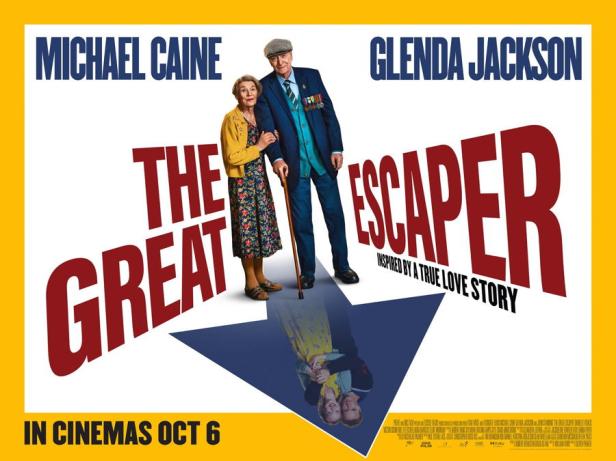
I heard good things about this film from an impeccable source so I rented it on BFI Player. I did find it an emotional watch and it features a last chance to see one great British actor and probably the last film for another equally fine screen actor. Seeing them together is a master-class – though ironically they are separated for much of the narrative. ‘The Great Escaper’ is a title that resonates with the media coverage of a true story from 2014 when a 90 year-old D-Day veteran made his own way to the 70th Anniversary of landings in Normandy (most veterans were in tour parties organised by the British Legion). The ‘escape’ was from a care home in Hove and I confess the title initially put me off seeing the film. In the film narrative it seems to be the police who generate the perfect tabloid title. I tend not to watch any ‘official’ celebrations with royalty and politicians, but I am interested in the human stories of what happened on D-Day and to the survivors in the aftermath. But I didn’t follow the story of Bernard Jordan’s trip in 2014 at the time. It was the inspiration for the film written by William Ivory and directed by Oliver Parker. The film isn’t a documentary account but the two central characters do represent Bernard Jordan and his wife Irene played by Michael Caine and Glenda Jackson.
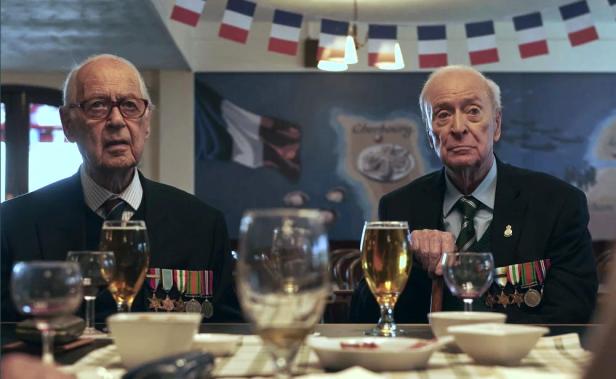
The narrative is organised around Bernard’s trip with short opening and closing sequence, but for much of the time the action alternates between Bernard in Normandy and Irene (‘Rene’) back in Hove. Both Bernard and Irene think/dream about 1944 when they met. He was a naval rating on a landing craft and she was working in a small munitions factory on the coast. These flashbacks cover the couple’s early encounters and the events of the 6th of June. They had been married for 70 years by 2014. Bernard, for whatever reason, has not got a ticket to join the formal tour party for the 70th commemoration of the landings. In 2014 it was a major event attended by the Queen and President Obama. Few survivors from the landings were expected to be able to make the 75th commemoration in 2019 so this was a last chance for most. Bernard decided to go without a ticket for the tour. On the ferry he meets another veteran, RAF bomber command pilot Arthur, who is also seemingly on his own (but booked in with the tour) and he is able to help Bernard with accommodation. It would appear that most of the events during the trip are inventions for the story. The ‘real’ Bernard Jordan was a Royal Navy naval officer in 1944 and a former Mayor of Hove during a long later career in local politics. Michael Caine (who was a National Serviceman in Korea in 1953) plays Jordan as a working-class lad and the social class differences in his relationship with Arthur (John Standing), who became a public school headmaster after the war, is an important element of the narrative. Both men have their own private reason for visiting France and it is this that Bernard dreams about.

The film was directed by Oliver Parker who is perhaps best known for his two adaptations of Oscar Wilde plays and the St. Trinian’s updates. I’ve only seen his Dad’s Army remake but it does seem his forte is comedy. There is comedy in the care home scenes, mostly in the scenes between Rene and the care home staff. Glenda Jackson is having fun, I think. But I was surprised at the sensitivity Parker shows in his handling of the drama beneath the comedy. As photographed by Christopher Ross and with the support of a score by Craig Armstrong, the film is clear and bright in ‘Scope ratio but not particularly distinctive visually. The dream sequences, especially those in the landing craft heading for the Sword beach are a contrast, however. This is partly because it is a beautifully sunny couple of days in 2014 but on D-Day it was grey and raining. I’m not sure how the dream sequences could have been improved and the film had a restricted budget, I think. The sequences did however deliver the narrative data, explaining what had disturbed Bernard for 70 years and prompted his decision to make the trip.

What to make of the film? I think there are some flaws in the story. ‘Bernie and Rene’ are not given any kind of back story, apart from the story of their courtship. If Bernard’s quest had troubled him for so long, why hadn’t he visited Normandy before now? Had he talked to Rene about it? I don’t want to spoil the narrative but I wasn’t sure whether he had fulfilled part of his quest as a younger man. Caine carries authority naturally in his performance which contrasts and deepens his presentation as a ‘cheeky chappy’ but also someone who doesn’t want false sympathy. As for the other events on the trip, Bernard and Arthur meet Americans in Normandy, a group of German veterans and a British veteran of a more recent war. There are some perhaps predictable exchanges. But in a sense none of this matters. Michael Caine is excellent in his role. He’s calm and understated with some dry humour but also capable of anger. Glenda Jackson is equally magnificent, witty, self-aware and sad. The two together in the final sequences will bring most audiences to tears. John Standing is also excellent in what is, I think, quite a difficult role, exposing his vulnerabilities to Bernard. The fourth important cast member is Danielle Vitalis who plays Adele, the somewhat troubled care home nurse who Rene takes a shine to. I notice that I must have seen Danielle Vitalis in her first role in Attack the Block in 2011 and again in Honeytrap (UK 2014). I’m pleased she’s managed to build a career, mainly in TV but perhaps this role will improve her opportunities in cinema films.
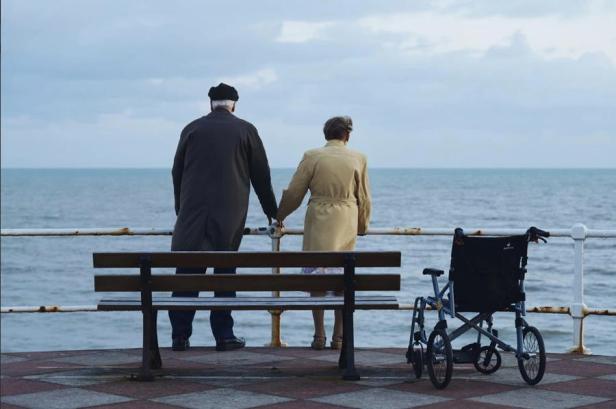
The film was shot in September 2022 when Michael Caine was 89 and Glenda Jackson 86, so both were the right age for the story. Originally the film was going to be released in the UK by Pathé but the company began to wind up its distribution arm in the UK in 2023. (Pathé was one of the production partners with BBC Films, three independent companies and the Swedish funding of Film i Väst covering post production sound.) I think the film would have benefitted from a June 2023 release to coincide with the D-Day anniversary but because of Pathé’s withdrawal, it was eventually released by Warner Bros which took over the Pathé slate after being associated with the company off and on for many years. Warner Bros. is a major Hollywood studio with a lot of muscle in the film market, but they don’t often handle films like this which require careful handling. The film has done well since its October 6 launch but I think as it moved into November and December, the darker, shorter days might have put off the older audience. It’s noticeable that there are few reviews on IMDb and those that are there are not all very good (some are quite clueless as to what the film is about). It is true that for younger audiences, the pacing is slow and the film runs 96 minutes but of course that is often more appropriate for this particular type of narrative. Most audiences will be there for Caine and Jackson and because of their performances I would certainly recommend the film.
 itp Global Film