
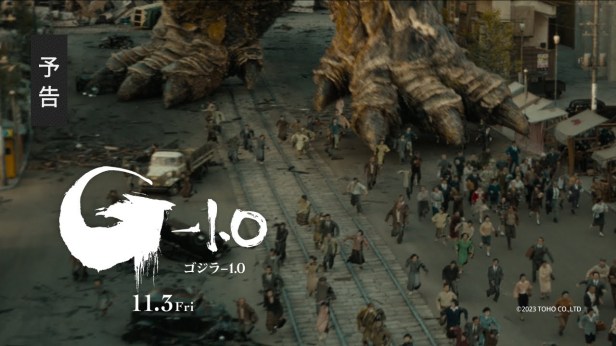
This Godzilla is the 33rd in Toho’s series of kaiju (‘strange monsters’ or the genre in which they appear) over the last 70 years. Nobody else does series quite like Toho and this film takes us back to the original Toho classic from 1954. It’s not a simple remake but it follows the original in structure, making changes more in terms of the ideologies of the period and representations of specific characters. The explanation for the title appears to be that in 1946 when Godzilla first appears Japan is still recovering from the devastation of American bombing culminating in the nuclear explosions in Hiroshima and Nagasaki which added to the general collapse of the economic and social infrastructure. A film made about Germany in the same period by the Italian director Roberto Rossellini was given the title Germany, Year Zero (Italy-France-Germany, 1948). Japan is in an even worse state and the damage and terror of Godzilla’s attack makes it worse. Thus ‘Minus One‘.

One of the dangers of films set in the past is viewing a situation ‘then’ through a contemporary perspective, i.e. ‘now’. But this film is not anachronistic. Kim Newman writing in Sight and Sound suggests that:
. . . the film embraces 1950s populist storytelling conventions – seesawing from tear-jerking self-sacrifice to heroic survival, all the while treating its star with the respect due a seventy-year-old icon.
Some critics have pointed out that certain characters are stereotypical. More on this below and it is a worthwhile debate. I think this is a wonderful film for many reasons and I enjoyed it very much. My joy is only slightly confined by the knowledge that as I write Japan is recovering from another major natural disaster, an earthquake of enormous power – 7.5 Magnitude. It feels wrong to be enjoying this ‘entertainment’ from Japan at this point but in a sense we could think about the film as paying respect to the Japanese capacity to survive and rebuild Japanese infrastructure and social relations after a disastrous war in the Pacific and across China and South-East Asia.

The narrative begins on Odo, the fictitious island from the original film, but this time it’s an island where a small group of aircraft mechanics are based in the last few weeks of the war in 1945. A kamikaze pilot lands his aircraft on the island maintaining that it is faulty and he must abort his mission. The chief mechanic tells him the aircraft is in a poor state but there is nothing technically wrong with it, implying that the pilot is a coward because his mission is to crash the aircraft into a US ship and sink it. When Gojira/Godzilla rises from sea, the pilot freezes rather than fire his 20 mm cannon at the monster. Everyone apart from pilot and the chief mechanic is killed. Later as we see the two survivors among the Japanese troops being returned to Tokyo after the war, the chief mechanic/engineer Tachibana Sosaku (Aoki Munetaka) throws a bunch of photographs at the pilot Koichi Shikishima (Kamiki Ryunosuke) telling him that these were the photos carried by the dead men and that their deaths were caused by the pilot’s failure to fire at the monster. Subsequent events will prove that the monster could not be stopped, even by 20mm canon, but Shikishima is now doubly charged with cowardice (and later he will be charged a third time). He returns in despair to discover his home has been destroyed in the fire-bombing of Tokyo and his parents are dead. Losing face in this way is a terrible burden to carry and this sets up the central theme of the film in which killing the monster will becomes the means by which Japan can re-build after what is recognised as a disastrous and tragic war in which so many lives have been needlessly lost.

Yamazaki Takashi wrote, produced and directed this film. He is also credited as ‘VFX supervisor’, although in a sense that might be subsumed within his producer-director role. Various reports suggest that he brought the production in on time and under a budget of just $15 million. This seems scarcely credible but then Japanese production costs have always been much lower than in North America where a similar film might cost $150 million. For me, the great strength of the film narrative is the development of the melodrama that heightens the impact of the four long action sequences showing the battles with Godzilla. In the original film, the story focuses on the scientist who wants to study the monster, his daughter and the two younger men who are competing for her affection, one of whom has a plan to destro Godzilla. In this new film the four central characters become five or six but the big change is that the ‘hero’ is the failed kamikaze fighter who builds two new ‘families’ around himself and it is possible to see these two groups, one ‘domestic’ and the other a group of workmates, as being representative of two aspects of Japanese society.
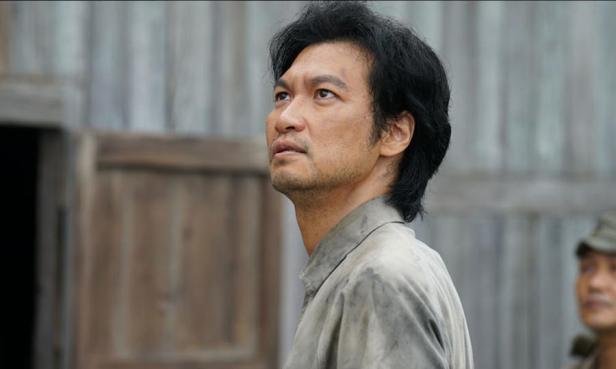
Crucially, the setting has shifted from 1954 to 1945-7 and the hero is seen in the context of the rubble of bomb-devastated Tokyo. I was reminded of a couple of Ozu melodramas, Record of a Tenement Gentleman (Japan 1947) and A Hen in the Wind (Japan 1948). The ‘Tenement Gentleman’ narrative is perhaps the model for Yamazaki’s ‘family’ here. When Shikishima suddenly finds himself ‘gifted’ a baby by a young woman, Noriko (Hamabe Minami), he searches for her and when she is found he offers her room in his damaged home. He accepts help from an older woman, Sumiko (Ando Sakura) and later discovers that the baby is not Noriko’s – she ‘rescued’ it, much as he has rescued her. This putative ‘family’ in which nobody is actually related must learn how to survive. Shikishima seeks dangerous work on a minesweeper because it pays a higher wage, but when the baby is a year or so older, Noriko gets a job in Ginza, an upmarket area in central Tokyo. Smartly-dressed for an office job Noriko is an interesting character. She is partly a representation of the coming ‘freedom’ for young women in the newly democratic Japan under Occupation (but the Occupiers never appear in this narrative, the US being wholly concerned with worrying about the Russians). She also has a narrative function in being trapped in Ginza when Godzilla makes his first Tokyo appearance. Shikishima’s concern for Noriko and the child is also important, giving him another reason to be part of the team hunting down Godzilla.

There are thousands of mines, both Japanese and American, in the local waters around the Japanese islands. Shikishima finds himself part of a team with ship’s captain, the ‘scientist’ and ‘the kid’. This trio make up the work group. With the addition of Tachibana the aero-engineer, who Shikishima finds (and who has somewhat modified his view on Shikishima’s ‘cowardice’), this quartet becomes the team to destroy Godzilla. What has happened here is that the quest to destroy Godzilla has become something more than just fighting the monster to save Tokyo. The team are fighting to protect themselves because they have something to live for, particularly Shikishima with the two women and a baby representing the future. The whole narrative is about finding a new Japanese identity to replace the ideology of Imperial expansionism and unquestioning loyalty to a regime. Looking back at what I wrote in response to A Hen in the Wind, I found this passage in which I draw on the writings of David Bordwell and Sato Tadao:
. . . the film is essentially progressive in moving away from using easy scapegoats to represent the state of Japan in the aftermath of war. Instead of villainous militarists or weedy collaborators, Ozu offers us a woman whose shame reflects the loss of ‘purity’ in the Japanese spirit while Shoichi’s aggression comes from the brutalising experience of war. In Ozu’s vision (as perceived by Bordwell) these ‘ordinary’ and flawed people find a way to face the future without national or personal purity but with a sense of realism.
I don’t think you need to know anything about the characters or plot of A Hen in the Wind to see what is being said here. Shikishima’s domestic ‘family’ is not ‘respectable’ and his colleagues have been emotionally damaged by the war (although ‘the kid’ was too young to fight and offers a different perspective). To properly understand this it’s worth reflecting on what living amongst the rubble in Tokyo must have been like during the Occupation (which ended in 1952). Japan was not allowed to have the warships which might have been used against Godzilla, only decommissioned ships with heavy guns removed. Scripts for Japanese films had to be agreed by the Occupation Authorities up to 1952. The original film in 1954 was not seen internationally until the 1990s because it suggested that the monster had mutated into such a powerful creature as a result of the nuclear tests by the Americans which began on Bikini Atoll in the Central Pacific in 1946. An American dubbed version of the film played down the nuclear contamination theory.
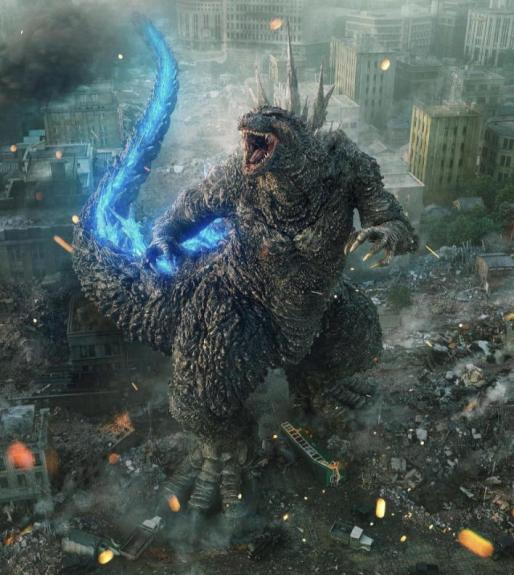
Comparing this new version with the 1954 original, I think the monster looks very similar. The similarities I noted earlier are there throughout the film and Yamazaki has carefully woven a slightly different narrative around the main events of the original story. Newman’s comments about the storytelling are spot on. This is a big popular film, one of those films that trigger the interest of the Japanese audience. Kamiki Ryunosuke as Shikishima is a major figure in Japanese popular entertainment. The two female characters are ‘typical’ in terms of 1950s films but unlike in the original film the younger woman is not used in a romance narrative as such and is not directly involved in the destruction of Godzilla. The role of the Japanese authorities in this version is also rather different. The scientist attracts ex-military men to support his plan and it feels much more like ‘the people v. Godzilla’. I wish now I knew more about the Toho series of films and the American responses. Among the fans of kaiju there seems to be a debate about what Hollywood could learn from the success of this new Japanese film. In the UK the film is playing in a wide range of cinemas and only in a subtitled version. It has made nearly £2 million after three weeks but looks as if it still has ‘legs’ to last a little longer in cinemas. In the US it is still playing after four weeks and has made nearly $50 million, making it one of the most successful subtitled films shown in North American cinemas.
I think this film could become an important study text for students hoping to learn both more about how a long-running series can be rejuvenated and about Japanese culture and the history of the Occupation period. If you go to a screening make sure you stay until the very end of the film and the potential clue as to what happens next.
 itp Global Film
By some quirk, this review arrived in my inbox as I was booking to see this film locally at the scaly tail-end of its release, so I was relieved to see you had positive things to say about it. I was uncertain how much attention a subtitled film would get after several weeks release at a half past three performance on a Tuesday afternoon, however I was far from the only one there. I guess some, at least, were back for a second viewing. Godzilla, or Gojira, seems to have lost some ground in recent years with lacklustre western adaptations, and another one coming up soon (alongside Kong).
This was glorious though with every character beautifully drawn, even the minor ones like Auntie Sumiko. This was a genuine force of nature. Almost unstoppable. He’ll be back.
LikeLiked by 1 person