
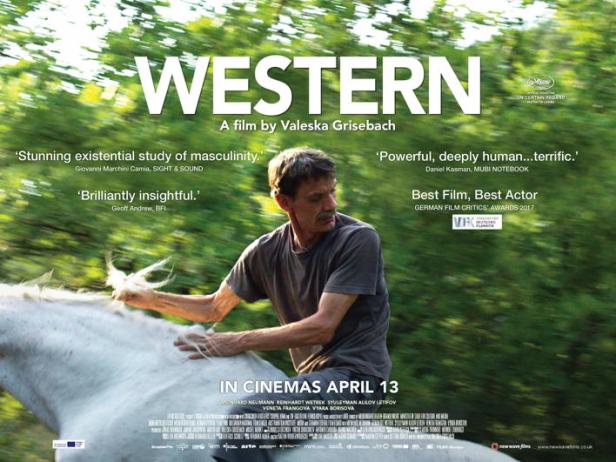
Western is a re-imagining of the idea of the traditional American Western by the German director Valeska Grisebach. The film won a prize at Cannes in 2017 after screening in the ‘Un Certain Regard’ strand and was subsequently nominated for the Lux Award of the European Parliament in 2018. A festival tour proved its international arthouse appeal and it was distributed in the UK by New Wave in 2018. It is now widely available on most major streaming services including MUBI and BFI Player (subscription) in the UK.
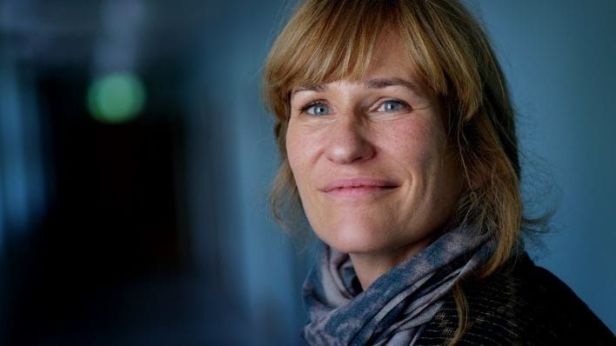
Valeska Grisebach has spoken about her initial fascination with Westerns when she was growing up in West Berlin in the 1970s. This film grew out of a wish to make her own ‘Western’ and in particular to explore masculinity in the Western. As she says in this Cineuropa Interview the idea of the Western is strong in the European mind as well as in North America. As she jokes, she had heard of the ‘warm wind’ blowing up for the South in Bulgaria and decided to set her story there. The film was shot over six weeks in 2015 (July– September) in Blagoevgrad Province in the South-West corner of Bulgaria close to the border with Greece and North Macedonia.
Grisebach had only made two films at this point, her graduation film Mein Stern (My Star, Germany-Austria 2001) and Sehnsucht (Longing, Germany 2006). There is a short introduction to the director here. She trained in film in Vienna but has also studied in Germany and she has been associated with the so-called ‘Berlin School’ in its wider formation which includes others as well as directors trained in Berlin. Her connection to directors such as Christian Petzold and Angela Schanelec is perhaps what she calls attention to “the normal, the quotidian” and “an approach to reality, and thus to our own identities”. She takes a long time to prepare and produce films and prefers to work with non-professionals where possible.
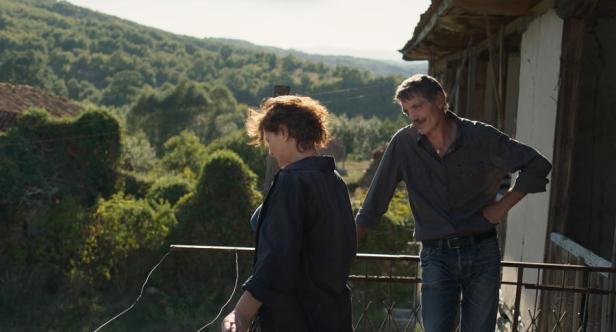
The idea behind this film is to explore the relationships both within a group of German workers sent to Bulgaria on a contract and those between the Germans and the local villagers. To do this in such a way as to explore the narratives of Westerns, Grisebach introduces several familiar elements. For instance, the central character Meinhard, played like most of the characters by a non-professional, Meinhard Neumann, is the member of German work group who is most interested in making contact with the villagers and early on he finds a horse in the woods which he mounts and rides into town (see the poster above). Later he will find the owner of the horse who appears happy to let him ride it. Meinhard also befriends the most attractive young woman in the village as well as several other villagers. Quite a mysterious figure in some ways, the rest of the German workers and the villagers both wonder where he gets his confidence and easy manner from. A rumour spreads that he was once in the Foreign Legion. Opposed to Meinhard is the leader of the German workers, Vincent (Reinhardt Wetrek) who takes his lead role seriously but also seems to feel that he has the right to run roughshod over the villagers. This he does in a number of encounters. The German presence in the district is not helped by the decision to fly the German flag above the work camp. It’s not too much of a stretch to see this as similar to the way the US Cavalry fly their flags over the forts they build in ‘Indian Territory’.
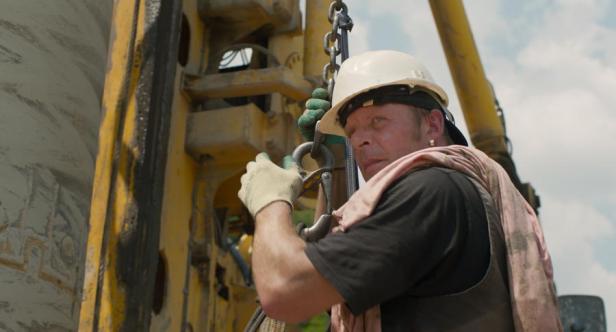
The other major thematic reference to the Western is the conflict over the work project itself. The Germans are contracted to build a water facility which will eventually improve the villagers access to water. The project is presumably paid for by EU funds in some way. Yet to actually build it the Germans have to get access to the existing water supply (for cement/concrete) and other local materials which in the short term will make the villagers lives more difficult. The Germans are effectively like colonisers and how they handle local relations is paramount – but do they understand this? At times, the locals appear in roles much like Native Americans. At other times they are like Mexican villagers faced with a group of powerful ‘gringos’ threatening the village. The actual setting of the narrative is also important. This area, close to the border was important for the German occupiers of Greece in the Second World War. Bulgaria was initially neutral but became a German ally in 1941, switching sides when Soviet troops entered the country in 1944. The villagers are aware of this history. This part of Bulgaria also offers beautiful landscapes and Grisebach spends time showing us these, perhaps remembering the way she may have viewed the Westerns of her childhood in which the landscape became like a character in many narratives.
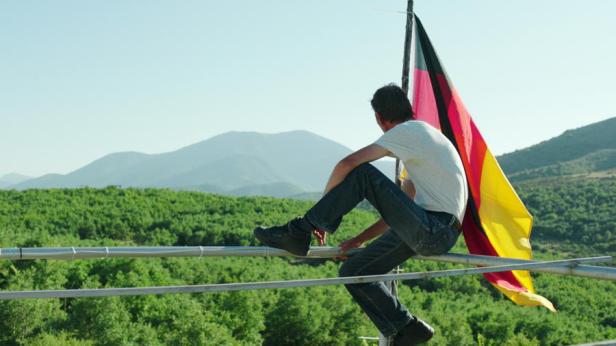
As well as the specific generic elements of the Western, Grisebach is also interested in representations of masculinity. In simple terms there is a struggle between Meinhard and Vincent with the villagers and the other project workers as followers rather than instigators. Gender differences are woven into the coloniser-colonised opposition. The coloniser demonstrates ‘his’ power by seeking out the colonised women and fighting the colonised men. Grisebach develops her narrative in subtle ways so that there are what feel like unexpected developments and outcomes. The narrative resolution in particular is a surprise if we follow genre expectations but makes sense in terms of the underlying analysis of the contemporary situation. This is a film in which there are so many ideas that it needs to be read in different ways. I recommend this review/interview from ‘New East Digital Archive’. In it Grisebach explains that what the film is really ‘about’ is the sense of how Germans are dealing with the ‘new Europe’ in which the relatively recent new member countries of the EU like Bulgaria find themselves in a different relationship with the founders of what was once the EEC, powerful economic partners with large populations and internationally recognised national identities. This film deals with the opposition of German workers and a village community in a relatively remote part of Bulgaria. It’s an opposition of the centre and the periphery, of West and East within the New Europe, an economic divide within the EU. Grisebach chose her German non-professionals mainly from the former East Germany, so in a sense it is the ‘Old East’ versus the ‘New East’. It’s also about a new ‘adventure’ for the German workers which perhaps they feel entitled to enjoy. Is that why they act in the neo-colonial manner? It’s worth remembering in the UK how the potential influx of Bulgarian workers was viewed in the UK after 2007 with the conception of those workers as ‘other’ in some way.
In the Europe of 2015-2016 when the film was being made, the UK had not yet left the EU but already Germany was the leading economic power in the EU and the process of German culture beginning to return to a perspective on ‘Central Europe’, rather than always looking West, had already begun. UK audiences who don’t watch many European films or TV programmes might not realise that these questions about internal EU conflicts, both economic and social/political/cultural have been explored for some time. As the review referenced above points out there is a connection between Grisebach’s film and Maren Ade’s popular German comedy Toni Erdmann (Germany-Austria 2016). It’s not surprising really since Valeska Grisebach was a script consultant on Ade’s film and both are part of the looser group of German and Austrian filmmakers with links to the Berlin School. Mare Ade was a producer on Western. The cinematography and editing of the film are both very good in the hands of Bernhard Keller and Bettina Böhler. Both worked on Grisebach’s previous film Sehnsucht and Bettina Böhler is also a regular collaborator with Christian Petzold.
Western is an excellent film, well worth your time. It is leaving MUBI in the UK in a couple of days, but the Region 2 DVD from New Wave is available (see the New Wave website for lots of reviews and information about the film). The film is also available on Amazon, Apple and BFI Player in the UK and on streamers in other territories.
 itp Global Film