
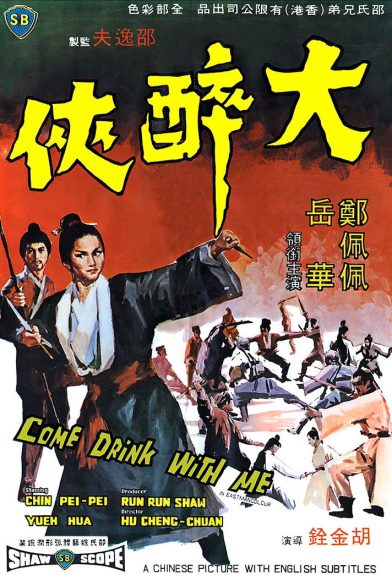
Come Drink With Me is argued to be the key film in the development of the traditional wuxia or ‘martial chivalry’ film, innovating at a particular moment when some of the same elements were being seen as present in the chanbara or swordfight films of Kurosawa Akira in Japan and the Westerns of Sergio Leone. It is an early directorial effort for King Hu (credited as ‘King Chuan’). Hu had left China in 1949 for Hong Kong, having trained as an artist. In 1958 he joined Shaw Brothers as a set designer, writer, actor and assistant director. Come Drink With Me was his second directorial feature, in colour and ‘ShawScope’, as a Mandarin language film. It was made in the studio in Hong Kong and on location in Taiwan.
The star of the film is Cheng Pei-Pei in just her sixth film and her first with top billing. She was just 19 when the film was made. She wasn’t trained as a martial artist but as a ballet dancer. This is explained by Hu’s desire, inspired by his interest in Chinese Opera, for a lighter and more choreographed feel to action scenes. Swallow’s presence as a female fighter is extended by her own group of female fighters who appear later in the film. The film’s narrative (written by Hu and Ting Shan-hsi) is relatively simple, although the details of the latter part of the film add more ingredients. Some time during the Ming period, a group of bandits capture the Governor’s son who was leading a caravan escorting the pirate chief to prison. They demand the release of their chief in exchange for the safe return of the young man. His sister, known as ‘Golden Swallow’, searches for the bandit’s hideout in order to rescue her sibling.
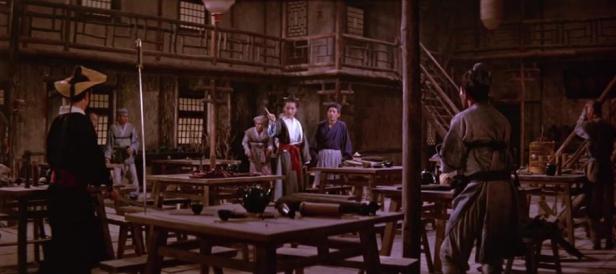
Most of the action takes place in one of four settings, the road through the hills, a roadside inn, the temple where the bandits are hiding and the home of the a mysterious character known locally as ‘Drunken Cat’. These locations are all iconic now since they re-appear in various later wuxia-related films. In particular, the inn is very similar as a location to ‘Dragon Gate Inn’ in Hu’s next film in 1967. Such a location features tables, chairs and benches, staircases to the upper floor, bedrooms, rooftops and beams etc. – a whole panoply of props for a fight.
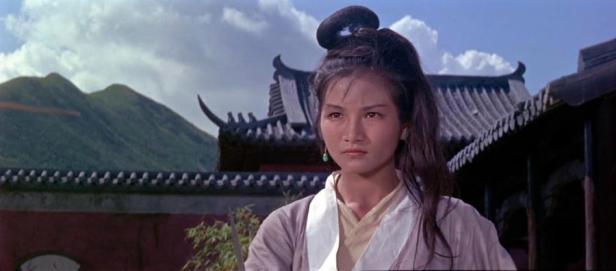
Golden Swallow is an accomplished fighter, though the only weak aspect of the plotting seems to be that none of her enemies recognise her as a young woman, at least initially. In the inn she will meet several of the bandit gang and win all the initial exchanges, but later we get the first inkling that good though she is, she can’t defeat the whole gang and that she will need to join forces with the mysterious ‘Drunken Cat’ whose real name is Fan Ta-p’i (Yueh Hua) who first appears with a gaggle of small children. Together with them he sings a couple of songs and behaves rather like a busker in the inn, earning money to pay for his drinks. But he also provides an important clue for Golden Swallow for her quest.
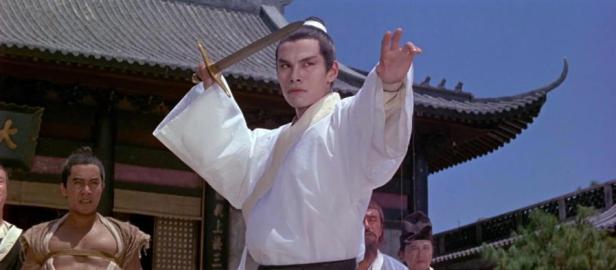
I don’t want to spoil the narrative if you haven’t seen the film, but ‘Drunken Cat’ becomes more important as the narrative develops and the film’s title refers to him. The other two main characters are Jade-face Tiger (Chen Hung-Lieh), who at first appears to be the bandit leader until the appearance of the abbot of the temple (Yang Chih-Ching). It then becomes clear that the abbot and Drunken Cat have a history between them.
This is a very beautiful film, directed with astonishing calm and confidence. Several reviewers make the point that the fight choreography and Cheng Pei-Pei’s balletic movements suggest a musical. Hu’s command of shot sizes and framing (cinematography by Nishimoto Tadashi) allied to his sense of how to edit the fight scenes (editor: Chiang Hsing-Loong) and the importance of the music score (from Chow Lan-Ping) creates a ravishing yet controlled and carefully composed spectacle.
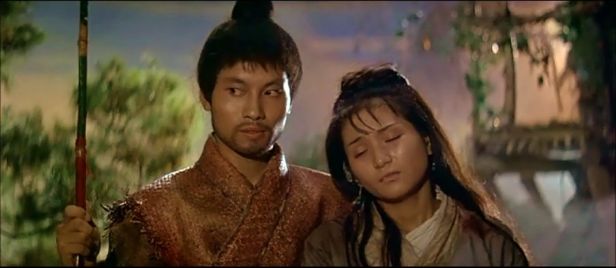
When we finally get to see Drunken Cat’s home base, it seems to me that it resembles the presentation of the ‘mythical world’ or jianghu of the wuxia. This is created by the mist and fog and the waterfall to create the kind of ghostly world found in several later films as the setting for the ultimate fight between kung fu warriors. One other aspect of the fighting style in the film is Golden Swallow’s choice of weapons – two short swords as well as darts – which are also used, with poison, by the bandits.
The more I think about it, the more important this film becomes in influencing the later wuxia from Zhang Yimou. Come Drink With Me is currently streaming on MUBI in the UK as part of a collection of Shaw Brothers martial arts pictures. If you think that you are averse to Chinese martial arts films, do try this film. It may well convince you that wuxia are worth investigating. You may also marvel at the skills and composure of the young Cheng Pei-Pei. Below are two trailers, one is the original Shaw Brothers trailer without subs. The second is the trailer for the restoration by Celestial Pictures demonstrates the dubbing that popularised the films in the US. (The trailers don’t use the beautiful music score of the film.)
https://mubi.com/en/films/come-drink-with-me/trailer
 itp Global Film