
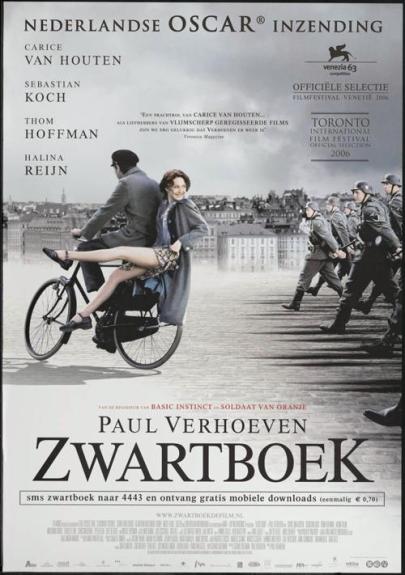
Around fifteen years ago there was a cycle of European films dealing with stories about the Second World War, mostly stories exploring the mythologies of resistance and occupation. Some of these films are unashamedly celebratory and record heroic deeds, some are more ambivalent. What they all share, however, is a local perspective that in some way works to redress the history of representations dominated by the Anglo-American producers of Second World War films since 1945. Black Book is one of the most intriguing of these films, partly because of its principal creator, Paul Verhoeven.
Verhoeven was born in The Hague in 1938 and as a small child he experienced the German occupation of the Netherlands. Black Book marked his return to Europe from Hollywood where he had a career of major ‘ups’ and ‘downs’. It acts as a complementary narrative to Soldier of Orange (Netherlands-UK 1977). Verhoeven decided to change the central character to a woman and to create a selection of characters who in his words are all ‘grey’ rather than clearly completely good or bad. Two of Verhoeven’s key interests dominate the narrative – a high level of realistic detail in the Dutch settings and an astonishing display of mainly female flesh, in the form of the film’s central character played by Carice van Houten. The sex scenes in the film might not have made it into US/UK distribution for a general audience in an English language film but for a ‘foreign film’ they were permitted. In the event the BBFC certificated it ’15’, in the US it was ‘R’. It seems that the censors were actually made of stronger stuff than some critics. Peter Bradshaw in the Guardian gave it one star and summed it up as “crass, vulgar and flatulent”. Others were more complimentary and the film was a big success in the Netherlands and deemed worthy of an Oscar nomination. The nudity didn’t seem to be a problem for many and van Houten’s performance is very impressive.
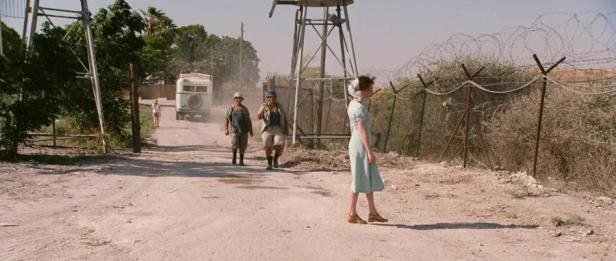
The film starts and ends in a Kibbutz in 1956. We know that Rachel Stein survived the war so the enigma is how she evaded the occupiers in their searches for Dutch Jews. But underpinning that central question is a more general one – how does the mythology of Dutch resistance stand up to the scrutiny of Verhoeven and his co-writer Gerard Soeteman? Reading around the film I discovered a claim that the Jewish population of the Netherlands suffered more deaths in proportion to the size of the Jewish community than in any other occupied country. The numbers are actually quite confusing since there were many Jews in the Netherlands in the 1940s who had fled Germany earlier in the 1930s and were not included in official figures. Verhoeven’s narrative focuses on two features of the plight of Jews . One is the large numbers of Jews in various forms of ‘hiding’ – in the cellars or attics of Catholics for instance, or disguised in some way with different identities. The second is the possibility of ‘escape routes’, especially after the Summer of 1944 when passage to liberated parts of Belgium becomes possible. However, German searches for Jews also increased at this time and the uneasy collaboration between the occupiers and the Dutch police enabled corruption and exploitation of Jews with family wealth that they wished to smuggle out of the Netherlands.

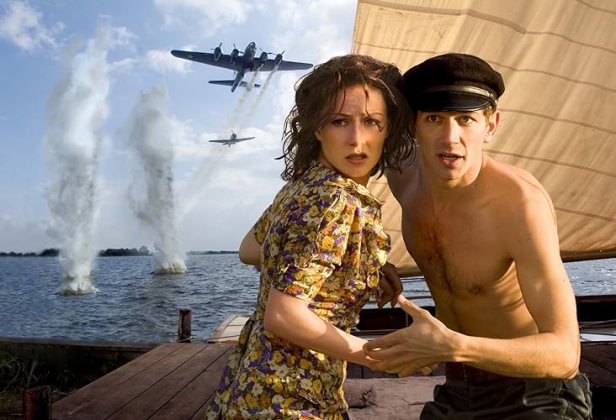
Rachel Stein is forced to abandon her hiding place when an American bomber is forced to jettison its bomb load when attacked by German fighters in 1944. She will then find herself joining a resistance group. In her previous life she was a cabaret singer and this experience alongside her youth and beauty means she has the chance to exploit her chance meeting with the local German commander to gather intelligence about raids on resistance groups. The film doesn’t end with the entry of Canadian forces into The Hague but carries on into the immediate post-liberation period when it isn’t straightforward to deal with the Occupation Forces and the collaborators. Who has been double-crossing who? It isn’t a spolier to suggest that much of the truth is in a little Black Book.

It’s now nearly eighty years since the real events of the German Occupation of the Netherlands, Belgium, France and Norway took place (as well as the slightly different events in Italy, Greece and Yugoslavia) but new narratives are still emerging especially in TV drama. Black Book is an important addition to those narratives and Verhoeven’s vigorous filmmaking adds to our understanding of what happened in 1944-5.
 itp Global Film
‘Flame and Citron’ with Thure Lindhardt and Mads Mikkelsen from 2008 probably another of these, and also well worth a watch. No introduction needed for either Mikkelsen brother obviously, but Lindhardt has also had an interesting filmography not only co-starring in Nordic noir’s ‘The Bridge’ but also in a very well-produced future war actioner ‘Kill Command’ (with Vanessa Kirby) that regularly troubles the schedules on Film 4. Carice van Houten also found quite a niche as a bad girl, sometimes supernatural, as in ‘Black Death’ which also regularly troubles the telly schedules. She is at her peak in ‘Black Book’ though with her allure foregrounded by Verhoeven.
LikeLike
Yes, Flame and Citron as well as Max Manus (2010) from Norway are part of the cycle and also Winter in Wartime (Netherlands 2009)
LikeLike