

After two abortive trips to cinemas (it’s a long story), I’ve finally managed to watch Martin Scorsese’s adaptation (with Eric Roth) of David Grann’s ‘documentary’ account of the story of the murders in the Osage Native American community in post-First World War Oklahoma. I read Grann’s book several months before the film came out and I thought it would be impossible to cram everything into a film narrative, even one 206 minutes long. I admire Martin Scorsese’s work to restore films and to fight for a diverse film culture but I’m not necessarily a Scorsese fanboy and I have in the past been uneasy about his approach to organised crime in American history. I’m happier when his central characters are not gangsters.

My initial feeling about Killers of the Flower Moon is that Scorsese has chosen to make the racist murderers the protagonists of the narrative rather than either the lawman who set out to investigate what happened or the women at the centre of the story, only one of whom survived. I note that one of my friends who didn’t enjoy the film very much, argued that Lily Gladstone was the best thing in it. I agree that is the case but to make her the central figure is problematic since she spends much of the film bed-bound by illness. But certainly in the first section of the narrative, her character Mollie Kyle is so much brighter and cleverer than DiCaprio’s Ernest Burkhart that she looks like she will win out. However, what brings her down is a combination of factors – mainly the machinations of Ernest’s uncle, ‘King’ William Hale (Robert De Niro), but also the way in which traditional Osage culture becomes corrupted or marginalised by the pressures of white society. It is this second issue that for me becomes the crucial source of the ‘lack’ in Scorsese’s narrative. This isn’t to say that he doesn’t tackle it, only that it isn’t given enough space.
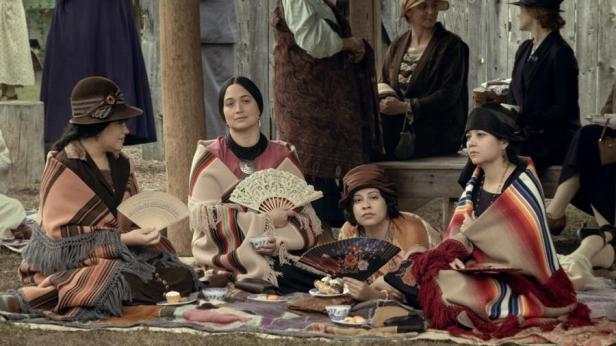
It’s always a quandary for a filmmaker of Scorsese’s stature to decide how much to ‘tell’ about the context of the story. Mass audiences are said to want entertainment, not a history or a cultural studies lecture. The set of circumstances that made the Osage nation into the per capita richest people in America makes for a complex story. How and why did they end up in Oklahoma and why was it difficult to investigate their story? The book provides some of the documentary evidence as to what actually happened and explains the context a little. Scorsese made the film for Apple on a big budget of $200 million, much of which is evident on screen in the reproduction of the town of Fairfax in Osage County. The scenes of the railway station and the main street did remind me of Heaven’s Gate in terms of the spectacle. This in turn links to the categorisation of the film as a ‘Western’. I’m not sure about this either.
My own definition of a Western includes the concept of the ‘contemporary Western’ which I have argued might apply to a Western which takes place in a period in which Westerns were already being seen on cinema screens – see my post on The Power of the Dog (NZ-Australia-France-UK 2021). Killers of the Flower Moon is set in the early 1920s in a landscape and an administrative region that refers to crucial moments in American history and specifically the designation of ‘Indian Territory’ in the early 1830s and the ‘Land Rush’ of 1889 in which half of Indian Territory was in effect given by the federal government to white settlers in a general ‘free for all’. Oklahoma was one of the last territories to be formally recognised for statehood in 1907 (as the 47th state). Scorsese’s film could be categorised as a contemporary Western but in many ways the narrative and Scorsese’s treatment of the story pushes it towards the crime film and what would much later be recognised as the ‘organised crime’ or ‘gangster film’.

In Sight and Sound, October 2023 there is a ten page interview feature on Scorsese and The Killers of the Flower Moon. In it Scorsese does provide quite a bit of the context of the film’s production and explains why he made the decisions about what to include and what to leave out and how much weight to give to each of the main narratives. It’s a fascinating read and I applaud many of the decisions he made, including to work with members of the Osage nation and to consult them about his approach. I also enjoyed the clever montage sequences and use of stills, some of which appeared to be ‘real historical images’ and some which were created for the film.
If you haven’t seen the film or haven’t read the book it might not be clear why I am so concerned about the decisions Scorsese took in planning his film. What happened in this case is that a series of decisions in Washington about how to ‘deal’ with the Native American population in the 19th century added up to a policy of ‘ethnic cleansing’ which cleared much of the lands which were the ancestral homes of Indigenous ‘Americans’ and made the resources available for exploitation by white settlers. Indigenous people themselves were continuously ‘moved along’ until some, like the Osage, found themselves on poor quality land in what was deemed ‘Indian Territory’. By a quirk of fate they also found themselves sitting on top of vast oil reserves, and by another quirk in the machinations of American capital, they could claim the legal ‘head rights’ to the oil and other minerals. But the system clawed back the lost control by declaring the rights-holders ‘incompetent’ to control their financial affairs and therefore requiring them to entrust their financial dealings to white ‘guardians’. Other whites could gain access to the Osage wealth by marrying in to the families.
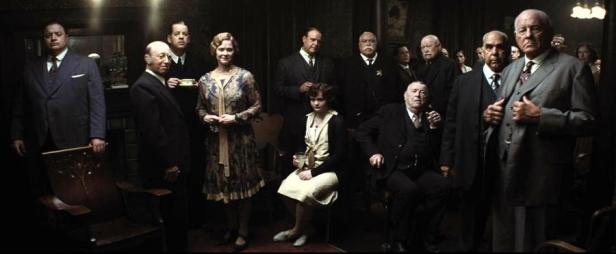
This history was uncovered by David Grann as part of his investigation of the murders (or ‘suspicious deaths’) of Osage women. All of this is there in the film, but unless you already know the story, I’m not sure how easy it is to follow the events shown. Eventually the Osage themselves acted by sending a representative to Washington requesting a Federal investigation. Again this is in the film, but not properly explained in terms of the Bureau of Investigation agent Tom White who arrives in Osage County. Grann describes the difficulty White faced in identifying and arresting those responsible for the deaths, using undercover agents. But arrests were not the end of the story. He also faced problems dealing with local politicians and the state judicial system. Eventually he was able to have the trial moved out of the jurisdiction of the Oklahoma courts, but even then the white exploiters played in the film by De Niro, DiCaprio and others seem to have survived the US penal system much better than the Osage survived predation by criminal activities.

The complex story of the Osage murders (which might number a hundred or more, since many were not reported or remain unsolved) has been covered in various ways in American media narratives, including forming one part of the 1959 film, The FBI Story, starring James Stewart. The complete narrative of murders, corruption, exploitation and racism is just too complex for a single media text. From outside the US it is an immensely shocking history and the two most shocking aspects are the wholesale corruption that involves the racism in Oklahoma in the 1920s – Scorsese does refer to the ‘Tulsa race massacre‘ of May-June 1921 in white supremacists attacked a Black neighbourhood – and the whole history of ethnic cleansing of Indigenous Americans from much of the Eastern United States over the preceding century since the ‘Trail of Tears’ in the 1830s. Scorsese’s narrative does include references to both of these issues but not in ways that are particularly helpful in explaining what happened in detail. He includes a statement that the Osage were not one of the ‘Five Civilised Tribes’ involved in the forced movement on the Trail of Tears, but they did have to move from their original lands, from the East in stages, because the pressure of European colonisation forced other nations onto Osage lands and then directly by the US government in the 19th century.

Scorsese appears to have made the attempt to include the history and he may well have concluded that he couldn’t organise his narrative around the investigation of the murders because that would have been seen as a ‘white saviour’ story headed by the Tom White character (played in the film by Jesse Plemons). Instead he chose to focus on the white exploiters. After seeing the film I came across the Twitter feed of Lily Gladstone and noted some of her comments about the film. A little later I found this interview in Variety with her. She carefully acknowledges everything positive that Scorsese did but welcomes the criticisms. Some came from the Osage themselves, suggesting that only they could tell the story from their perspective. Here’s a sample quote from Lily Gladstone’s interview:
“Marty is a titan, but he’s not bigger than history. He’s a major shaper of it though. It’s the tricky nature of a story like this. You have more representation, but coming from somebody who’s not from the community. So you always have to look at it with a different angle. And there’s nothing wrong with that; you just have to be very aware of the film that you’re watching and what lens it was made through.”
Lily Gladstone herself is from a Blackfoot community in Montana but she has worked with National Indigenous Women’s Resource Center, a grassroots organization addressing the disproportionately high rates of violence against Native women. One thing I would certainly agree with Scorsese about is her extraordinary presence on screen which he and I both took from her appearance in Kelly Reichardt’s Certain Women (2017).
I think Scorsese’s deal with Apple is also an important factor. If you really want to do justice to the story about the ‘Reign of Terror’ in Osage County in the 1920s (and to David Grann’s research), Apple would arguably have been better off making two or three shorter films or perhaps a six part serial. But I guess that wouldn’t have created the discussion that surrounds a Scorsese picture. My own feeling is that Scorsese might have focused more on Mollie (the Gladstone character) and her family and that actors not associated with Scorsese’s gangster pictures might have played the roles taken by De Niro and DiCaprio. What we get is a well-made and intelligent picture and Lily Gladstone is terrific – but it doesn’t tell the full story and in particular the full Osage story.
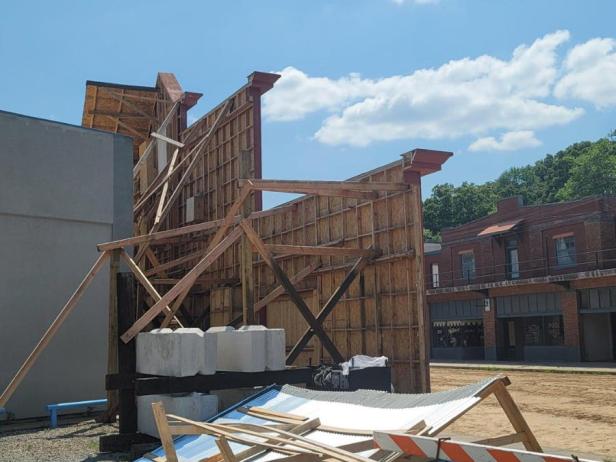
I should add that the performances are all very good, the production design is as you would expect – and the cinematography by Rodrigo Prieto and editing by Thelma Schoonmaker. The music is if anything too muted but it is carefully selected by Robbie Robertson, his last credit before his recent death. Robertson had part Mohawk heritage. Scorsese also cast several musicians in important roles including Jason Isbell, Sturgill Simpson, Jack White and Charlie Musselwhite (Choctaw). It looks like Killers of the Flower Moon will last several more weeks in cinemas before it streams on Apple TV. It’s a film to be seen – and talked about at length.
 itp Global Film
A helpful commentary. I think Roy is right about both the positive and negative aspects of the movie. It is certainly well done and looks and sounds great; and it is always engrossing. I did wonder about the lack of an intermission. I have suffered this several times in recent years and I am sure there are several spots for one in this work.
LikeLike