

Released in the UK in 2022 by documentary specialist distributor Dogwoof, this very long film takes the viewer through the career highlights of the legendary Ennio Morricone. I found it difficult to see the film during its brief cinema run and it has been sitting at the top of my DVD rental list for a long time. Finally, it has arrived and I’m very pleased to see it.
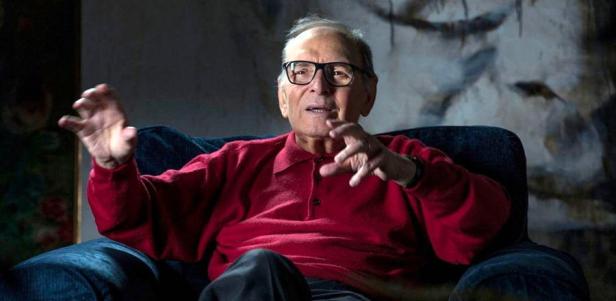
It’s a conventional bio-documentary involving lots of talking heads, archive footage and interview clips of the man himself conducted not long before his death at the age of 91 in 2020. It is presented in a CinemaScope ratio with the older clips in Academy and other formats within the ‘Scope frame. This does mean, of course, that we get to see some of the many widescreen epics scored by Morricone in the proper ratio. The celebrated Italian director Giuseppe Tornatore is credited as writer-director with a host of producers, co-producers and executive producers. There are a great many ‘guest’ contributions, talking heads who in some cases are simply saying how wonderful they think Morricone’s music is. One of my few quibbles with the film is that there are simply far too many of them and they add very little. They also mean that the film is 156 minutes long. But I acknowledge that is is important to emphasise how much Morricone has been appreciated by his peers and now his successors and the film does succeed in getting across the real cultural struggle within Italian music and music generally that Morricone faced because of his long association with ‘film music’ – even while still maintaining an interest in experimental music and large scale public performances of his work.

There are three sections to the film. In the first we learn about Ennio’s childhood as a trumpeter, following his father’s wishes. The family were not wealthy and Ennio felt the class difference when he entered a prestigious conservatoire in Rome as teenager. This section was perhaps the least accessible for me as I am barely literate in terms of reading music scores and understanding the various techniques of composition and the structures of classical music compositions. It occurs to me that young Italians have an advantage in that much of musical notation appears to use Italian terms. My one criticism of this section is that there are few clues to the dates of the different stages of the young Ennio’s career. He was born in 1928 so he would have been in the conservatoire during the Fascist period that ended during 1944. This short section then leads onto, for me, a much more interesting period from the mid 1950s when Morricone begins work as a commercial music arranger, mainly uncredited for contributions on TV shows and some films and in 1960 he begins a long association with RCA in Italy and becomes an innovative arranger of pop songs. As I understand it, before Morricone began to make an impression, the orchestration on a pop record was simply ‘accompaniment’, following the melody. Morricone introduced the idea that the music could do more than just accompany the melody and could introduce other elements, perhaps a dialogue with the lyrics, perhaps a mixing of rhythms. He would use different instruments and it was at this time that he also got interested in avant garde and experimental music. I do remember that during the early 1960s British pop sometimes borrowed songs from Italy to use as the basis for new recordings in English. The highlight of this section for me is an archive clip of Paul Anka singing a Morricone arrangement of the song ‘Ogni Volta’ (1964) in a live concert. Earlier there is a clip of Morricone playing an arrangement on a typewriter following his exposure to John Cage’s work at the Darmstadt music festival. It is also in this first section that we first learn about Morricone’s long marriage and the support he receives from his wife.
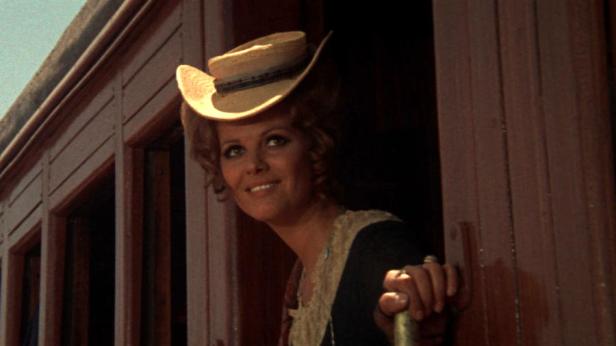
From the early 1960s he also began to moonlight arranging and now composing for films and it’s not long before we get to the Leone ‘Dollars’ trilogy. During the 1960s Morricone became closely associated with Italian Westerns and they would provide him with an intro to filmmakers globally. It was a blessing and a curse. Much later he would be faced with directors such as Oliver Stone and Quentin Tarantino who still seemed to want something similar to the music of the Dollars trilogy. Morricone told them in no uncertain terms that what their films needed was something else and at least they had the grace to listen to him. Eventually he would win an Oscar for his music on Tarantino’s The Hateful Eight (US 2015). He should have won it much earlier. Out of the 500 or so music scores or arrangements that Morricone wrote for films, there are literally dozens of major international films – far too many to mention. My personal favourite would be his score for Leone’s Once Upon a Time in the West (US-Italy 1968) but there are many other clips in Ennio from films I had either forgotten about or didn’t even know. Giuseppe Tornatore was the director of Cinema Paradiso (Italy 1988), one of Morricone’s favourites. There is also a clip from Tornatore’s The Legend of 1900 (Italy 1998) – and Bertolucci’s Novecento (France-Italy-West Germany 1976).
Towards the end of the film two important ideas explored. One is the legacy of Morricone and the ways in which younger musicians of all kinds are copying his arrangements and sampling many of his famous scores. This is what allows Bruce Springsteen, of all people, to get hyperbolic about the music, which isn’t really necessary. The second idea is that Morricone was not only an innovator in arranging and scoring but that over his long career he fundamentally changed the cultural status of film music and in effect created a situation in which classical music can learn from film music and vice versa. His career encompassed many changes in music culture and he came through them all. His legacy is surely secure. I think it’s true to say that both film scholars and film journalists have not paid enough attention to film music, but perhaps cinema audiences have. I learned a lot from this film and I enjoyed it very much. The film is also available to stream on most major streamers. If you want to know more about Morricone and film music I recommend this documentary.
 itp Global Film