

Passages stars three of the best actors in contemporary cinema and it’s directed by Ira Sachs who with co-writer Mauricio Zacharias has attracted critical attention from international critics across his career, especially with Love is Strange (US 2014). I’ve read about his films but this is the first I’ve watched. This is a French-German co-production presented in traditional European format of 1.66:1 and oddly is performed mostly in English with only brief snatches of French spoken by the secondary characters. The reason for this is that the English commercial art producer Martin (Ben Whishaw) is married to the German filmmaker Tomas (Franz Rogowski) and they are based in Paris. The couple speak to each other and most of their colleagues in English despite the fact they have been in France for several years. The narrative disruption occurs in the first sequence when Tomas has wrapped a film shoot in a club and he finds himself dancing with a guest on the set, the stunning Agathe (Adèle Exarchopoulos). Martin goes home and Tomas finds himself very attracted to Agathe, spending the night with her. When Tomas returns to Martin in the morning, it’s clear that he’s not happy and that a form of triangular struggle will ensue.

The Press Notes offer an interview with director Sachs in which he gives various insights into his approach. He says that after the pandemic he wanted to make a film about people at a particular moment in their lives – an intimate story about the here and now. The narrative takes place over the few weeks following the wrap and first screenings of Tomas’s film. In that time he and Martin will have to decide about their marriage and about Agathe, who is a primary school teacher. Sachs also drops a series of big names who were an inspiration in the making of his film. Apparently he took his starting point from Luchino Visconti’s last film, The Innocent (Italy 1976), a film I haven’t seen in which IMDB tells me “a chauvinist aristocrat flaunts his mistress in front of his wife, but when his wife is unfaithful, he finds her attractive again”. Sachs also mentions Taxi zum klo (West Germany 1980) written and directed by Frank Ripploh who was a significant queer actor and director at the time. Again, I remember the film’s release but I didn’t see it. Ripploh created a character not unlike Tomas, but possibly slightly less house-trained. I note that this 1980 queer film suffered the same fate as Passages when submitted for certification – cleared in most territories, although in the UK it got an 18. In the US, however, both films were rejected and given NC-17 status, meaning they would be very hard to see in any mainstream cinema. As several reviewers point out, in the case of Passages this is a shame as the film is in many ways a European-style art film and not something shocking for adult audiences. It seems that women’s naked bodies are allowable on screen most of the time but a man caressing another man’s bottom is immediately a breaking of a taboo. Dear MPAA, do grow up!, seems to be the only sensible response.

The third director Sachs mentions is Maurice Pialat and also the writer/editor Arlette Langmann the later partner of Pialat who oversaw the development of the female character in Passages. Sachs certainly chose the appropriate lead actors for his film. Franz Rogowski is riveting on screen as the narcissistic Thomas. He’s a horrible character who many would loathe on sight (me included, probably). Whishaw’s Martin is seemingly quiet and withdrawn but also capable of some steel. Sachs speaks of Adèle Exarchopoulos as a younger version of Bardot or Moreau in terms of her depths as an actor. He also comments on the costume design for the trio with sexy, tight dresses for Agathe, rather fay outfits for Martin and a collection of tight crop-tops for Tomas courtesy of costume designer Khadija Zeggaï.
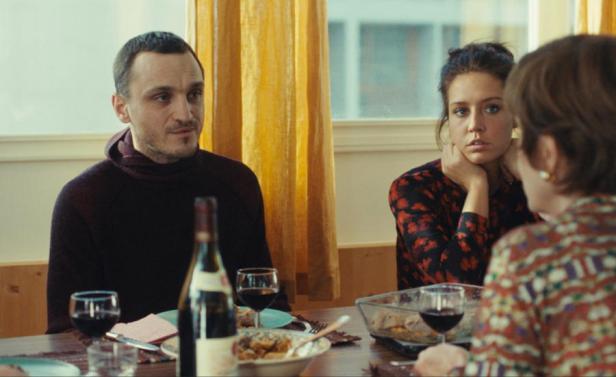
But what does it all add up to? MUBI offers us three American reviews that talk about the honesty of the portrayals of these three characters while recognising how toxic these relationships might become. The performances are terrific but I suspect I’m the boring, socially conservative viewer who thinks Tomas is unbearable and Martin a little too reserved at times – and, of course, Agathe deserves something better from a relationship. Having said that, the bravura closing shot of the narrative with Tomas furiously pedalling his bike through Parisian streets is a good ending. The cinematography generally, by Josée Deshaies is very good. I like and admire all three actors so watching the film certainly wasn’t a chore. One American reviewer suggests that we might learn something about modern attitudes towards sex, romance and relationships. I suspect that I’m not the target audience, but that reviewer may be right. Do take a punt. It is a well-made film with great performances.
 itp Global Film
Certainly a well made film with excellent performances. I found the Rogowski character rather objectionable, as I think we are meant to, and rather wish more time and character development was devoted to Ben Whishaw’s role as he almost seemed like a background character here. I didn’t really buy the attraction between Agathe and Tomas which made the film a bit unbalanced, especially as most of the narrative seemed to be devoted to the most unsympathetic character. I saw it at Pictureville which was very quiet for this viewing, and seems to have been taken out of action just when a little outreach from the Leeds Film Festival might have ushered a few more punters its way.
LikeLike
Your reference to the ‘quietness’ of the audience is interesting. I’m guessing they were older than the characters in the film?
It is bad news about Pictureville and the RAAC problem. I don’t know the full details yet but it could be a long closure if the ceiling needs replacing.
LikeLike
You are correct. It was an 11:00 screening with a few older fans and a couple of youngsters, which I suppose is what I call people in their thirties now. I hope RAAC does not prove to be the final nail in the coffin for Pictureville especially as Square Chapel seems to be taking a break from showing films also.
Don’t often find myself at Everyman except during film festivals, but ‘Night Train’ from Poland was an especial treat last Sunday and also a sell-out.
LikeLike