
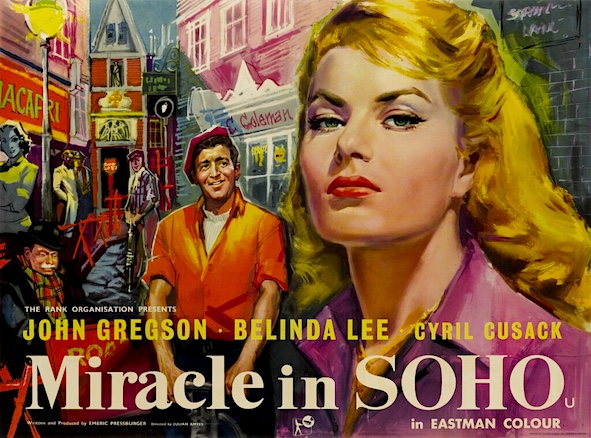
The British Film Institute celebration of the films of Michael Powell and Emeric Pressburger is now well underway and several titles are currently free to view on the BFI Player streaming service in the UK. Miracle in Soho is the first film that Pressburger was involved with after the closure of The Archers in 1956. He first wrote the script in 1934 and when it was finally used for a production in 1957 some critics thought it was far too old-fashioned. This criticism is understandable but perhaps a little misguided.

The film was directed by Julian Aymes but many of the creative team were Archers regulars such as Christopher Challis as cinematographer, Brian Easdale for the music score, Sydney Streeter as associate producer and several more. Pressburger produced the film. The central idea of the story is the disruption in a typical Soho street in London when a gang of workmen arrive to dig up the roadway and lay new tarmac. The street has a diverse population with at its centre a family of Italian migrants. The key figure in the gang of asphalters is Michael Morgan played by John Gregson in an uncharacteristic role as an Irish ‘skirt-chaser’ (the derogatory term for young women as ‘skirt’ is used in the dialogue). Nearly all the 88 minutes of the narrative are on the street or in the flats, shops, café and pub. (The running time of the film varies according to different sources.) The street is a studio set built at Pinewood. It is this set, beautifully designed by Carmen Dillon, that is one of the main targets for the critics who dismissed the film. The anonymous reviewer in Monthly Film Bulletin (August 1957) refers to a “depressing production, with its synthetic Soho setting”. The studio street actually first appears after a panoramic/aerial view of ‘real’ central London neighbourhoods. I think that over the next few years, when Soho appeared as a location in a range of documentaries and features, mostly filmed in black & white, this studio set would increasingly be seen as artificial. When Michael Powell made Peeping Tom a couple of years later and located his story a few streets away on the other side of Oxford Street in Fitzrovia he managed to confuse the critics by shooting in real locations but making them look artificial through his use of colour and lighting. He suffered the same negative reactions by critics, though for different reasons. Powell’s film was deemed obscene whereas Pressburger’s was “too sentimental”.

In the 1950s, colour productions in British cinema still tended to be reserved for specific genres, including mainstream comedies but also occasional dramas and even horror films such as Horrors of the Black Museum (1959). Carmen Dillon actually worked as art director on several colour productions including comedies such as a couple of the successful ‘Doctor’ films and Simon and Laura (1955) plus the crime melodrama Sapphire (1959). I’m still surprised when I watch London films of the 1950s shot in colour, the default still seems to be black and white in my memory. The street in Miracle in Soho, ‘St Anthony’s Lane’, is certainly ‘artificial’ but I recognise that all the elements in the street such as the shops and pubs and, importantly the church, seem authentic based on my memories going back to the late 1960s.

Though Soho’s reputation for sleaze was established by the 1960s, the streets a little further north towards Oxford Street remained fairly communal I think and Pressburger’s central focus on the Italian family survives the various re-writes the original script must have undergone. Pressburger first intended it to be directed by a fellow Jewish exile from German cinema in Paris in 1934. By 1957 the idea of the family finally looking at the opportunity of emigration to Canada links it to the Ealing film of 1955 Touch and Go in which a middle-class family are preparing for emigration to Australia. In fact, that Ealing link is perhaps more important than might at first be apparent. In the mid-1950s Ealing Studios was at the point of collapse and its survival first rested on the whims of John Davis and Earl St. John at Pinewood. It was they who offered Pressburger the opportunity to make Miracle in Soho. It was the kind of sentimental, mainstream picture they were looking for. John Gregson had appeared in The Battle of the River Plate for Powell and Pressburger in 1956 and was known for both war pictures and comedies. His early film career saw him in many smaller roles in Ealing pictures before his big breakthrough in the comedy Genevieve in 1954. Belinda Lee as his co-star in Miracle in Soho was a ‘Rank starlet’ who had a leading role in Ealing’s 1956 film The Feminine Touch, a romantic melodrama about student nurses in London, also in colour.

Belinda Lee plays Julia the conservative younger daughter of the Italian Gozzi family and the one woman who Michael Morgan doesn’t immediately sweep off her feet. There is an all too brief appearance of a young Billie Whitelaw as an earlier conquest and Morgan’s pursuit of a barmaid played by Barbara Archer. Belinda Lee was a very attractive young woman (just 22 when this film was released). She did fulfil one of Rank’s aims – to make an impression in European film markets and she would make several Italian films in which she played much racier characters than Julia. But her career was short-lived as she died in a road accident in 1961.

The supporting cast is filled with an array of familiar British character actors led by Archers regular Cyril Cusack as Sam Bishop, the local postman who also leads the Salvation Army mission in the area. I won’t spoil the narrative surprise that is the ‘miracle’. The film is something of a disappointment. Emeric Pressburger’s recycling of what might have been a light Central European comedy drama, comes across as a rather old-fashioned English social comedy at a time when social realism was what critics validated and the first stirrings of the British New Wave are just becoming apparent – Woman in a Dressing Gown was released (in black & white) in the same year. The one positive, I think is that the film points towards the later success of soap operas on British TV. There are elements in this film which would be developed successfully in Coronation Street in 1960. Now I think about it, the soap used to begin with a crane shot of Salford before moving into a typical street to find its stories. I’m grateful to the BFI for the chance to see the film.
 itp Global Film
Belinda Lee died in 1961 not 1965.
P Gray,
LikeLike
Thanks for the correction. I think this must have been a typo, caused perhaps by her age of 25 when she died. I have corrected the date on the posting.
LikeLike