

Guillermo del Toro is a major filmmaker, a writer, director and producer across both Anglophone and Hispanic language cinemas. He does, however, have his detractors and some of his projects haven’t met their expected success. I’m a fan and everything I’ve seen from him so far has been worthwhile. I have tended to avoid some of his American genre films but I’ve seen most of his other films. Nightmare Alley was released in the North America in 2021 and arrived in the UK in January 2022 when I was still wary of returning to the cinema. I’ve just watched the film on a rented Blu-ray.

Nightmare Alley is a much expanded and developed remake of a 1947 film noir which I haven’t seen, starring Tyrone Power and Joan Blondell and directed by Edmund Goulding. The original version was a 20th Century Fox picture so I presume that following the purchase of Fox by Disney, the property was free for Disney to exploit. It’s listed as a ‘Searchlight’ production, the name used by Fox for its more specialised films, so perhaps the project was already in development when the takeover took place? On the other hand, ‘Searchlight’ appears to be a brand that Disney has decided to keep alive, perhaps because of the kudos it still carries and because Disney didn’t have a brand quite like it at the time of the takeover.
The Blu-ray comes with several ‘Extras’ in which del Toro discusses different aspects of his approach. I only glanced briefly at these before I started watching the film but I did note that the director suggested that he wasn’t attempting to create a noir remake. There is also a suggestion that this is perhaps the first of his films not to have a fantasy element involved in the narrative.
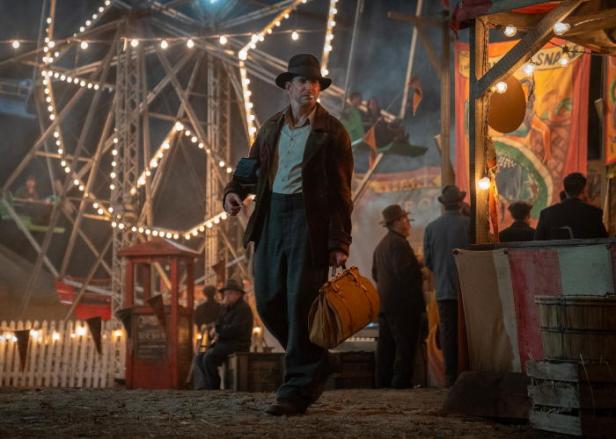
The idea behind the plot is that the central character ‘Stanton Carlisle’ (Bradley Cooper) is a drifter during the late 1930s who stumbles into a job in a travelling carnival. Carlisle is introduced in a scene that will haunt him throughout the narrative. We are not asked to cheer for him but he is a physically attractive man behind the stubble and the worn clothes. He’s also resourceful and talented. His talents include a capacity for picking up ideas and learning new skills quickly. It isn’t long before he gets involved in several of the carnival acts and begins to see ways to make more money. He leaves the carnival after turning himself into a successful ‘mentalist’. He acquires the requisite skills from Pete (David Strathairn) and Zena (Toni Collette) and finds a partner in Molly (Rooney Mara). The couple then leave the strange community represented by the carnival and begin to build up an act which is eventually booked into high class hotels in the North East (Buffalo in fact, a location that appears in another historical narrative by del Toro, Crimson Peak, 2015). This is certainly another world where Carlisle will find bigger ‘marks’ with much more money. But it will also be much more dangerous, especially when he meets the psychologist Dr Ritter (Cate Blanchett). She is the femme fatale who in this case offers him an almost Faustian pact – through her he could meet the wealthiest people who might be susceptible to his mind-reading. But what might she want in return?

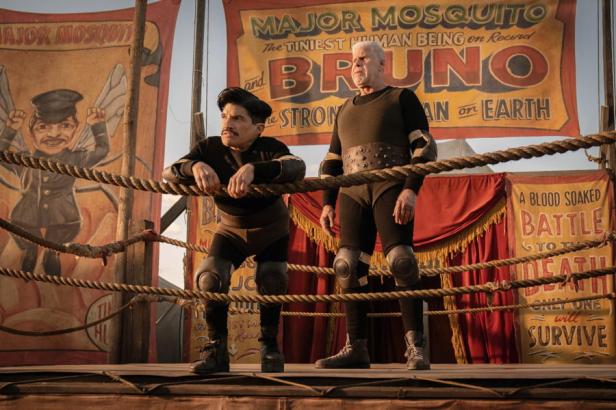
The carnival represents a tour de force of del Toro’s imagination, realised by production designer Tamara Deverell and her team. They are equally creative in presenting the environments of the wealthy in Buffalo. The cast is amazing. As well as those noted above I would pick out Willem Dafoe as the carnival boss, Richard Jenkins as the Buffalo tycoon, Mary Steenbergen as another wealthy mark and Ron Perlman as the carnival strongman and ‘protector’ of Molly. The photography by Dan Laustsen and the music by Nathan Johnson do justice to the production design and performances. So, why didn’t I feel gripped by the narrative in the same way as I did by the Mexican and Spanish films made by del Toro? I enjoyed each scene as a spectacle and I was intrigued by each plot development but somehow not enthralled by the whole. And yes, it probably is too long at 150 minutes. I do think part of my problem with the film is that Bradley Cooper (also an executive producer) doesn’t do that much for me and since he is the central focus of the narrative that’s a real problem. But it’s a problem I’ve created. There is nothing wrong with his performance as such. The real problems are in Guillermo del Toro’s conception of a ‘dark drama’ in which his imagination and creative ideas have ultimately overwhelmed the story.

I’ve read through a few reviews and articles on the production and I recommend Kim Newman’s take in Sight and Sound (March 2022) and perhaps even more useful, Joanne Laurier on the World Socialist Website. Laurier includes a discussion of the original 1947 film and the novel by William Lindsay Gresham. The key points here are that Gresham was one of the American volunteers who joined the International Brigade during the Spanish Civil War, fighting against the Francoist insurgence that overthrew the Republic. His novel of 1946 drew on his experiences in Spain, including his conversation with an ex-carny worker. In 1947 Twentieth Century Fox was seen as ‘punishing’ its star performer Tyrone Power who agitated for different roles by offering him the Stanton Carlisle part in a production they otherwise perhaps wished they hadn’t taken on. Power himself had wartime experiences that might inform his performance and although the film was not big box office its status has risen over time as has Power’s performance. I must watch the 1947 film. Joanne Laurier makes several interesting comments in her comparison of the two films. The most striking is that the 1947 film manages to present the carnival world and the fears of mainstream American population that were exploited by the mentalists and fundamentalist preachers and mediums, as a metaphor for American capitalism. This was achieved without losing the humanity of the carnival acts. Gresham’s intention was to suggest that it was the capitalist system which brought the misery and degradation, not the human failures of the people involved.

In his Spanish films, del Toro used fantasy to show how fascism in Spain undermined society and destroyed lives during and after the Civil War. He was aware of Gresham’s novel and its political sub-text and what the 1947 film achieved, but somehow he lost sight of it as the production developed. (He co-wrote his version of Nightmare Alley with Kim Morgan.) The Depression and the coming of war are not made an important element other than through aspects of mise en scène and a couple of dialogue exchanges about the invasion of Poland and the attack on Pearl Harbour. Joanne Laurier ends her piece like this:
A genuine opportunity has been missed here. Most importantly, what del Toro and his talented collaborators have not accomplished is to help educate and inoculate the population about American capitalism’s ideological machinations and social crimes.
I think I’ll need to revisit this when I’ve seen the 1947 film. in the meantime here’s the trailer for the del Toro film.
 itp Global Film