

It’s sad to think that there will be no more films by Terence Davies who died aged 77 on October 7th. I want to remember him in some way and my first experience of his work – seeing Distant Voices, Still Lives in the cinema on release – remains strong in my memory. The early scenes of the film seem stamped on my brain. It gave me an emotional punch and that sense of memories from my childhood 60-70 years ago. My older brother would have been roughly the age of the three young people in the film. I should quickly say that none of the terrible things in the film were part of my childhood, but the background sounds and images include many ‘Rosebud’-type moments.


The film begins with a great example of the Davies approach. A head-on shot of a terraced house, with heavy rain bouncing off the window ledges and the short path to the front door, sees the woman of the house grabbing three bottles of milk off the step and closing the door. The soundtrack carries the shipping forecast on the radio which continues when the shot cuts to inside the hallway of the house and the woman calls upstairs to her three grown-up children. At first we don’t see Eileen, Maisie and Tony, we just hear their footsteps as we look at the empty staircase. This brilliant opening will later reveal itself as the morning of Eileen’s wedding, though now it immediately flashes back to her father’s funeral as the camera reverses and offers us the front door with its glass panes and Christ icon. To achieve this the camera crew perform their own miracle in the tight confines of the hallway. This movement is accompanied by Mum (‘Mam’) singing ‘I get the blues when it rains’. The camera holds on the door and Mum’s song gradually fades out as a beautiful dissolve reveals the open doorway. As the hearse slowly comes into view, Jessye Norman is singing ‘ There’s a Man Going Round Taking Names’. As well as a powerful sequence about memory in its own right, these first few minutes also present us with the formal devices of the film: the radio and the non-diegetic song, the diegetic songs, the static camera position followed by slow tracking, the action off-screen that gradually comes into view and the moving backwards and forwards in narrative time. We don’t know yet what will be in the film’s narrative but we get a sense of how it will be presented and we can guess that it will be contained within a close-knit community. The UK poster above uses the tableau shot of the family at the time of Eileen’s wedding.

Distant Voices, Still Lives is now seen as one of the most important British films, even if the numbers of people who have seen it remain quite small. Its categorisation as an art film means audiences in the UK have been small in number but on the other hand it represents one aspect of British art cinema for cinephile audiences around the world. Sadly, I suspect that the people who might recognise all the significant sounds and images in the film may have missed it. A great deal has been written about the film, including a BFI Modern Classic by Paul Farley, who was born in Liverpool and is now Professor of Poetry at Lancaster University and has some of the best qualifications for the task. But he was born in 1965 by which time Davies had turned away from his childhood memories and begun his own distinctive journey. I can at least remember some aspects of the 1950s and in this sense the film rings true for me. It’s a cliché now but Noel Coward’s line about the potency of cheap music has never been truer. My trigger would be the Eddie Calvert trumpet instrumental of ‘Oh, Mein Papa’, but probably even more triggering are the radio extracts that Davies chooses. Alongside the shipping forecast, he includes at different times, snippets of Sunday lunchtime programming on the Light Programme in which ‘Two-Way Family Favourites’ each week served the families whose young men were stationed abroad during their National Service (like Tony possibly?). It was followed by the ‘Billy Cotton Band Show’ and comedy series such as ‘The Glums’ (‘Take it From Here’) and ‘Beyond Our Ken’ all included by Davies. The radio and the singing in the pub alongside weddings and funerals provided communal relief for the family from the week’s toil and in the 1940s from the occasional outbursts of cruelty and violence from the abusive father played by Pete Postlethwaite. The fear created by father’s behaviour is matched by the fear of the bombs during the war with Liverpool a major target – but in the shelter there is a sense of a broader community.

‘Distant Voices’ refers to the 1940s memories of Davies himself, but since he wasn’t born until November 1945, mainly the stories he might have picked up from his older siblings who are portrayed as children and teenagers. Only three appear in the narrative, though he was actually one of ten children. ‘Still Lives’, actually made two years later, is set in the 1950s when the three grown-up children are all eventually married. Davies didn’t set out to make a realist film and, as far as I know, most of the film was shot on location in London since the family house in Kensington, Liverpool 7 had been demolished. Similarly, although there are distinct Liverpool references such as the Futurist Cinema, others are more generic – everyone seems to have bottles of Tetley’s beer – from the Leeds brewery which didn’t buy into the Liverpool market until later in 1960 when it merged with Walkers of Warrington. But Liverpool is represented in the casting. Pete Postlethwaite was a working-class Catholic boy from Warrington born roughly the same time as Davies. Jean Boht, a Cheshire girl cast as Auntie Nell was starring in the Liverpool-based TV series Bread when she performed in the film and Debi Jones from Crosby as Micky sings very well. Other actors in the cast seem to have Brookside TV credits so I assume that they are at least Manchester/Lancashire based. Mum was played by the redoubtable Freda Dowie from Carlisle. The whole cast is terrific.
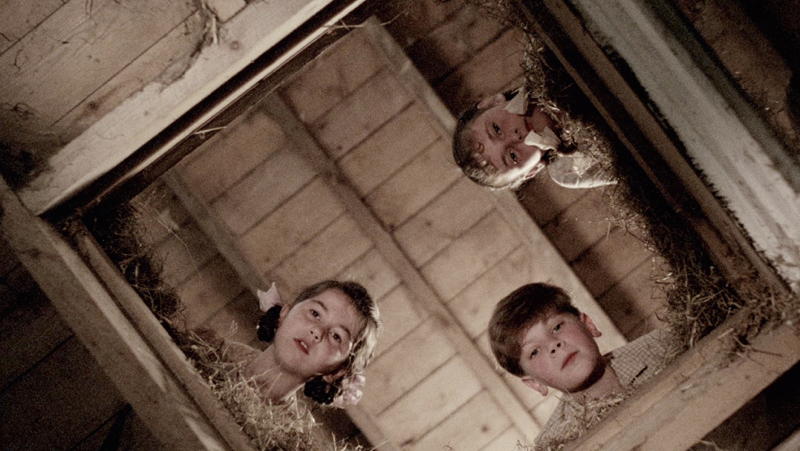
Davies was an unusual working-class boy who seems to have been influenced mainly by being taken to see Hollywood musicals and melodramas by his mother. He also changed his local accent by listening carefully to the announcers on the Home Service of BBC radio. Later he would emerge as a seemingly unhappy gay man. There are at least two priests in the film and both have middle-class English voices. I wonder if they are deliberately not the Irish priests we might expect in Liverpool’s Catholic communities? As well as the ‘plummy voice’ as my colleague from the other bank of the Mersey calls it, Davies also grew to love classical music and the poetry of T. S. Eliot. His unique tastes in music and cinema are a feature of his documentary about the Liverpool of his childhood, Of Time and the City (UK 2008). Distant Voices, Still Lives stands on its own in his filmography. It followed his early short films which also had their autobiographical elements and were later put together as The Terence Davies Trilogy (1983) which features the three phases of the life of ‘Robert Tucker’. Distant Voices, Still Lives was followed by The Long Day Closes (1992) which was not so much a sequel but the family seen from the perspective of Davies himself as the boy in the later 1950s with more films and music. Back in 2008 I ran an event on Davies with a screening of The Long Day Closes. The notes from the event are available here: TDaviesNotes.

Distant Voices, Still Lives is dark because of the father’s violence and cruelty. It’s probably what many people remember most about the film, but for me the most affecting scenes are the singing and the simple but powerful mise en scène. I was amazed to discover that there used to be live cattle kept for milking in small dairies in some terraced housing streets in Liverpool (see BFI Player: https://player.bfi.org.uk/free/film/watch-leaving-of-the-cows-1975-online) – once 4,000 cows were kept in ‘cow hosuses’ in Liverpool. It’s no surprise then that a workman like Tommy Davies kept a pony. One commentator on MUBI suggests there is too much singing. I beg to differ, it’s wonderful.
In 1988 British cinema was still in the early stages of recovery from the nadir of 1984 when UK cinema audiences had sunk to their lowest ever level. It’s fair to say that in this period it might have collapsed completely if not for the low budget productions financed by Channel 4 and BBC Films and the support of the British Film Institute. Thank heavens for public service broadcasters and public funding. Distant Voices, Still Lives benefited from Film Four International’s funding arrangements with West German TV and regional funding, in this case ZDF, the then German equivalent of BBC2. The film is currently streaming on MUBI (and other streamers) and there is a Blu-ray of the 2018 4K restoration published by the BFI. The Blu-ray package includes a variety of interesting ‘extras’ and I hope to investigate some of these in a later posting.
 itp Global Film
I too remember all those radio programmes which were on especially when my mum was doing the ironing. Perhaps that is why I still rather enjoy ironing!
LikeLiked by 1 person
I like ironing to the radio too. But most of all I remember the arguments about whether Family Favourites should be on when we were eating our Sunday Dinner.
LikeLike