
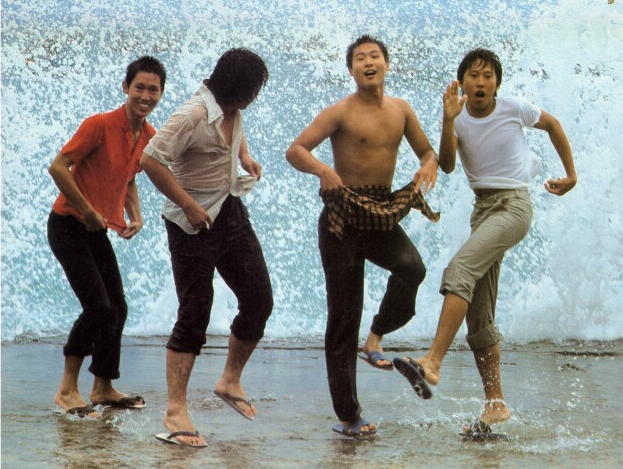
After three ‘commercial films’ in 1981-2, Hou Hsiao-hsien made a distinctive statement with his fourth feature which displays many of the familiar traits of his later films. Gone are the actor-pop stars and songs and the clear generic narratives of the earlier films. Instead, an observational camera is used to present four youths on an island in the Penghu group to the south of Taiwan, who have finished school without any particular skills or qualifications and are simply waiting for their call-up for military service. They get into trouble and generally cause a nuisance before being taken in by the police and processed. At this point three of them decide to move to the mainland and the big city of Kaohsiung on the South Coast. One of the boys has an older sister who lives in the city and they hope she will help them find somewhere to live and point them towards employment.
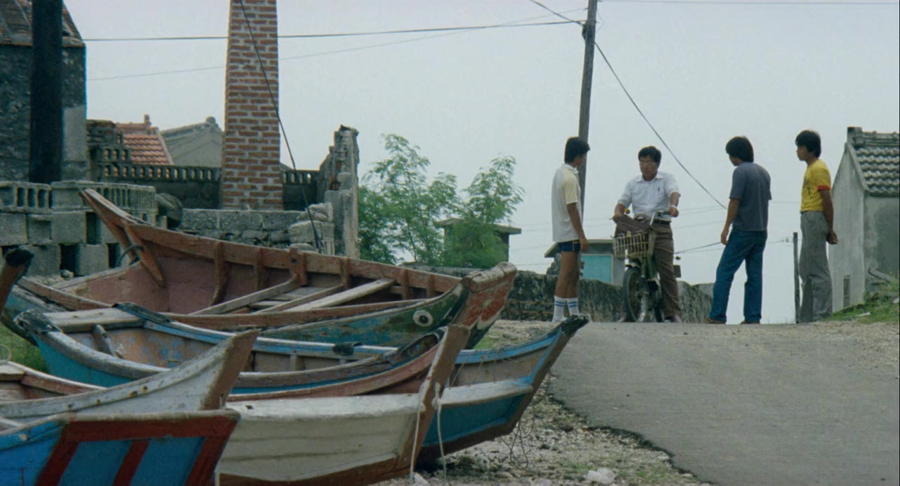
What follows is a familiar story of migratory flows and family relationships, of the movement from the rural to the big city. The narrative does eventually focus on Ah-ching (Niu Chen-zer), one of the four youths, and several other narrative strands are connected to him. Hou adds a number of personal flashbacks in which Ah-ching remembers moments from his childhood which traumatically involve his father. Disability caused by an accident has caused the father to be physically present but in practice absent from his son’s teenage years. These are presented in slightly bleached colour so that we notice the time-shift. The everyday ‘adventures’ of the youths involve them with several family members – they all seem to have siblings or cousins in different parts of Taiwan. At one point the youths sneak into a cinema where, instead of the ‘porno shorts’ that Ah-ching is hoping to see, they watch Rocco and his Brothers (Italy 1960), Luchino Visconti’s film about a poor family from Southern Italy who move North to Milan to escape poverty. The idea that Western art films will have more sexual content than local films also forms the basis of another interaction.
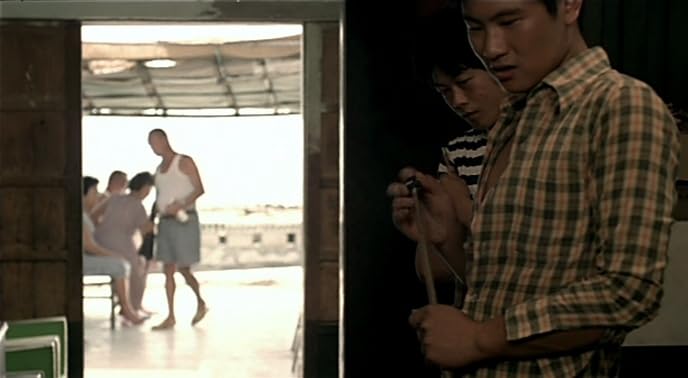
The visual style developed here by Hou and his cinematographer from his earlier three films, Chen Kun-Hou, uses long takes, long shots and often static framings. As an ‘observer’ the camera composes images in which objects or characters in the foreground often obscure what is in the background. Sometimes the framing is a doorway or a corridor and sometimes the static shot means that characters enter and leave the frame during the shot. Music is used to distance the events from the audience. Following a suggestion by Edward Yang, Hou replaced the music originally composed for the film with excerpts from Vivaldi’s ‘Four Seasons’, which certainly distances us to some extent from, for instance, the bustle of the streets in Kaohsiung. The story has no ending as such as the characters simply move on to the next stage of their lives, whether it is to begin military service, get a job on a ship or simply move to another city in search of work.

In the same year that Hou made The Boys from Fengkuei, he also contributed to the portmanteau film The Sandwich Man and this suggests that 1983 is a significant date in the birth of the New Taiwanese Cinema. Films about ‘disaffected youth’ are universal in signalling a challenge to traditional forms of cinema. There are some resemblances in Hou’s film to Martin Scorsese’s Mean Streets from 1973 during the period of New Hollywood, but also to Wong Kar-wai’s Days of Being Wild (HK 1990) associated with the Second New Wave of Hong Kong Cinema. In both these films the young men are older but the links are there. Hou in the 1980s would eventually become a film festival favourite around the world and he would have a direct influence on other aspiring Asian filmmakers. The early work of Jia Zhang-ke, for instance as a key filmmaker of the Sixth Generation in China includes two films, Platform (1998) and Unknown Pleasures (2002), both of which appear to acknowledge The Boys from Fengkuei. Included on the Blu-ray that I watched is an audio-visual essay by Adrian Martin and Christina Álvarez López. Martin expands the points above and he suggests other links that Hou might be consciously or unconsciously making. Like several other commentators he refers to Federico Fellini’s I Vitelloni (Italy 1953) with its vignettes of ‘layabouts’ in a small coastal town. He also adds two other related titles. Jean Renoir’s Le crime de Monsieur Lange (France 1936), not for its narrative content but for its use of choreography of space and movement – much of the action in The Boys of Fengkuei takes place in and around Ah-ching’s home in Penghu and in the terraced flats of the home the boys find in Kaohsiung. Martin also mentions Rossellini’s Germany Year Zero (Italy-Germany 1948) in which a young boy roams the streets of the ruined city of Berlin while his father is ill in bed. Renoir was in one sense the founder of the realist style which Visconti, Fellini and Rossellini were all heir to and these are links worth thinking about.

For my part, I enjoyed The Boys of Fengkuei very much after at first fearing that I might not be able to identify with the boys. But Hou and his scriptwriter Chu T’ien-wen skilfully create a narrative that drew me in. Chen was a young woman in 1983, writing for Hou for the first time but over time becoming his close collaborator. Two aspects of the film stand out for me. Firstly the family and friendship relations, sometimes abrasive but always with a sense of mutual reliance, and frequently celebrated through scenes of mealtimes and snacking. Secondly I was impressed by the location photography and specifically the flat and open island home and the contrast of Kaohsiung’s bustling streets. I’ve never been to Taiwan but now I feel I have. The collection of three early films by Hou on the Eureka Blu-ray is definitely worth exploring. (Trivia note: Hou appears in the trailer below as the man playing mahjong towards the end.)
See posts on Cute Girl (1980) and The Green, Green Grass of Home (1982) on this blog.
 itp Global Film