
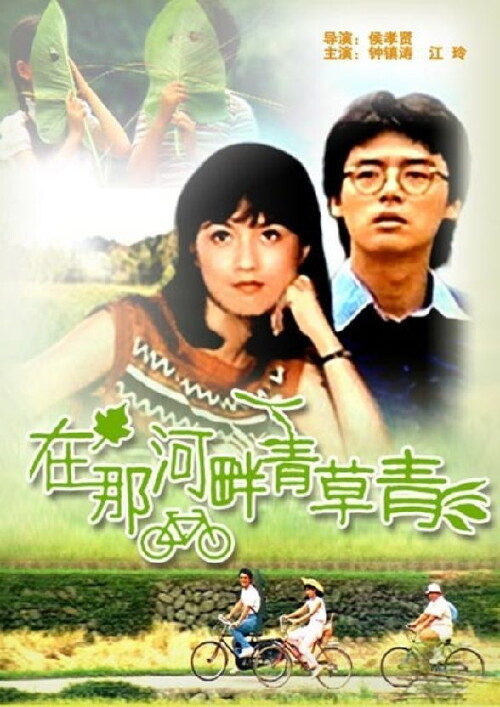
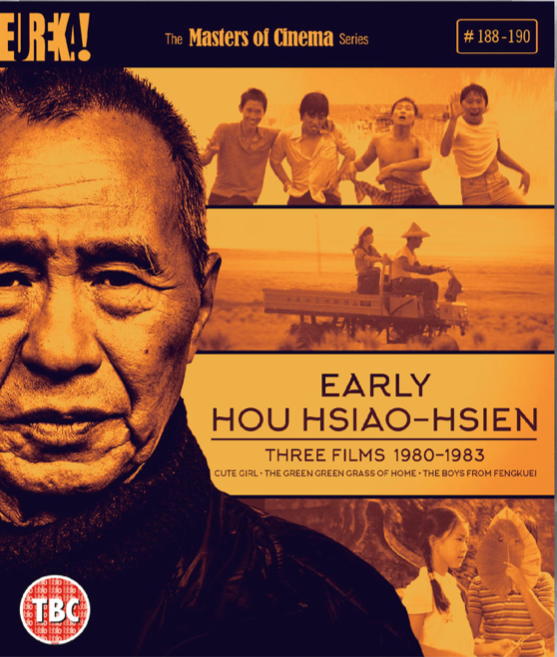
Hou Hsiao-hsien followed up Cute Girl (1980) with another ‘comedy romance’, Cheerful Wind, in 1981 featuring the same two stars Feng Fei Fei and Kenny Bee. Kenny Bee then appeared for a third time in The Green, Green Grass of Home in 1982, the second film in the Eureka/Blu-ray package of ‘Early Hou’ films, and I think it is possible to see a change here. The film is set in a rural village in the mountains in Southern Taiwan, which has the distinction of a railway station and local children racing the Japanese-style single-car diesel unit on their way to school. The train is also an early example of the influence of Ozu Yasujiro’s work on Hou. (I’ve since learned that Hou hadn’t actually seen any of Ozu’s work when he made this film – so it just appears to be an Ozu image in my imagination.)

The film’s opening sequence briefly sets up the stability of the local village school community but then immediately disrupts it when a teacher announces she is leaving the school, but that her brother is going to take her place. Cue the arrival of Kenny Bee as Mr Lu via a nice little sight gag about leaving his ticket on the train and being sent back for it by the properly vigilant local station-master. From hereon in the familiar process of the new teacher and his students begins as does his ‘settling in’ period in the village. He ends up with a room above the village theatre and a big welcome from his fellow teachers at the school.
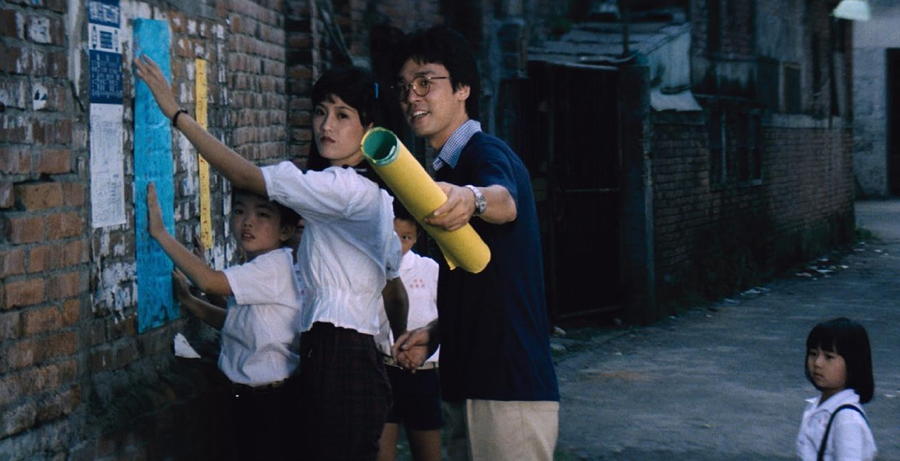
As well as the new teacher Lu Da-Nian , the narrative also focuses on three of his students – miscreants known as the ‘three musketeers’ – and their families. In this way, although the narrative is later revealed to involve a form of romance/comedy, it is also, and more importantly, a social commentary on rural life in Taiwan. There is an almost documentary feel to many scenes and a focus on shared family meals, working in the paddy fields, doing homework etc. Formally too, this film moves towards Hou’s later style. The camera of Chen Kun-Hou is allowed to observe and not to follow a strict narrative chain of causation. This is especially true in terms of the antics of the children. There is a video essay for each film in the collection produced by Adrian Martin and Christina Álvarez López. They make the point that Hou, with his cinematographer, demonstrates his growing skill in more composed framing of images. The genre pull is less strong and the ‘episodic’ nature of the narrative allows all kinds of ideas about the rural community to come to the fore.

A key issue in the plot is the practice of using a mild electric shock as a means of harvesting small fish in the river. The practice has been deemed illegal and the children are taught that it is bad for the environment. Da-Nian walks a fine line in trying to stop the practice, but also not to confuse his students and create conflicts between students, two of whom have difficult family lives and fathers who adopt this fishing method in the local river to feed their families. While this is going on he also attempts to woo fellow teacher Su-Yun (Chen Meifeng). This isn’t helped by the arrival of a young woman from Taipei who has been pursuing him. This results in one of several humiliations for the teacher in front of his students and the other teachers.

I thoroughly enjoyed this lovely film. River conservation, lots of railway footage, a community school and a realist portrayal of rural families. What’s not to like? There are a couple of songs which in this case enhance the overall narrative purpose and the romance stays more in the background. I was intrigued by one subtitle when one of the parents is referred to as an ‘aborigine’. This was 1982 and now I believe indigenous people in Taiwan are referred to as ‘Native Taiwanese’, making up a significant minority comprising several sub-groups adding up to some 600-800,000 people. The film gives a representation of Taiwanese society that comes over to me as both traditionally Chinese but also Japanese-influenced. No surprise there but I was intrigued to pick up hints of Kore-eda Hirokazu’s later Japanese films (children travelling alone on trains), but also elements of both Fifth and Sixth Generation mainland Chinese films. It’s worth remembering that in the mid-1980s, Hou would be hitting film festivals at the same time as Chen Kaige and Zhang Yimou. He would also later become an executive producer of Zhang Yimou’s Raise the Red Lantern (China 1991). At this point there isn’t the same sense of Hou wanting to dig deeper into the history of Taiwan since 1945 and the social issues that have developed, but they are coming. I’d certainly recommend this Blu-Ray package as a good introduction to Hou’s work and how his filmmaking developed. The Boys From Fengkuei (1983) will be discussed here in a couple of week’s time.
 itp Global Film