

The Widescreen Weekend is the survivor among the important film festivals that once featured at what was originally the National Museum of Photography Film and Television in Bradford. We’ve lost the International Film Festival and Bite the Mango which brought filmmakers from Asia and Africa to Bradford and the Animation Festival has moved to HOME in Manchester. But the Widescreen Weekend lives on and the next iteration starts on Thursday 28th September running through to Monday 2nd October. It’s a long weekend and this year it’s a very special weekend celebrating the 70th anniversary of CinemaScope. You can see the whole programme here.
Ironically what is now the National Science and Media Museum is currently undergoing extensive refurbishment and the IMAX screen and the small Cubby Broccoli cinema are both closed until later in 2024. But Pictureville, situated in the separate building which was once the library theatre, remains fully functioning. Pictureville is now, I think, the only cinema worldwide capable of screening three strip Cinerama which of course will feature in the weekend. The pressure on the Pictureville screen will be relieved to some extent by the decision to hold some screenings at Bradford Playhouse (the former Bradford Film Theatre). There are also some one-off special screenings in Roberts Park, Saltaire (that was on 8th September), Bradford Cathedral (The Iron Giant, US 1999) and, hosted by Bradford Queer Film Festival, at Common Space, John Street a screening of Chrissy Judy (US 2022). Many of the screenings will be digital but we are promised some screenings on film at Pictureville.
The Widescreen Weekend has always attracted fans not just from around the UK but also from much further afield and they are very welcome in Bradford. On this blog we have been very passionate about film form and film technologies and in particular about the qualities of the image on screen. We are very fortunate to have a cinema like Pictureville with a high quality team of projectionists. But I have to confess that for me some of the festival programmes in the past have not interested me that much because the actual films didn’t attract me. On the other hand I do have fond memories of spectacular films that I would probably never have seen anywhere else. I can’t forget Goya (East Germany-Bulgaria 1971) and Kurosawa Akira’s Dersu Uzala (Russia-Japan 1975), both shown on 70mm prints when the International Film Festival and the Widescreen Weekend ran together in 2011. But the 2023 Widescreen Weekend certainly does have interesting titles and several screenings are very much on my radar. I’ve just picked out a few that interest me, but do look through the whole programme, there is much more than I can cover.

Kaagaz Ke Phool (Paper Flowers, India 1959) is a film that I have always wanted to see in its original form as the first CinemaScope film from India. I first saw it panned and scanned on TV and it only became available in a ‘Scope print in 2012. Given the nature of Indian film productions today it seems surprising that it took so long for ‘Scope to reach India but the same was true for ‘Scope’s journey to Japan. One of the big issues about film industry and film culture in India has been the scandalous neglect of film conservation and preservation. It is getting better but restorations certainly need to be supported. Guru Dutt is one of the major figures of the ‘Bombay social film’ from the Golden Age of Hindi Cinema. He died far too young at 39 but in a career lasting less than twenty years he became an actor, producer, writer and director associated with many of the most important films of the 1950s and early 1960s. In this last directorial effort he plays a director who begins a career decline just as his protégé, played by his real-life discovery Waheeda Rehnan, sees her star rise – a nod to the classic Hollywood title a Star is Born. The visual properties of the film also possibly display Guru Dutt’s interest in Citizen Kane and his important role in introducing film noir styling to Hindi cinema. This was his last credited appearance as director, though he continued to produce and to act until his death in 1964. Guru Dutt personally acquired ‘Scope lenses from Hollywood which he planned to use in a film featuring his wife Geeta, the famous playback singer in an acting role in 1958, but he decided to abandon that shoot after shooting only a few reels of film.
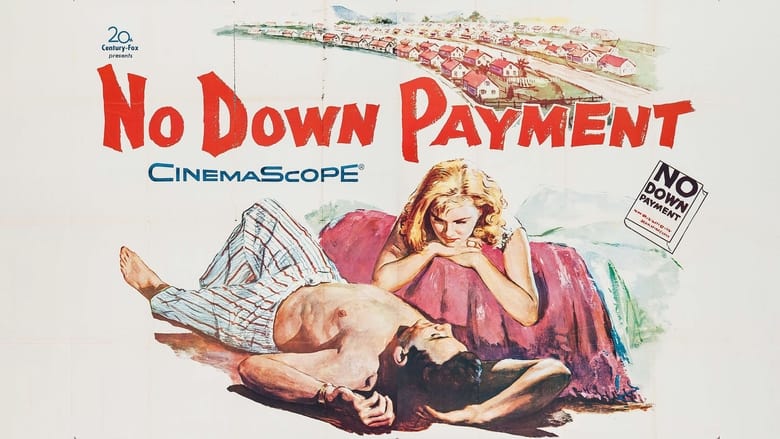
No Down Payment (US 1957) is, like Kaagaz Ke Phool, a Black and White ‘Scope picture, but this time a Hollywood suburban melodrama directed by Martin Ritt and starring Joanne Woodward and Cameron Mitchell. I wasn’t aware of this film but I remember Ritt’s later B&W ‘scope picture, Hud (1963) with Paul Newman. No Down Payment was shot by the veteran Joseph LaShelle and it sounds my kind of film.

There are plenty of other gems in the programme that I’m much more familiar with including three other superb B&W ‘Scope pix, Kurosawa Akira’s The Hidden Fortress (Japan 1958) and Naruse Mikio’s When A Woman Ascends the Stairs (Japan 1960) with the wonderful Takamine Hideko. Both films use Tohoscope. The Kurosawa film was one of Japan’s first ‘Scope productions. Thirdly, there is Bradford’s own B+W ‘Scope classic, Billy Liar (UK 1963), filmed mostly in the city. Another early ‘Scope pic is Nick Ray’s Rebel Without a Cause (US 1955). I assume that this will be shown in the original even wider ‘Scope ratio of 2.55:1 which was possible because the stereo soundtrack was on a separate magnetic recording rather than printed optically on the projection print. Fans will also get a chance to see Alfonso Cuarón’s Roma (Mexico-US 2018) which was difficult to see in cinemas as a Netflix production. Finally, I’m also pleased to see Lola Montès (France-Germany 1955) also in 2.55:1 and the last film by the great Max Ophüls. It is joined in the programme by Jacques Demy’s deliriously colourful Les demoiselles de Rochefort (France 1966) with Catherine Deneuve and her sister and Françoise Dorléac – formidable!

So, congratulations to Sally Folkard and her team who put the programme together. I’m looking forward to visiting the festival.
 itp Global Film
A number of the titles in the festival are screening in their original film format, 35mm or 70mm.
Bonjour Tristesse 1958: adaptation of the novel by Françoise Sagan: directed by Otto Preminger, in Technicolor and Cinemascope.
The Young Girls of Rochefort / Les Demoiselles de Rochefort, 1967: written and directed by Jacques Demy, in Eastmancolor and Franscope.
When a Woman Ascends the Stairs / Onna ga kaidan wo agaru toki, 1960: directed by Mikio Naruse, in Black and White and Tohoscope
The Hidden Fortress / Kakushi-toride no san-akunin, 1958: directed by Akira Kurosawa, in Black and White and Tohoscope
The Hateful Eight, 2015: directed by Quentin Tarantino, in color and Ultra Panavision 70
Rebel Without a Cause, 1955: directed by Nicholas Ray, in color and CinemaScope
Roma, 2018: directed by Alfonso Cuarón, transferred from digital to 70mm
This means that fortunate film buffs can see as many actual film prints, [as opposed to digital files] in a weekend as they are likely to see in the whole of the rest of the year.
I should note that the Hyde Park Picture House has now reopened with its twin 35mm projectors ready for screenings; hopefully this will mean some 35mm screenings at the Leeds International Film Festival in November.
LikeLike