
This Western by Henry Hathaway is perhaps not known as well as it should be. At least it was new to me and I’ve watched a lot of Westerns. It has a high rating on IMDb suggesting that it is recognised by fans. At a taut 89 minutes Rawhide has only one major flaw – the title. The narrative has nothing to do with cattle or tanning for that matter, though I suppose it might refer to the staging post where horses are exchanged and reins and tackle seen to by the staging post manager. This is a simple narrative. A staging post in the West on a route between San Francisco and New Orleans is attacked by a quartet of villains who have escaped from gaol. They are led by Rafe Zimmerman (Hugh Marlowe), an educated man who was imprisoned for murder. The other three are not very bright. Zimmerman intends to rob a specific stagecoach that he knows will be carrying gold from California. He intends to ambush the stagecoach when it stops to change horses. But he must also control the staging post manager Tom Owens (Tyrone Power), who has with him a woman ‘Vinnie’ (played by Susan Hayward) and a baby girl (the reasons for this odd trio are explained in the narrative). The whole story is quite conventional in its narrative elements.

However, there are several interesting aspects of the film. I’ve seen one comment which suggests this is “a good B Western, with a re-cycled generic score”. The score by Sol Kaplan is indeed generic, but this is no B picture. Tyrone Power had been an A List star at 20th Century Fox since the early 1940s and Susan Hayward had been a leading lady for nearly as long. Neither actor was associated with Western parts as a genre regular but both had made Westerns before. Similarly, the director Henry Hathaway had not made a Western since the early 1930s (but would later make several well known and critically acclaimed Westerns). At this point Hathaway was best known for his documentary-style crime films in the late 1940s. Overall, this is a classy Fox ‘A’ picture. But is it really a Western? Well yes, in terms of its iconography and setting in the West in the second half of the 19th century and in its cast of characters. Yet its narrative structure could be equally applied to several other genres and the action in the film is restricted to the staging post for nearly all of its running time, suggesting a form of chamber drama, albeit one with guns.

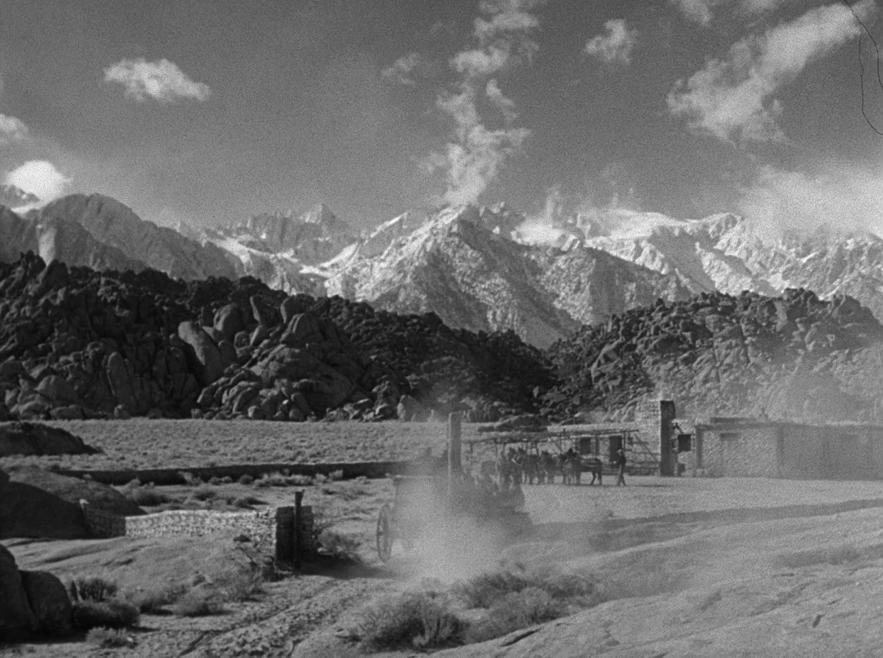
The genre categorisation also derives from other factors, including a script by Dudley Nichols, one of the best known and most celebrated scriptwriters of the period and best-known perhaps for his several collaborations with John Ford, including Stagecoach (1939). Though the story details are different, there is a clear connection between Rawhide and Stagecoach, especially in the interior scenes in the staging post. But the difference is in the presentation. Stagecoach was photographed by Ford regular Bert Glennon who knew how to give Ford the landscape shots and deep focus interiors that the director envisaged. Rawhide was shot by Milton Krasner, just as experienced as Glennon, but though familiar with Westerns not so wedded to the kind of imagery created by Ford. At this point Krasner was more associated with crime dramas and melodramas. Nevertheless, Krasner does a fine job with location shots of the Alabama Hills in Lone Pine, California but also ‘night for night’ shots in and around the station house. He serves Hathaway’s carefully choreographed mise en scène and provides close ups as required in compositions which are often presented in depth (see above). Krasner’s two 1950s pictures were All About Eve and the early Sidney Poitier starrer No Way Out. Some reviewers have described Rawhide as a film noir Western. I can see the case for this and it would bracket the film with others such as Pursued (1947) with Robert Mitchum. But noir cinematography was dominant across several genres in this period and it may be more useful to think about the narrative’s links to crime thrillers and in particular hostage narratives or even ‘home invasion’ narratives. I note that some reviews mention The Desperate Hours (US 1955), William Wyler’s film in which Humphrey Bogart leads a trio of escaped convicts who take over a suburban home and keep the family hostage. This had occurred to me as well as I watched Rawhide.
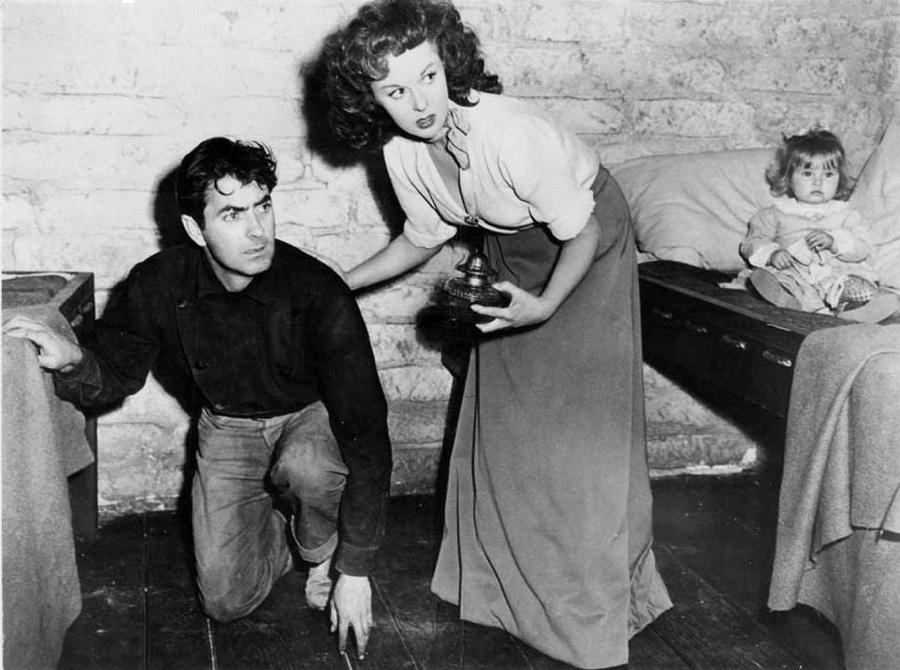
In fact, Rawhide appears to be a re-make of a Fox ‘gangster melodrama’ from 1935, Show Them No Mercy! in which a couple with a baby experience a breakdown in their car during a storm and seek shelter in a shack which then turns out to be the hideout for a gang of kidnappers. The conventional narrative then relies on the casting and performances of the principals. They in turn rely upon a script which in the case of Rawhide has been re-fashioned by Nichols and a couple of other writers. Some Western fans feel Nichols promotes too much ‘speechifying’ but he certainly knows how to create tension. Power and Hayward have to pretend to be man, wife and child so that Zimmerman is convinced that he can use the assumed family bond to force Owens (Power) to behave ‘normally’ when the stage coaches turn up (one from the East) before the one from the West carrying the gold.

Zimmerman is able to guess and pre-empt many of Owens’ strategies to disrupt his plans and of course luck works in both directions. Zimmerman must control his three companions and most of all Tevis (Jack Elam). In most of the over 200 films and TV programmes in which Elam appeared he usually lasts only a few minutes on screen as a ‘heavy’ and in his latter years sometimes a comic heavy. I was therefore surprised and intrigued that a still relatively young Elam has a much bigger role here as a leering and very unpleasant thug who delights in taunting Hayward’s Vinnie. He is also involved in an extraordinary sequence in which the baby girl escapes from her captivity and Tevis gleefully fires his gun to frighten the child, missing her by only a foot or so. Some critics suggest this is an example of a sadistic streak in Hathaway’s work: he also directed the scene in Kiss of Death (1947) in which Richard Widmark pushed a woman in a wheel chair down a staircase. The Widmark scene was cut by censors in the UK and it is unlikely the abuse of the child in Rawhide would be allowed today. The other two villains are much more likely to follow Zimmerman’s orders but their general incompetence or lack of intelligence mean they are also a danger. Again, Dean Jagger and George Tobias are well cast and perform their roles professionally in terms of the script.

But despite Elam’s efforts, the main focus remains with the three principals. Intriguingly Zimmerman is played as the well-organised and believable ‘Deputy Sheriff of Huntsville’ presenting the badge he has stolen. If he’s plausible, Tyrone Power as Owens is more problematic as a character. The script makes him the son of the owner of the stagecoach company, sent from the East to learn the ropes (his mentor is gone in the first few minutes). He is the handsome matinee idol, perhaps more suited to his adventure movie and swashbuckling roles. Here is dressed in a very snazzy Western shirt, one of those that John Wane wears in The Searchers, similar to a cavalry ‘bib shirt’. (The shirt will let him down at a crucial point.) Rather than the ultra masculine hero, he is seen cooking the food for the stagecoach passengers. He also loses his gun early on. In the conventional terms of the Western he might be seen as emasculated. This then potentially has an impact on his relationship with Vinnie. Susan Hayward plays her as tough, gritty and ‘feisty’ (a problematic term I know) – as well as beautiful and sexy in her long skirt, kerchief and white blouse (that remains remarkably clean despite the privations she suffers). IMDb does try to categorise the film as a ‘drama and romance’ and in conventional terms the narrative supports this – but, however it works out, Vinnie will not be a conventional wife and mother. I’ve written about Susan Hayward in her rodeo picture The Lusty Men (US 1952) with Robert Mitchum. I’m still not sure what it is she has got, but it works for me.
I suggested the film has only one flaw but if I’m being picky there are a few more which annoy me, but don’t undermine the film as a whole. At one point Zimmerman speaks to Tom as if he was a young greenhorn. Power was only three years younger than Marlowe at 36. The final shoot-out seems rather odd in that Tom is firing a six-gun and he manages far more than six shots. Perhaps more importantly, Krasner’s excellent camerawork is undermined by some poor transitions between location footage and studio interiors of the station house. But these are minor quibbles. The important things all work and this is a classic example of a well-made entertainment film, even if some of the representations are very much of their time. The film is available on disc and on streamers and is free in several versions on YouTube.
Here is a trailer for the film, including the voice-over introduction by Gary Merill:
 itp Global Film