

Some readers will be aware that I don’t usually watch US TV serial dramas. It’s primarily because they are so long (i.e. the number of episodes per season) and they tend to block out everything else. But also, I don’t subscribe to any channels that show premium serials. So why did I finally watch all ten episodes of Season 1 of Yellowstone? There are three main reasons. First the show was conceived by Taylor Sheridan and John Linson and in Season 1 all episodes were written and directed by Sheridan. I was impressed by his earlier film scripts for Hell or High Water (US 2016) and Wind River (US 2017) which he also directed. Second, Yellowstone is clearly connected to the concept of the ‘Twilight Western‘ and there are even lines of dialogue that refer directly to the theme of the decline of ‘cowboy culture’ and the West. Thirdly, in the two films mentioned above Sheridan included Native American characters, finding work for several Native American actors in the process, and introduced storylines based on issues relating directly to Native American communities. Yellowstone appears to embed more issues related to Native American ideas about culture than most filmed drama narratives that I’ve come across. And finally this first season of the show was shown on Channel 5, free-to-air TV in the UK and on the streamer/catch-up service My5. Channel 5 is currently owned by Paramount Networks.

This Paramount production in 2018 was initially a Weinstein Company project but that name was expunged early on because Weinstein became persona non grata. Paramount actually didn’t seem keen on it at first and after a release on Paramount Network it was allowed to go to Peacock, the NBC streamer. But as it became more popular, Paramount re-embraced the show and it has now lasted into its fifth season with numerous spin-offs and prequels. At one point, the programme was seen as the most popular cable series in the US. The reason for that popularity is arguably based on two traditional conventions. First the show is built around a ‘feuding family’ and second, some form of emotional or physical conflict seems to develop and explode across the screen roughly every ten minutes.
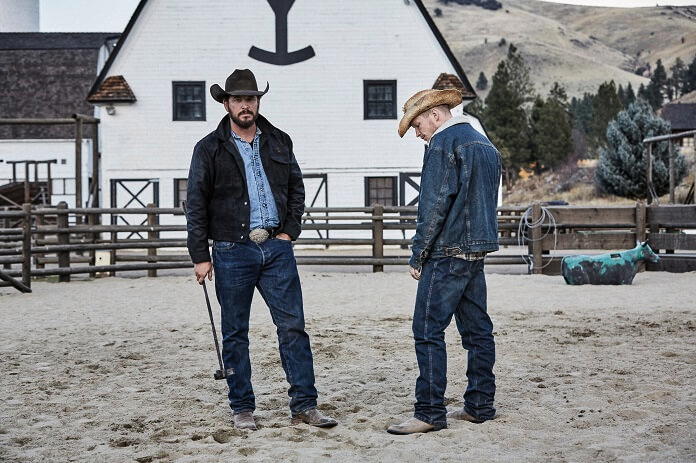
‘Yellowstone’ is the name of the ranch first developed by the Dutton family in the last quarter of the 19th century in Montana after a cattle drive from the South (a process which formed the central narrative of Larry McMurtry’s Pulitzer Prize-winning novel Lonesome Dove). Over the decades since then the ranch has become the biggest in the US and now occupies half the valley, bordering on three other equaly important properties, the Yellowstone National Park, a Native American reserve territory and a large plot of land purchased by a Californian investor (Danny Huston) intending to develop up-market holiday and recreation facilities. Each of these three are capable of border issues that might threaten the Dutton family in some way.
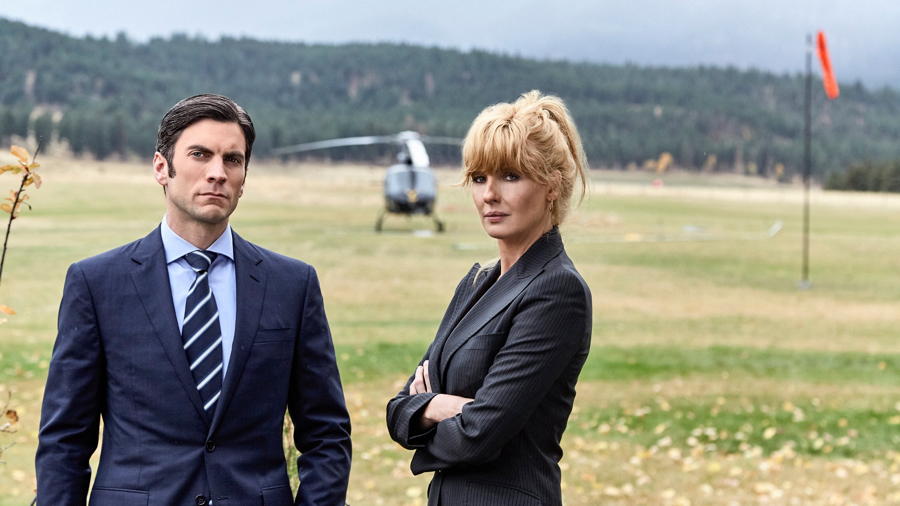
The current patriarch of Yellowstone is John Dutton (Kevin Costner) who is determined to keep control of his empire at all costs. He also expects that his grown up children, Beth (Kelly Reilly) Jamie (Wes Bentley) and Kayce (Luke Grimes) will devote themselves to the cause of maintaining the Dutton hegemony in Montana. The narrative includes several flashbacks that help the viewer to understand how the current family situation came about. A fifth important character is John Dutton’s head cowboy, Rip (Cole Hauser). An ex-con, Rip was given a second chance by Dutton and his subsequent loyalty, as well as his intelligence and efficiency, has made him a powerful figure in solving all the Duttons’ problems. It’s difficult not to think of Rip as the equivalent of Robert Duvall’s character in The Godfather. The family, of course , has prompted audiences to think of the Ewings of Dallas, substituting land for oil as the basis for the family fortune.
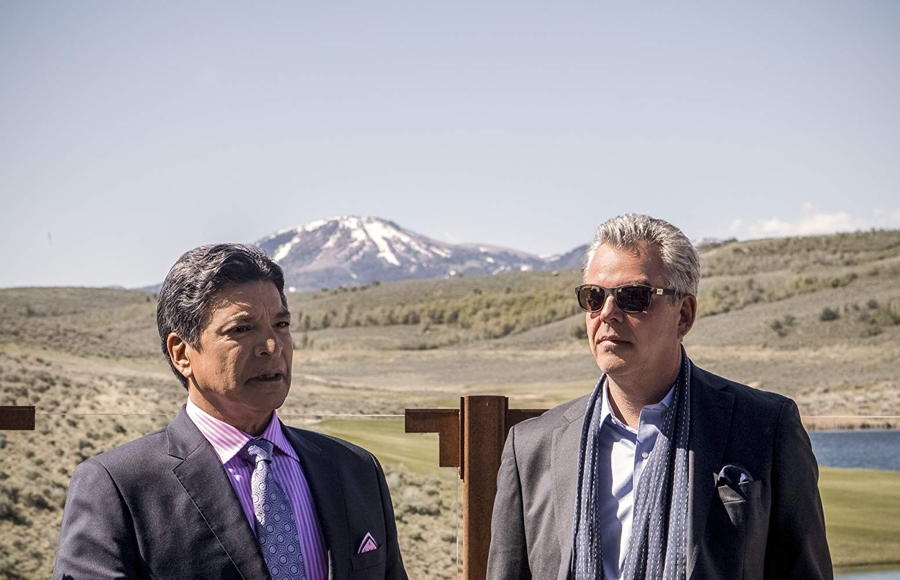
The ‘inciting incident’ in episode 1 sees a relatively small group of Dutton livestock somehow crossing the boundary into the reserve. Dutton wants the cattle back but the new tribal chief Thomas Rainwater (Gill Birmingham) decides to keep hold of them. Later we will realise that he has ambitious and ingenious plans to recover the lost lands of his people from the Duttons. Just to make the situation more difficult, Kayce Dutton finds himself caught in a tricky situation between the two sides. Kayce, the youngest Dutton, is an ex-Navy SEAL and a young man who always seems to get into trouble despite his best attempts to ‘do the right thing’ and as a trained soldier he is equipped to do damage to any enemy. As a young man, Kayce formed a relationship with Monica (Kelsey Asbille), a girl from the reserve and they had a child, Tate. As John Dutton’s grandson Tate is potentially the ‘next generation’ rancher. It’s a clever move to create both the possibility of tension between the Native American and settler families and the unlikely possibility of some kind of reconciliation. Monica is a teacher and a modern young woman – something of a challenge for John Dutton to accept.

I’m not going to reveal any more of the plot points and instead I’d like to explore the fascinating mix of genre elements and the ways in which audiences seem to have engaged with the show. The ‘ranch Western’ is a well established genre category. Ideologically the ranch represents the coming of ‘settler capitalism’ to the West and ranchers are the bad guys in many Westerns with their seizure of land and investment in cattle imposing an economic conflict on the frontier. This all came to a head with Michael Cimino’s Heaven’s Gate in 1980 with its theme of the capitalist and proto-fascist forces of the large landowners in Wyoming trying to suppress the immigrants in the region. I’m a big fan of this film which was trashed on release, presumably because it spoke a truth about American history. John Dutton is a descendant of these landowners. The series also reminds us of Alan J. Pakula’s Comes a Horseman from 1979 with Dutton a later version of Jason Robards’ character in that film. In the 2020s, the Duttons’ cattle are no longer the economic centre of this story (we see only a little of the work with the cattle and not enough to convince us that they form the financial basis of the ranch). More important is the huge area of the land owned by the family. This may be their downfall. Their enemies can plot to increase land values that will in turn increase the property taxes for the Duttons. The Duttons need to consolidate power through public office. But it may well be the internal family melodrama that catches them out. Beth and Jamie are key to this narrative development, she with her corporate share-dealing skills and he as a lawyer with plans to run for public office.

I’m not sure when the next four seasons of Yellowstone will appear on Freeview TV in the UK. Season 5 has not been completed because of the writers/actors’ strikes in 2023. I will be interested in what happens in all four seasons , but I’m also happy to stop after this first season which seems to have achieved a great deal. I note that from the few audience responses I’ve seen, Yellowstone has been hugely enjoyed but also hated by some with criticisms of the characters. For me, Monica and Kayce are the key characters. I’ve never been a Kevin Costner fan but here I think he has been brave to take on the John Dutton role and he does a very good job. If you are in the UK but don’t usually bother with Channel 5, this serial is certainly worth a watch.
 itp Global Film