

The Witch is an adaptation of the 1962 novella Aura by Carlos Fuentes. Fuentes (1928-2012) was a renowned international writer, fluent in Spanish and English and the son of an important Mexican diplomat. He himself became a Mexican ambassador as well as teaching at various leading universities. Since the novella was written early in his career it inevitably draws to some extent on his cultural background.
The Italian title of the film translates as ‘The Witch in Love’. The film also seems to have an alternative English title of ‘Strange Obsession’. It wasn’t released into UK cinemas as far as I can work out.

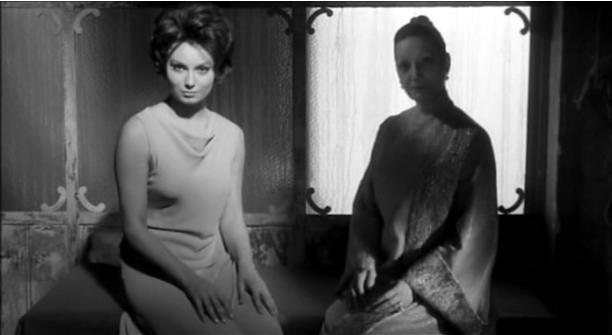
The British actor Richard Johnson, a Shakespearean stage actor particularly active in films in the 1960s, plays Sergio, a writer fluent in three languages. He’s a womaniser and a character who might not attract much sympathy these days. One morning when he is moving between two of his conquests in Rome, he becomes interested in an older woman who seems to be following him. Eventually, he tracks her down to an ancient palace in need of some TLC. He confronts her and discovers that she is Consuelo Llorente (Sarah Ferrati), a Mexican widow whose husband was a senior Mexican official. She offers him a job organising her library and transcribing her husband’s handwritten diaries, at least some of which relate erotic stories about the love life of the couple. Sergio is at first uninterested but then is surprised by the sudden appearance of a beautiful young woman, Aura (Rosanna Schiaffino). He decides to wait around a little longer.

I’m not going to spoil the narrative development but, given the English language title, most audiences will recognise that Consuelo may well have created Aura as a ‘familiar’. The film is directed by Damiano Damiani, who is mainly known outside Italy for some of his superior genre films – police/crime films and political thrillers. I was attracted to the film because the third main character is played by Gian Maria Volontè, who was about to have a big international success when his second film with Sergio Leone, For a Few Dollars More was released in the UK and US in 1967. In this film Volontè plays Fabrizio the existing ‘librarian’ of the Llorente papers. Fabrizio too is taken by the beauty of Aura and he hopes that Sergio will leave and not return. The middle section of the narrative features a tense triangular relationship between the three younger characters as Consuelo watches on.

I enjoyed the film very much. I was watching one of the four films in an Arrow boxset of Blu-ray discs released in 2022. The print has been restored in 2K and the lustrous black and white photography by Leonida Barboni is a joy. The music score by Luis Bacalov is also very good, particularly in the third and final section which features a Latin beat picking up aspects of the Mexican roots of Conseulo. Much of the narrative takes place in the old palace, which has some modern fittings, but is generally filled with antiquities. It’s a warren of rooms, doors and cupboards on several floors and Consuelo and Aura make sudden appearances that leave Sergio disorientated. All the four principals are very good but I note that several commentators find the film too long at 109 minutes, especially since much of the time the scenes play out as chamber pieces. The action scenes are well staged but take up far less time than the confrontations between characters. Sergio doesn’t know whether he should leave or allow himself to be completely seduced by Aura. There is no overt sexual display but I did find some of the scenes to be erotic, partly because of the costumes Aura wears. Schiaffino is the star of the film and her husband Alfredo Bini was the producer.

The big question about the film is the difficulty of categorisation. The boxset announces a collection of ‘Gothic Fantastico – Four Italian Tales of Terror’. This is certainly a ‘gothic tale’, but any fans of gialli or the other Italian popular genres of the 1960s/1970s may find it rather ‘tame’ because its pleasures are more reminiscent of arthouse films than genre films. On the other hand some arthouse purists might find aspects of the final part of the film to be excessive – as well misogynistic. I note that one reviewer had the same feeling as me – that the film felt at times like one of Joseph Losey’s films such as Eve (Italy-France 1962) or The Servant (UK 1963). There are suggestions that Fuentes didn’t like the adaptation and that he had hoped that Luis Buñuel might adapt it. Certainly, there are strong links to the kinds of surrealist and psychological material found in Buñuel’s Mexican films of the 1950s such as Él (Mexico 1953) or The Exterminating Angel (Mexico 1962).

As for Gian Maria Volontè, he more than holds his own against the principals, but he is essentially a supporting player. Because I was so taken by Rosanna Schiaffino, I checked through her filmography and she could well be included in the list of European actors who were able to get work in international productions. If there is one type of film that demonstrates how the international film worked it is the Second World War epic in which American GIs meet European women, invariably played by leading beauties. Sure enough in Carl Foreman’s The Victors (UK 1963), Schiaffino appears alongside Melina Mercouri, Jeanne Moreau, Elke Sommer, Romy Schneider and Senta Berger.

I should have mentioned that I watched the Italian audio version with English subs. I thought the Italian dub was pretty good. There is also an English language dub but I didn’t try that. There is an array of extras on the Blu-ray and I found some of these very useful especially in terms of Italian cinema in the 1960s. I also learned that Sarah Ferrati was a leading theatre actor in Italy and this was one of only two cinematic features for her – she mainly appeared in TV films outside of her theatre work. Her very precise movements and speech work well in conveying the ‘other worldliness’ of her character as Consuelo – I wonder if she felt a connection with Richard Johnson through their experiences of theatre? I confess I had almost forgotten Richard Johnson as an actor, largely because the films he appeared in didn’t attract me as a young person. I was surprised to learn that he was briefly married to Kim Novak around the time he made The Witch. He would later return to Italy to appear in other horror films.
I only rented one of the films in the boxset, but I might try one of the other three films at some point. I will return to Damiano Damiani because, also in 1966, he made the rather wonderful Western, A Bullet for the General starring Gian Maria Volontè.
The Witch is also streaming on several of the main platforms in the UK and US, though I don’t know if the Italian version is available. I would recommend the print I watched.
 itp Global Film