

Plan 75 is interesting on many levels, not least because UK distribution of Japanese films is sketchy at best and tends to comprise either the films of a limited number of auteurs such as Kore-eda Hirokazu, Kawase Naomi or recently Hamaguchi Ryusuke and anime or genre pictures such as swordfight films or crime films. Plan 75 is a form of SF, ‘speculative fiction’ and was selected as Japan’s Oscar entry for 2023 after successful appearances at festivals in 2022. It’s also a French ‘minority production’ and together these different facets of the film’s background perhaps persuaded Curzon to bring it to the UK and Ireland. It was released in May 2023 but is still available to stream on Curzon Home Cinema and also on BFI Player which was my choice as a rental offer.
I’m always keen to see Japanese films, especially those made by women since they are still relatively rare in UK distribution. I was, however, a little wary of this title as its subject matter is rather ‘close to the bone’ for anyone over 65 and even more so for those 75 or over. ‘Plan 75’ is the government-sponsored scheme in a Japan only a few years into the future, offering support for voluntary euthanasia to those over 75. Since I suspect that we older film fans constitute a sizeable element of Curzon’s audience, it’s a brave move.
The film begins with an act of violence (presented obliquely rather than directly) which slightly puzzled me until I read in the Press Notes (in French) that it was a reference to an incident in 2016 in which nineteen people were killed and more seriously injured by an ex-worker from a care home in Sagamihara, Kanagawa – part of the Greater Tokyo Area. He denied his guilt on the grounds that people with disabilities don’t contribute to society. This shocking incident is an extreme reaction to a social issue recognised in Japan and several other countries – an ageing population profile. I listened recently to a radio item that picked out South Korea as another country with a major problem in demographic terms, caused by very low birth rate figures. Writer-director Hayakawa Chie in her Press Notes interview suggests that there are aspects of Japanese culture that might encourage ideas such as those in Plan 75:
I have the feeling that the Japanese have a kind of self-sacrificing spirit. Sometimes this is presented as a ‘virtue’ and a ‘modesty’.
Imamura Shôhei’s The Ballad of Narayama (Japan 1983) is one of three films telling the story of a 19th century community in which everyone reaching the age of 70 is taken to the top of the local mountain and left to die. This has been seen as part of Buddhist mythology or ubasute. Hayakawa again:
There is a similarity of spirit between the characters of The Ballad of Narayama and those of Plan 75. In Plan 75, I wanted to show that the government, which does not show its face in the film, manipulates this spirit to set up an inhuman system.
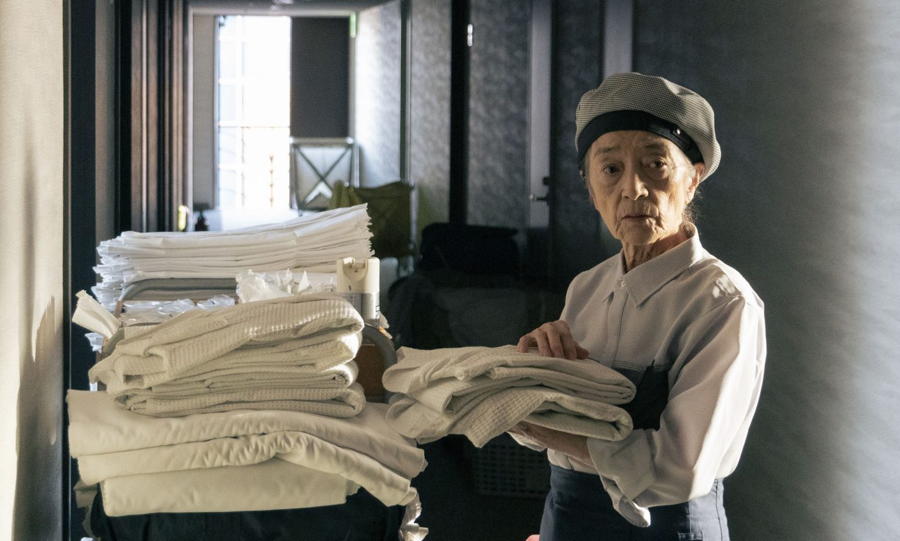
But while there may be a sense of ‘being a burden on the young’ felt by some older people, the social and economic factors underlying the life experiences of a portion of Japan’s older population are equally important. It struck me while watching the film that anyone over 75 in Japan would have been born in the last years of the war and the first few years of the Occupation when it was very difficult for many families. Japan is a rich country today, but in the 1950s its economic miracle was just beginning to take hold and the society was still conservative and traditional. One of the main characters in the film, a 78 year-old woman Kakutani Michi (Baishô Chieko) reveals that as a young woman in the late 1950s/early 1960s she was forced into an arranged marriage and suffered as, in effect, an unpaid domestic servant for her husband’s family. As a result she is now childless and without sufficient financial support.

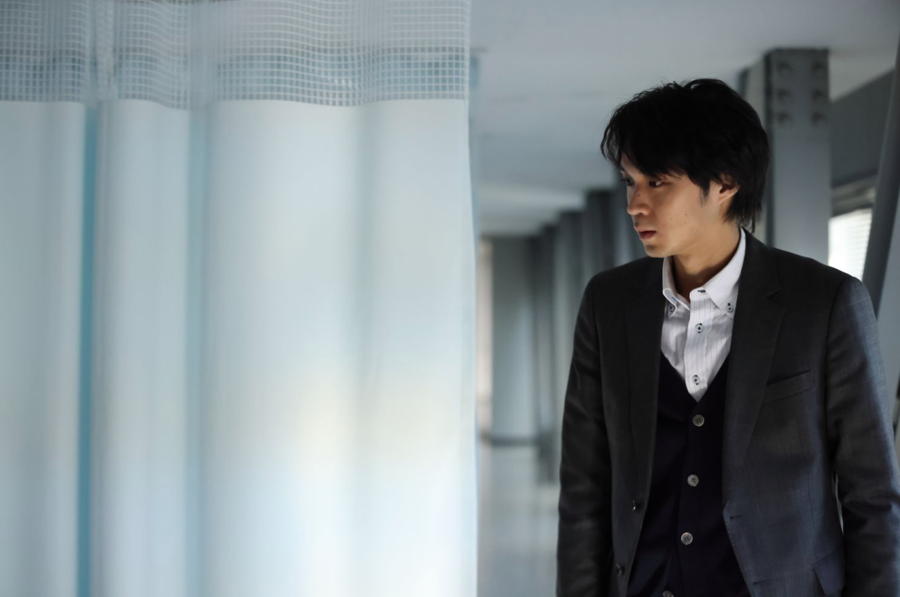
Hayakawa Chie originally wrote a short script for inclusion in a ‘compendium film’ Ten Years Japan (2018) which comprised five stories of roughly twenty minutes each. She then worked with two of that film’s producers, Jason Gray and Eiko Mizuno Gray, to expand her original script to feature-length. In this expanded version there are three main narrative threads associated with ‘Plan 75’. The date when the narrative is set is never specified but there is no attempt to suggest a ‘future Japan’ is going to be very different, so we assume that this is just a few years away. One story involves a young man, Hiromu (Isomura Hayato), who works for the Plan recruiting potential ‘customers’ and organising support for them. One day he realises that one of older people who have applied for the Plan is his uncle Yukio (Takao Taka) who he hasn’t seen since he was a young boy when Yukio and Hiromu’s father fell out after a family row. He becomes involved in his uncle’s case and re-builds a relationship. Kakutani Michi, mentioned above, lives on her own and has been ‘let go’ from her last job. When she realises that she must also leave her modest home and she doesn’t have an income that will cover the rent of a new home, she decides to apply for Plan 75 and enjoys the support she receives from a young female support worker. Finally there is the story of Maria (Sutefanî Arian), a young Filipina with a sick child back home who needs specialist treatment. Maria is in Japan as a migrant worker and joins the Plan staff because the rates of pay are very good. There are nearly 300,000 Filipino migrants in Japan. Unlike many countries in the West, Japan has been a relatively insular society over the last fifty years without mass inward migration of young people to balance the population profile. The three separate stories in Plan 75 are linked in the final section of the narrative.
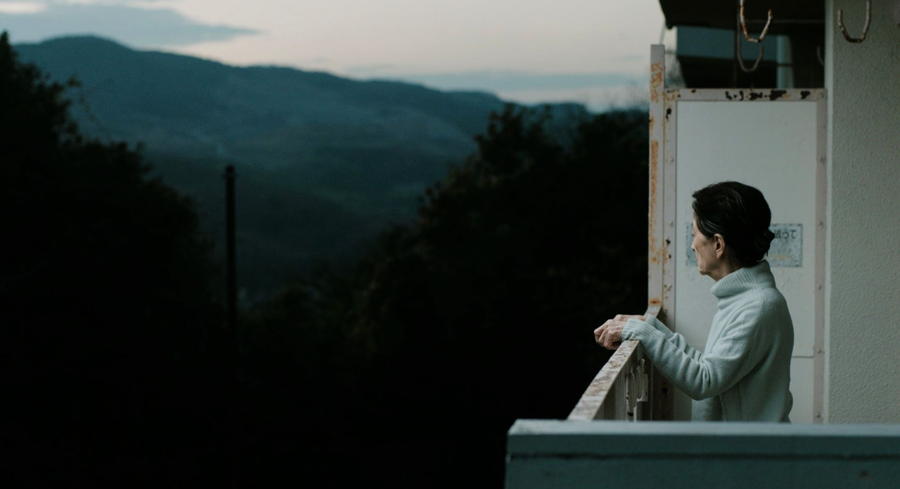
I think labelling this film ‘science fiction’ is misleading but although the pacing and the tone suggest a serious drama, there are narrative elements that are open to generic presentation. Several reviewers make the point forcibly that the film is a condemnation of right-wing governments that want to find a ‘solution’ to the problem of an elderly population that is not productive and becomes a ‘drain’ on public spending. Nobody in the UK is likely to forget the horrendous death toll in care homes during the COVID pandemic – largely because the sector has not been properly funded or fully integrated into the welfare system. In Hayakawa’s film, she is careful to keep proceedings generally calm and to present a programme of euthanasia that is blandly efficient rather than openly terrifying. It is an inhumane system, yet the narrative is built around three instances of Plan 75 workers who break rules and allow human feelings to disrupt the bureaucracy. Inevitably this will cause trouble. I won’t spoil any of the three stories but I will note that they don’t produce a clear narrative resolution. That lack of resolution is itself chilling, but then so is the implication that anyone over 75 has no reason to live. Of course these are the 75 year-olds without money or ‘social capital’, often lonely and part of an increasingly large group in modern capitalist societies – not the 75 year-olds with decent pensions that you or I might know. This is a film that offers a warning to us all. It works because of terrific performances, especially by Baishô Chieko, and excellent music and cinematography. I don’t think we ever learn where the film is set, but mostly it is in cramped interiors, offices and city streets. It’s not until the last section that a natural landscape appears. Finally, I want to note that the post-production of this film was in Paris and it represents another example of film as a major element of French ‘soft power’. This was a minority French production and Unifrance reports that of the 94 films submitted for the International Feature Film Oscar in 2023, 23 were French co-productions.
The trailer below is unusually good – not giving away plot points but offering moments in the narrative that demonstrate the subtlety of this exploration of a potentially explosive government initiative.
 itp Global Film