

The UK release of Last Night in Soho was October 2021 when I was still in personal Lockdown and not prepared to venture out to cinemas, even for a film that I really did want to see for several reasons. Besides it being an Edgar Wright film, I was intrigued to see Thomasin McKenzie in the lead. But just as importantly I was intrigued by Wright’s attempt to represent Soho as it is now and how it was in the mid-1960s. I began to visit Soho regularly from 1967 onwards until the late 1980s. Soho is of interest for several reasons. It was the centre of the film industry in the UK for many years with the head offices of all the major companies and many small preview theatres. It had interesting pubs, delis and small restaurants. It was also the birthplace of UK pop music in the 1950s as well as the most well-known and ‘most represented’ red-light district in the country with more than its fair share of strip-joints, clubs, ‘dirty bookshops’ and brothels. This latter fame meant that many film productions gravitated towards Soho, both as an ‘exotic backdrop’ and a narrative device signalling any number of failings or depravities by characters. But Soho was also like a village with a church, a school and a street market. By 2021 it had been ‘cleaned up’ and gentrified, losing many of its previous ‘attractions’. It’s not so interesting now. If you don’t know London that well, Soho is usually taken to be the block of streets bounded by Oxford Street to the north, Charing Cross Road to the east and Shaftesbury Avenue and Regent Street to the south and west.

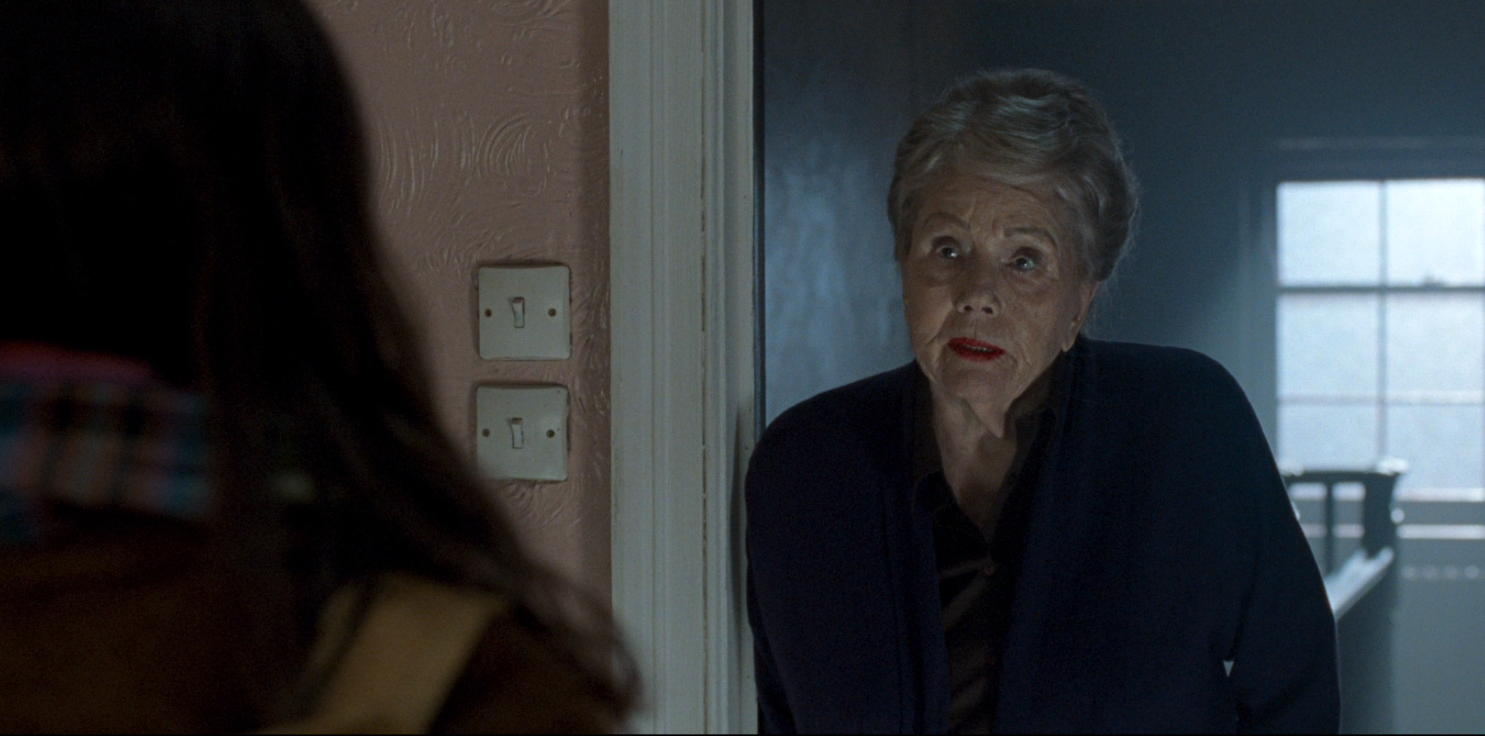
The narrative of Last Night in Soho begins in rural Cornwall in the bedroom of ‘Ellie’ (Eloise) Turner played by Thomasin McKenzie. She is wearing a dress in an early 1960s style, made out of beautifully-cut sheets of stiffened newspaper pages as she dances about to the sound of Peter and Gordon’s ‘A World Without Love’ (February 1964) playing on her Dansette. The detailed mise en scène of her room confirms that she is a would-be fashion designer obsessed with 1960s pop culture. Pretty soon we learn she has been accepted at the London College of Fashion now part of the University of the Arts in London and she gets on a train for the capital. But before that we get a clue that she thinks often about her mother who died when she was a small child and who perhaps had similar ambitions? Ellie has been brought up by her grandmother, played by Rita Tushingham, who herself played a young woman from ‘the North’ who travels down to London in Smashing Time (1967) and in the earlier film The Knack (1965). This new film also includes two other icons from the mid-1960s in the form of Terence Stamp and Diana Rigg. It is dedicated to ‘Diana’ as Ms Rigg died before the film was released.

From this opening we might expect that the film will become a romantic comedy or possibly a form of colourful musical as Wright’s familiar use of popular songs brings us the Searchers’ ‘Don’t Throw Your Love Away’ (April 1964). Only the references to her mother and her grandmother’s clear concern about the London trip offer the slightest doubts. The film is an ’18’ certificate so something is amiss. In the next few scenes Ellie appears to be caught up in all the familiar traps for the ‘country mouse’ arriving in the big city. On the Blu-ray I watched there are several deleted scenes included as ‘Extras’ and one sees her conned by an expert on her first trip on the tube. That was left out of the finished film but we do see her subjected to leering misogyny by a male taxi driver. It’s not until a little later when Ellie decides that her accommodation in a student hall of residence is not for her that the film shifts gear. She finds a room to let in an old house in ‘Goodge Place’ a fictitious street that itself feels part of an older London. The rather fierce landlady who lives downstairs is played by Diana Rigg. The room is large and Ellie’s close to Soho (and to the College of Fashion) but as the neon from the street fills the room at night she feels herself transported to the nighttime Soho of the 1960s and in particular to the experiences of young wannabe singer ‘Sandie’ (Anya Taylor-Joy). At first thrilling, this experience gradually becomes much darker, especially when Sandie meets Jack (Matt Smith), a smirking, Brylcreemed horror who promises to find her an opening. Eventually Ellie becomes haunted by a host of characters. Is this a ghost story or is she suffering not only nightmares but also constant hallucinations, perhaps brought on by mental breakdown?
Last Night in Soho reportedly cost $43 million dollars, the money probably spent on music rights and special effects as well as elaborate sets. It was first unveiled at the Venice Film Festival, then Toronto and soon after for a US/UK release in October 2021. It was a prestige release with Edgar Wright again being asked to curate a British Film Institute mini-season at BFI Southbank titled ‘London After Dark’, featuring many of the films that inspired his ideas about Soho in the 1960s. The film market was very flat in 2021, struggling to bounce back from the pandemic in many territories, so it isn’t surprising that Last Night in Soho made only $22 million worldwide at the box office. Physical media sales and rental may have contributed another $1-2 million but revenue from streaming or digital download is not available. We therefore don’t know if the film was a major financial failure but it certainly looks that way. What’s the problem? The split evident in the film’s reviews is the obvious starting point. Reviewers who like Wright’s previous work tend to go with this slight change of direction. Those who were not so committed to the previous films find that it doesn’t work, most citing the shift to what is in effect full blown horror cinema in the giallo tradition of Dario Argento or Mario Bava. Argento’s Suspiria (Italy 1977) is just one of the titles mentioned in reviews. Several reviews suggest that the final resolution of the narrative doesn’t make sense. I can understand why audiences might not like the shift to this kind of horror, but I think the narrative is quite coherent in a structural sense even if this is fantasy rather than realism-based horror.

Wright began his feature film career (after a successful career in TV) with Shaun of the Dead (2004) and its mix of comedy and horror that met widespread acclaim. His skill at blending genres carried him through mainly successful later features which brought him appreciative audiences and both critical and commercial standing. Most of his films include comedy and a relatively light touch. Baby Driver (2017) perhaps began to push the violence further forward in the mix and increased the bravura stylistic turns and the carefully structured use of popular music. Horror is a tricky genre in any form of genre mix. Relatively cheap horror aimed at a 15-25 audience can do very good business but bigger budget horror is more risky and if it is combined with the kind of cinephilia displayed by Edgar Wright it can become too much for mainstream audiences. I’m reminded of another relatively big budget film, not mentioned by any reviewers I’ve read, probably because it isn’t a horror film. Absolute Beginners (UK 1986) is about Soho and the music industry in 1958 and is presented as a British musical. It was seen as a flop at the time for the relatively inexperienced producer-director pairing of Stephen Woolley and Julien Temple.
Edgar Wright’s Soho of the 1960s is certainly recognisable for me and I particularly enjoyed the alleys or ‘ginnels’ as they are known in Northern England, the narrow passages between buildings that allow access to parallel streets. During the pandemic, Wright also filmed the empty streets of Soho today and these appear in the closing credits. His knowledge of the Soho films of the 1960s is well to the fore but is probably not shared by many in his audience. They might be more impressed by his visual flair, aided by the cinematography of Chung Chung-hoon (best known for his work with Park Chan-wook), production design by Marcus Rowland and especially costume design by Odile Dicks-Mireaux. The main problems apart from attitudes towards horror are more to do with contemporary concerns over #MeToo and questions about diversity. Wright had been tagged by some commentators with accusations of a mild form of ‘laddishness’ in his earlier films. In this film there are four key roles filled by women and three by men, one of whom is marked as the bad guy. Thomasin McKenzie is terrific and more than lives up to the promise shown in Leave No Trace (US 2018). Anya Taylor-Joy is very good in a role which doesn’t allow her much scope beyond ‘performing’ as a singer/dancer. Rita Tushingham and Diana Rigg live up to their icon status. But some reviewers still find Wright as an unconvincing creator of female roles, despite sharing the writing with Krysty Wilson-Cairns (highly praised for 1917). I’m not going to comment further on these representations but there are plenty of women who have written reviews, some pro, some anti.

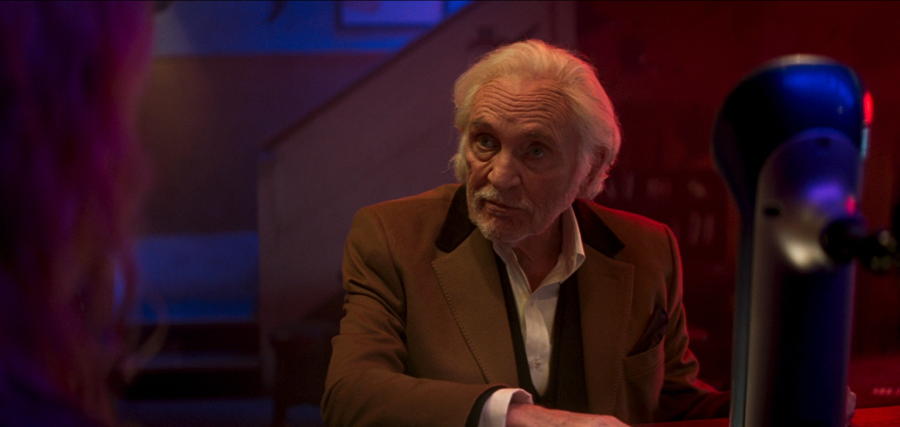
Terence Stamp (as a 1960s survivor who seems threatening to Ellie) and Matt Smith both seem well-cast but the third male character, fellow student John (Michael Ajao), is perhaps more problematic. John is a mild-mannered and clearly ‘nice’ young man, whose help Ellie first dismisses but later accepts. He will become her friend in need and more. But as a young Black British man from North London he is the only non-white character of any significance in the film. He could be seen as ‘bearing the burden of representation’ and this clearly caused a problem for at least one reviewer. I also think the writing here has missed a trick. Soho in my memory was always a diverse community, especially in the 60s when the music clubs attracted visiting American and Caribbean players and mixed audiences. Alongside this the film also doesn’t represent the sex industry of the 1960s which at the time was controlled by Maltese gangsters. Soho had always been a centre for European migrants since the Huguenots in the seventeenth century and later the Greeks and Italians.
It’s unfair to expect Wright to recreate every aspect of Soho but issues like diverse casting are important. As one reviewer suggests, it feels odd that Ellie’s student group seems almost entirely young white women and the sole young black man. This isn’t quite true but we get only glimpses of college life, The lack of openly gay characters also seems odd for fashion and for Soho. The music tracks chosen for the film, like the filmic references, seem spot on. ‘Eloise’ for instance is a 1968 song sung by Barry Ryan and written by his twin brother Paul. The twins were the sons of Marion Ryan, a singer from the 1950s who became nationally famous through her many TV appearances. The only problem is that the audience who know all the songs would probably be put off by the giallo elements.
I’m not sure I ‘enjoyed’ the narrative but I did enjoy all the musical and filmic references, especially the several Michael Powell references and the allusions to Catherine Deneuve in Repulsion (UK 1965) and as an example the technical skills of filmmaking and the richness of Soho’s cultural history, this film didn’t disappoint me.
 itp Global Film
‘Ginnels’ is a new word for me, thanks for that. I find Wright’s particular grab-bag of influences really resistable, but would agree that the technical spec here is great. But I think I’d rather see a doc on Soho itself.
LikeLiked by 1 person
A ‘ginnel’ is a dialect word used in Yorkshire and Lancashire for a narrow alley between two high walls of buildings as distinct from the wider alley between two rows of terraced houses.
I read your review so I knew what to expect. There are actually many ‘documentaries’ on Soho in the 1960s.
LikeLike