
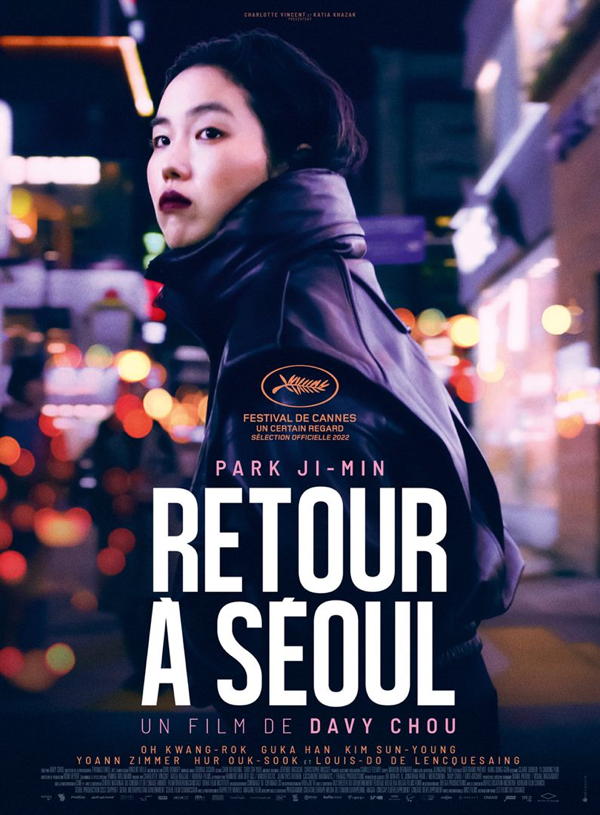
I started watching this film with little idea of how the narrative would develop. All I knew was that a young woman returns to Seoul from Paris. The narrative is in four sections covering different time periods over eight years. The narrative opens with a scene intercut with the title credits in which Tena (Guka Han) is listening to music on her headphones. She looks up and sees she has a guest. Later we understand she is working the desk at a hostel/guest house. The new arrival is Freddie (Frédérique) and the conversation between the two swiftly moves from Korean to English as Tena realises that Freddie, although she looks Korean, might be American? The scene then cuts swiftly to a bar/restaurant where Tena and a young man are entertaining Freddie and they converse in French. Tena is the daughter of a French teacher and the young man, Dongwan has studied Asian and French literature. This rather complex opening is partially explained by the background of the writer-director Davy Chou who was born in France to Cambodian parents. The film is a 70% French production with 20% German co-funding and smaller contributions from Belgium, Cambodia and Qatar. There is a much stronger filmic relationship between East Asian cultures and France than with the UK or even the US. I think this is possibly because of the way French cultural policy is used directly to develop ‘soft power’. In turn cineastes in the region also often look to French models of filmmaking and especially co-production. With this film we have the perfect match of this general cultural tendency with the specific instance of diasporic concerns. (Currently, South Korea is the best film market outside Europe for French films.)
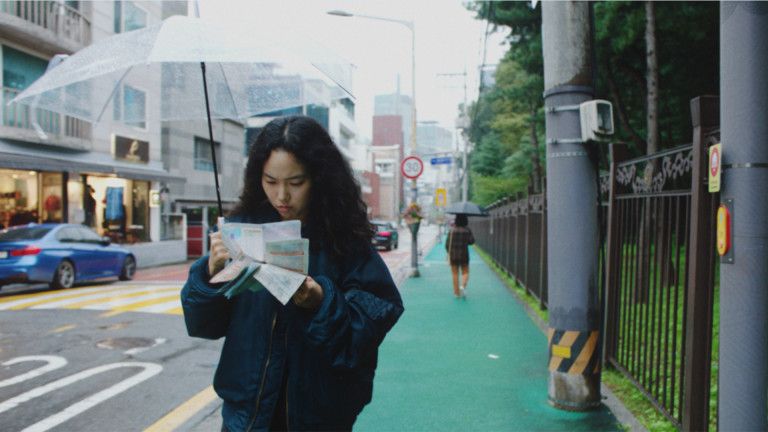
Quickly, in the first restaurant scene, Freddie’s background – adopted as a baby and leaving South Korea – is raised and she produces a photograph of the woman she thinks is her biological mother. It is only later that we learn that her appearance in Seoul is mainly by chance – she was supposed to be going on holiday to Japan but that had to be cancelled and the travel company offered her a flight to Seoul. We follow Freddie’s experiences finding her father during this first part of the narrative then we jump forward two years and then five years and finally one year. I won’t spoil the narrative pleasure with more detail of the structure.

In the early scenes, I wondered if this would be a familiar diasporic ‘culture clash’ narrative in the way Freddie reacts to Korean mores and displays her ‘Frenchness’. When she met her biological father I began to think that perhaps a Kore-eda Hirokazu-style family melodrama was going to develop (i.e. as in his Korean adoption story Broker). But this film is neither of those – though there are some elements in common across the three films. The press notes reveal that the director came to the story through a friend who was herself a Korean adoptee in Paris. She accompanied him to South Korea to show him ‘her country’ and provided personal insights into an ‘authentic story’. The director says that though he isn’t Korean, or a woman and he hadn’t been adopted, he did have his own experience of visiting Cambodia to draw on. The last part of the set-up is that Park Ji-Min, who plays Freddie, left Korea as an eight year-old and has since been living in France, but she is not an adoptee. She is a ‘plastic artist’ and not an actor. Chou spent three years with her developing the script as well as consulting other Korean adoptees. Park challenged many of his ideas and her character is certainly not a familiar generic type.
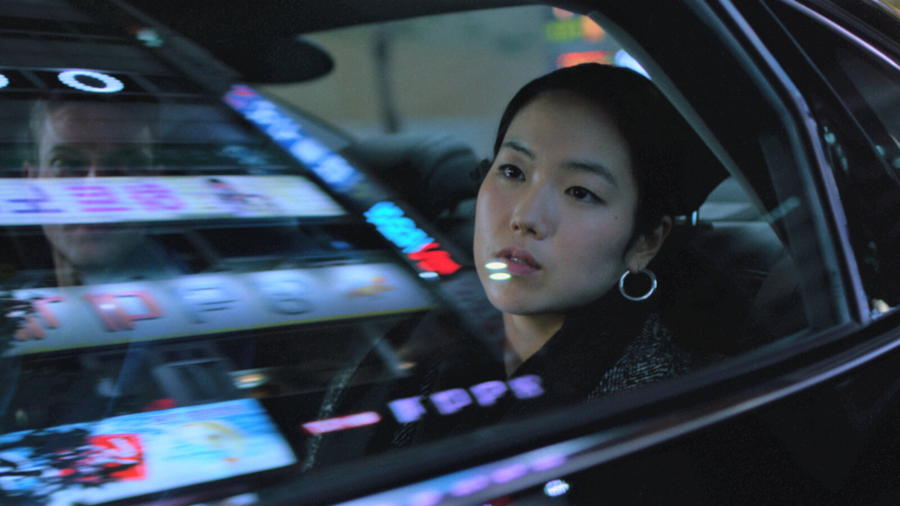
This is a very interesting and sometimes very affecting film, but it is complex as Freddie tries to re-invent herself and to deal with both her strong personal beliefs and her vulnerabilities. I confess that in the first section of the film I thought Freddie was quite rude and uncaring in the way she treated some of the people she met and I was particularly sorry for Tena who had to put up with quite a lot. It had been suggested to Chou that he should use a Korean actor as Freddie but he thought her French identity was important and later in the film when she develops a working relationship with a French businessman (played by Louis-Do de Lencquesaing, a well-known French actor) it becomes even more relevant. The cinematographer on the film is Thomas Favel who shot Davy Chou’s 2016 feature Diamond Island set in Cambodia. I have seen comments that Return to Seoul doesn’t look like it was specifically shot in South Korea and that it might have a universal feel. I’m not sure about that and I’ve included a still image here from a scene in which the older Freddie gets in a car to go to the ‘entertainment district’ in Seoul. That image made me think of numerous East Asian/South-East Asian films. Another reviewer suggests that the cinematography changes over the course of the film, partly perhaps because of how Freddie changes and partly how South Korea changes over time?
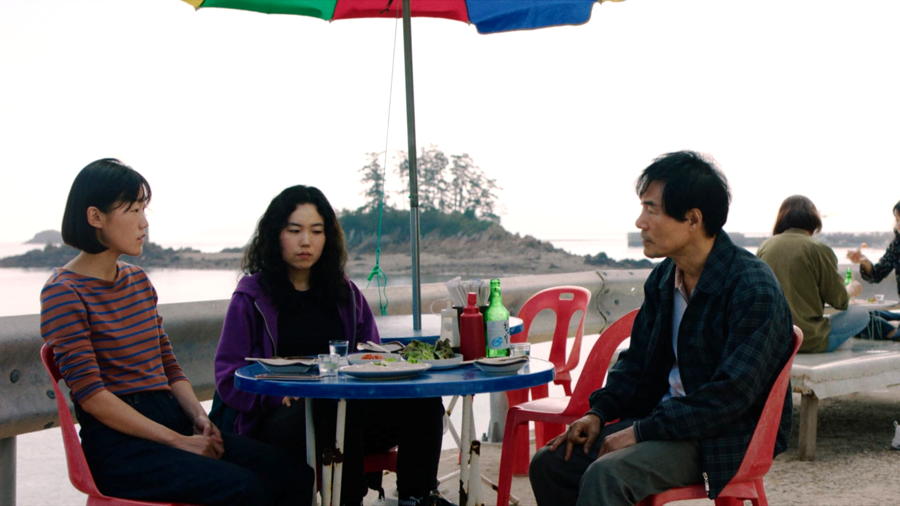
Hannah McGill in Sight and Sound (May 2023) makes a number of interesting observations in reviewing the film. One is about South Korean drinking culture which here has a double function both in terms of its etiquette, which Freddie rejects, and also the links it makes between Freddie and her father, both of whom seem to drink to excess, at least in the first half of the film. Drinking soju, a form distilled liquor which features in the first restaurant scene is also interesting as a marker of the social class difference between the adult Freddie and her father. She drinks soju as part of getting to know the group of young people but later reveals far more sophisticated tastes. Her adopted family have clearly given her a solid middle-class upbringing, though we get only a few clues as to how it worked out for Freddie. Her father drinks cheap liquor because he can’t afford much more as a working man. One of the unspoken issues that lies behind Freddie’s struggles to understand her Korean biological family is the rapid development of the South Korean economy and the big changes in society that took place after the political struggles of the 1980s, which would have certainly been experienced by her father and his parents.

Davy Chou handles scenes confidently and with skill, using two techniques to help develop our understanding of Freddie’s behaviour. One is to hold the camera on Park Ji-Min in particular for a significant amount of time after she has spoken (or has been spoken to), as if she is thinking about what has been said, but also perhaps so that we might think about it. Initially I found this helpful but later in the film I sometimes found it irritating. The other technique involves his use of music, of different types, but mainly Korean music. Sometimes the music helps to articulate what characters might be thinking and sometimes it is more directly part of the narrative such as when Freddie dances in a bar.
Return to Seoul is well worth seeing – and thinking about. In the UK it was only released in cinemas a few weeks ago and may still be available on some screens. It is now streaming on MUBI and can be seen on Amazon via the MUBI app. It has been widely distributed internationally and is currently the fifth highest box office earner for French films abroad, available in 12 countries according to Unifrance. Here’s a clip featuring the first restaurant scene.
 itp Global Film
I caught this at Pictureville several weeks ago and did find the protagonist a tough lady to develop any sympathy for, which I think was partly the point because of the tough exterior developed by the displaced lead character. She is surrounded by entirely more relatable characters. Towards the end when the shell has been cracked the film improved for me. It is certainly an insight into a different culture.
LikeLike
Yes that seems like a fair comment.
LikeLike