

‘A Generation’ refers to the young men and women who were teenagers in Occupied Poland in 1942-3 fighting against their Nazi oppressors and in the mid 1950s (if they survived) trying to re-build Poland, then part of the Soviet bloc in a new Eastern Europe slowly emerging after the death of Josef Stalin. (The Polish title translates as ‘Generation’, I think.) Although the film was adapted from a novel by Bohdan Czeszko, who also wrote the script, it was directed by Andrzej Wajda in collaboration with several of his fellow graduates from the Łódź film school. Wajda had been 19 in 1945 and this was his feature film début at 27 when he took it on in 1954. He was one of the first directors of the so-called New Polish cinema and would go on to be one of the most important European filmmakers of the post-war era, whose work stands as a testimony to the struggles of the Polish people. In doing so he became known and celebrated across the world.

This film is now available as part of a 3-film Blu-ray boxset in two slightly different packages from Criterion in the US and Second Run in the UK. I watched the Second Run disc. The film on the Blu-ray disc is accompanied by an important selection of ‘Extras’ – a 2005 statement to camera by Wajda himself, an introduction by Michał Oleszczk and a commentary audio track by Michael Brooke. There is also a 6 minute 1951 short film by Wajda. These extras are essential if you want to understand the context of the film’s production, distribution and exhibition in Poland and in the international film market. The film was the first of a trilogy of films about the period from 1942-45 by Wajda and was followed by Kanal (1957) and Ashes and Diamonds (1958). He returned to the wartime period several times in his long career, culminating in a personal emotional peak with Katyn (Poland 2007), about the mass execution of Polish officers by the Red Army in 1940. Wajda’s own father was one of those who ‘disappeared’ at Katyn when Andrzej was a young teenager.

In 1954, Polish cultural policies were still under heavy pressure from Moscow to conform to the strictures of Soviet ‘socialist realism’, Stalin’s dubious ‘gift’ to film aesthetics. Although Stalin was now dead, the strictures were still in place but there was some leeway which Wajda exploited. There are two aspects in which A Generation can be seen as creating a tension between the ‘official line’ and a more open type of historical drama. The first is aesthetic. ‘Socialist realism’ was never intended to be ‘realist’ as such but instead to represent working men and women as heroic in their struggles on behalf of their communist society. Wajda in the early 1950s was, by contrast much taken (like many of his contemporaries worldwide) by the achievements of the Italian neo-realists such as De Sica, Rossellini and Visconti. This is evident in the opening shot of A Generation which comprises a single 4 minute take slowly tracking and panning across a slum area on the western edge of Warsaw. Socialist realism was generally studio-bound and required carefully posed images. Wajda freed the actions of his characters, making excellent use of location shooting wherever possible.
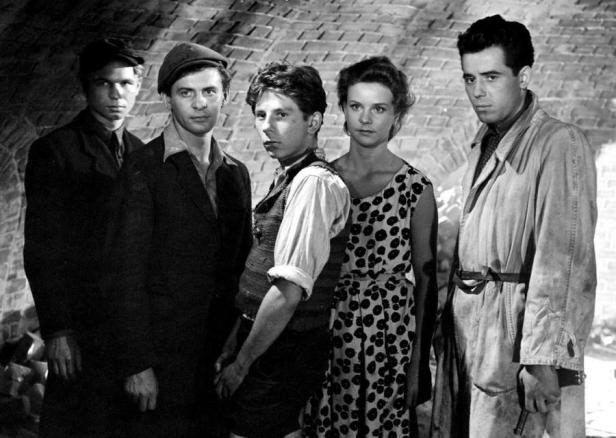
The other aspect of the film was also controversial and arguably more problematic. The orthodox approach in 1954 demanded adherence to the general ideological stance of the Polish Communist Party. The protagonist should be a loyal worker and any opponents should be identified as the villains in the narrative. Wajda decided to follow this line and the two central protagonists are Stach and Jasio. Stach (Tadeusz Lomnicki) is a young man first seen trying to steal coal from a moving train guarded by a German sniper. This doesn’t go well and instead he becomes an apprentice in a furniture factory that makes bunk beds for the German occupying forces. In the factory and at night school he gradually comes to see what might be achieved by joining a resistance group. Jasio (Tadeusz Janczar) comes from a family that seems a little better off and he is a more volatile character who is less disciplined in his actions to support the ‘People’s Army’. The situation in Warsaw under Occupation was quite complicated. There were essentially three main resistance groups. The Jewish population within the Warsaw ghetto attempted to defend itself and then to initiate an armed uprising. The People’s Army was the communist organisation while the ‘Home Army’ was the largest group and comprised traditional right-wing groups who looked to their government in exile in London. Stach identifies the Home Army leaders in the factory who are visually signed as, if not the enemy then certainly not comrades in arms.

Whereas Wajda’s aesthetic decisions offended the official line, his adherence to the ideology offended both parts of his possible domestic audience and many of the audiences abroad and certainly in the US. But although the film struggled to get into cinemas because of interference by the authorities, it did find audiences eventually both in Poland and internationally. In the UK, as was common in the 1950s, it took several years to achieve a release but the reviewer in Monthly Film Bulletin July 1960 gave it a favourable review when it opened at the Academy on Oxford Street. Sight and Sound gave it its highest three star rating in its thumbnail review. Ironically, it opened after the third film in Wajda’s trilogy, Ashes and Diamonds (1958) which reached the UK in 1959.
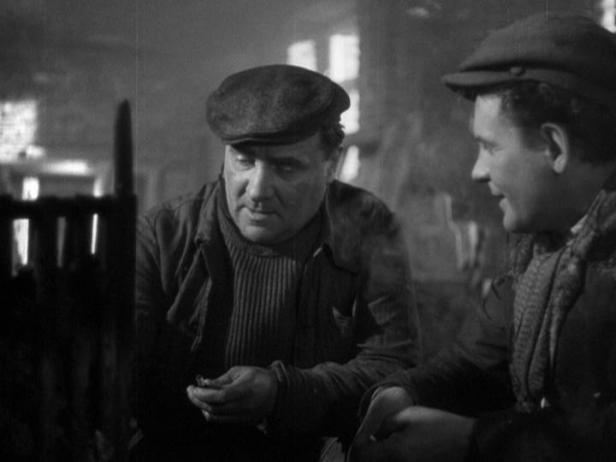
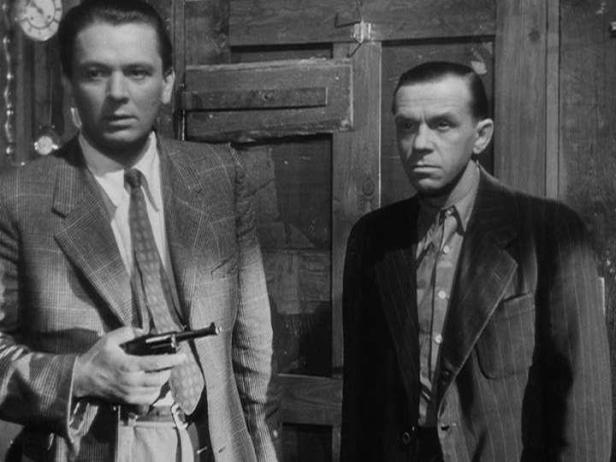
Wajda would go to construct his career throughout the changes in the attitudes of Polish Communist leaders (i.e. the shifts between greater freedom and more restrictions) up to the era of Solidarnosc and its role in the downfall of the communists in 1989. Wajda became adept at exploring issues through the use of metaphor and complex characterisations. Outside Poland he came to be aligned by audiences with the humanist global filmmakers such as Kurosawa Akira and Satyajit Ray who dominated art cinema in the 1950s and 1960s alongside other leading European auteurs such as Ingmar Bergman and Federico Fellini. After 1989 Wajda directed several films that appealed to a more popular nationalist Polish audience. He also expressed regret that audiences became less inclined to watch the kinds of films he had made under the strictures of the communist state. Here’s an answer he made to an interviewer’s question about ‘political filmmaking’:
Interviewer: Why were such fantastic films made during the communist years in Poland, and now that everything is free, Polish films are so weak?
Wajda: In a totalitarian state, in one where fictional elections mean that people have no political representation, artists become their voice. For years and as far as our capabilities, talent, and political situations permitted, we tried to be the voice of Poles. Political cinema requires a large audience. The artist cannot lean out the window and call out to society. How many people will hear? (Unfortunately the website from which the quote is taken, http://www.wajda.pl/en/wywiad80.html is no longer available. Wajda died aged 90 in 2016.)
What all of this means in terms of A Generation is that Wajda focused on the actions of Stach and Jasio rather than presenting an ‘official line’ directly. Stach carries us through the overall narrative which sees him attracted to the People’s Army partly because of Dorota (Urszula Modrzynska) the young woman who is a local organiser for the group and through Sekula (Janusz Paluszkiewicz) the older worker at the factory who befriends Stach and who has a more senior role in the People’s Army. We learn more about Jasio’s background and this helps us to identify more strongly with him as he takes on German soldiers in an attempt to support fighters in the Jewish ghetto. This extended action sequence makes full use of location shooting and proved quite influential in introducing Wajda and his team to audiences.
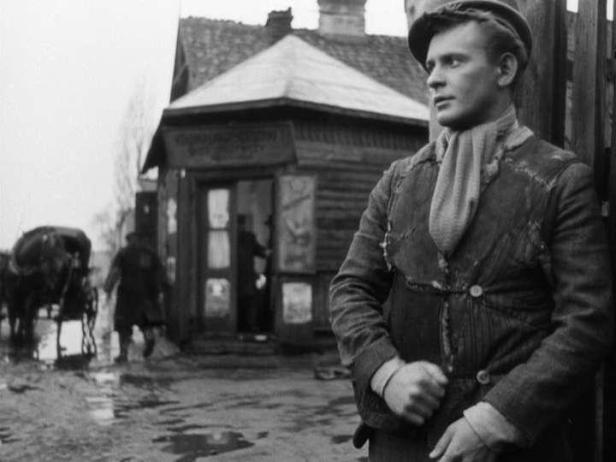
For anyone wanting a more extended discussion of A Generation and the history of its production context, I recommend the Criterion Essay by Ewa Mazierska (2005) in which she discusses a third cultural strand to add to the official socialist realism and Wajda’s adoption of neo-realism. This is ‘Polish romanticism’ which she identifies in Wajda’s approach. Romanticism in this case is also supported by the humanist touches. Stach is very much attracted by Dorota and at one point, the camera captures Stach unawares framed in a photographer’s backdrop used for wedding photographs. Stach and Dorota meet for the first time outside a building where a wedding party is emerging. The music score is also important in this regard.
Here is Wajda introducing his début film. I enjoyed watching it very much and I will at some point rewatch more of a director I’ve always admired.
 itp Global Film