
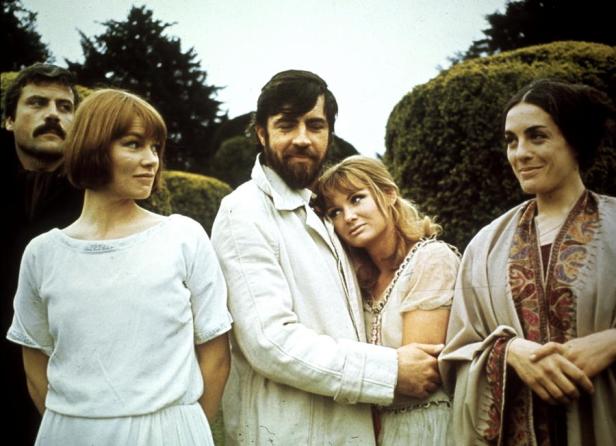
So many filmmakers of the post-war period have died recently that it is impossible to pay tribute to all of them, but I’m going to try to include a couple of Glenda Jackson’s films after her death earlier this month. I’d also like to add to my recent Harry Belafonte tribute, but that will have to wait for a while.
Glenda Jackson (born 1936) will always be important to me as a working-class girl from Birkenhead who fought her way into RADA and became one of the UK’s most celebrated actors of stage and TV screen. For a period she was also an international film star, headlining films that were prominent at the box office and winning two Oscars. I didn’t watch her on the stage or on TV (I tended to watch relatively little TV in 1970s and 1980s and I was never a fan of the classical/historical dramas in which she was cast). My appreciation of her career in film is based on only a few titles and now is a good time to revisit some of her work and experience for the first time one or two more. In 1992 Glenda Jackson turned her lifelong support for Labour into an acceptance of a nomination as candidate for the party for the constituency of Hampstead and Highgate. She then spent 23 years as an MP before standing down in 2015. She was ‘Old Labour’ in terms of her commitment and recognition of the importance of her roots and a loyal and hardworking member of the party.
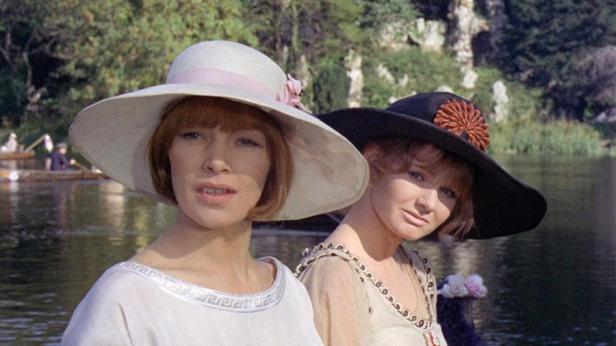
Women in Love is an adaptation of the novel by D. H. Lawrence, first published in 1920. The film was scripted by Larry Kramer and directed by Ken Russell. Lawrence was arguably a more well-known literary figure in the 1960s than in subsequent decades, largely because of the coverage of the ‘Lady Chatterley’ trial in 1960. In 1960 Penguin books published an unexpurgated edition of Lady Chatterley’s Lover (1928) and was subsequently charged under the Obscene Publications Act 1959, a new law that allowed publishers the opportunity to mount a defence of a publication on the grounds of literary merit and a contribution to the public good. When the publisher ‘s defence was successful, the book sold 3 million copies and for the population as a whole the name ‘D. H. Lawrence’ was linked to sex and sexual relationships. I remember a copy wrapped in brown paper appearing in my school classroom soon after the trial. In 1960 a film adaptation of Lawrence’s Sons and Lovers was produced in the UK and directed by Jack Cardiff. The first adaptation of a Lawrence novel for the cinema, this was a commercial and critical success. Another Lawrence adaptation, of the 1922 short story The Fox in 1967 was followed by a second short story adaptation of The Virgin and the Gipsy (1930), released in 1970. TV adaptations of the Lawrence novels tended to come later.
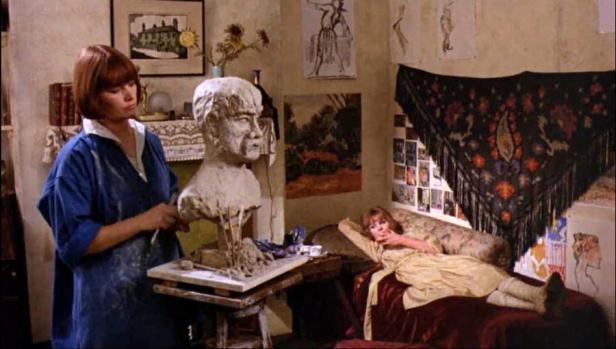
Lawrence’s novel from 1920 was adapted with a slightly different timescale than in the novel. The Brangwen sisters Gudrun (Glenda Jackson) and Ursula (Jenny Linden) are schoolteachers in the immediate post-war period of the 1920s in a small East Midlands mining community. They become involved with the heir to the local colliery business in their East Midlands town, Gerald Crich (Oliver Reed), and his best friend Rupert Birkin (Alan Bates). The drama that develops around the four of them presents a discourse about gender and social class difference. Gudrun has a relationship with Gerald and Ursula with Rupert. The Brangwens are a lower middle-class family. Mr Brangwen teaches craft skills, Gudrun teaches art and Ursula we see with a class of younger children. Rupert is a schools inspector and when they first meet him he appears to be in a relationship with a rather pretentious upper middle-class woman, Hermione (Eleanor Bron). Gerald thinks of himself as a ‘modern employer’ when he takes over the management of the Crich family colliery – but this means he is simply less paternalistic than his father and that he looks forward to replacing men with machines. Rupert is partly modelled on Lawrence himself and he and Gerald argue philosophically about love and marriage. Meanwhile, their relationship is underpinned by a strong homoerotic attraction, represented visually by the famous naked wrestling match they stage, lit only by firelight.

Gudrun and Ursula also discuss love and marriage, but not in any moralistic sense, but rather as part of exploring what life and the world has to offer. They seem very much like the ‘modern women’ of the 1920s who are at this point not married and still living at home, although this is no doubt partly due to the number of eligible men having greatly diminished during the Great War. Gudrun is, in some ways, the most provocative character though Rupert is the one whose behaviour is the most challenging. In her useful essay on the film on the Criterion website, Linda Ruth Williams points to the several ways in which Russell’s film from the end of the 1960s connects directly with Lawrence’s story written in the 1920s. Rupert is almost ‘hippyish’ and his ideas about sexual liberation fit alongside the the fashion sense of the young women presenting the 1920s almost as if in dialogue with the new fashion sense of the late 1960s.
I remember seeing the film in the summer of 1970. It is a strong memory because I saw it on the Charing Cross Road in a double bill with Truffaut’s Stolen Kisses (Baisers volés, France 1968). It must have been a long programme for a sunny day. Although several scenes from Women in Love stuck in my memory, I was actually much more taken by the Truffaut film. I identified with Jean-Pierre Léaud and I can date my interest in art cinema and the French New Wave from that experience. At that point, I hadn’t seen Glenda Jackson before and although I was aware of the controversy surrounding Ken Russell as a ‘provocative director’, I had not watched his TV films or his first two features. I was intrigued therefore as to what I would make of Women in Love fifty years on.

Ken Russell (1927-2011) was an important figure in the history of British film culture for several reasons and my colleague Keith Withall discussed his career in a posting on this blog in 2012. Russell fell foul of the arbiters of cultural taste in several ways. As far as the general public was concerned it was his clashes with both the BBFC and the BBC that were most visible. In this respect, Women in Love with its full frontal male nudity as well as its conventional but less coy bedroom scenes was remarkable but was also arguably Russell’s one moment when his provocation was met with widespread public approval. I’ll just pick out two other ways in which he provoked. During the 1960s he worked on ‘arts documentaries’ experimenting with ways of using music, performance and art design to present the lives and works of music composers and visual artists. This, amongst other things, threatened the traditional hierarchy of British cultural preferences. Russell was using a ‘low culture form’, film and television, to present high culture – classical music, fine art etc. Not only that but he did it while mixing ‘fact’ and fictionalised sequences. Finally, Russell’s overall approach was seen as akin to the anti-realist, fantasy and ‘whimsy’ of other despised directors and genres of British Cinema, such as horror, that offended against the strongly realist stance of British film criticism, still in place in the 1960s and 1970s. Ironically one of those directors, Michael Powell, was ‘recovered’ and celebrated by film scholars in the 1970s and 1980s and other aspects of what Julian Petley once described (in 1986) as the ‘Lost Continent’ of British Cinema such as Hammer horror films have also been given their proper due. But not poor Ken. After Women in Love, he remained somehow marginal despite making films for Hollywood studios and working with major stars. Several of his films became difficult to see on curtailed releases or only in cut versions. He remained popular with his fans and sometimes with larger audiences when the films connected more directly with popular culture (e.g. Tommy in 1975).

A whole baggage of criticism, controversies and assumptions accompanies any attempt to view Russell’s work now. Glenda Jackson and Oliver Reed became two of Russell’s frequent collaborators over several years and that’s another reason for thinking carefully about Women in Love. I enjoyed my recent viewing, though perhaps I should have gone for the full BFI Blu-ray treatment to really get the benefit of the cinematography by Billy Williams, the music score by Georges Delerue, the art direction by Ken Jones and the costume design by Shirley Russell (married to Ken at the time, I think). The film looks terrific. It’s as if Russell and his team manage to take the the standardBritish cinema/TV historical drama and re-vitalise it, finding real energy in the locations and costume designs. The credits suggest that the team scoured the North East of England to find back streets, mining villages etc. as well as country houses that look ‘authentic’. The miners emerging from the colliery are suitably dirty and the trip on the tram (filmed at the National Tram museum in, ironically, the Derbyshire village of Crich) immerses us in the working-class world of Ursula and Gudrun very effectively.
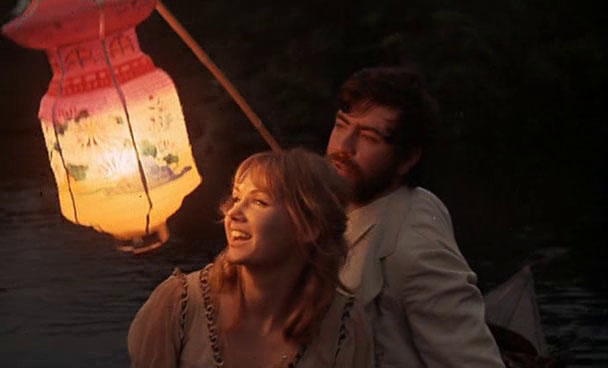
The editor Michael Bradsell had worked with Russell on two of his TV films and on other TV classics such as Culloden (1964) and The War Game (1966). Editing seems to have been something for which in his later career Russell was particularly criticised. Here Bradsell helps Russell to always keep the narrative moving over quite a long running time as well as providing some of the ‘excessive moments’ such as when the torrid sexual tussling of Alan Bates and Jennie Linden is directly linked to the death of Gerald’s sister and her new husband, drowned in the family’s lake.

How does Glenda Jackson cope with all of this in her first experience of a Ken Russell film? She is magnificent throughout, completely in control and more than a match for Oliver Reed and Alan Bates. At one point, when asked, Gudrun says she is 26. Jackson was 32/33 when she made the film and she does come across as the mature woman not the younger woman of the 1920s, but I don’t think that’s an issue. It was suggested that she wasn’t conventionally beautiful. Perhaps not but she looks very good in this film and the force of her personality in any case makes her more attractive than many of her contemporaries. Her relationship with Oliver Reed’s character is developed further in the last section of the film when she moves into the dominant position in the relationship and flirts with the gay German artist she meets in her hotel in the Alps. I think that in 1970 I was too young to properly appreciate her performance. Despite the top billing of Bates and Reed, it is her film.
Women in Love is well worth a look if you’ve never seen it or another look if you saw it on release. It exists on Blu-ray from both the BFI and Criterion. At the moment, I can’t find it on streamers – and indeed little of Glenda Jackson’s back catalogue seems to be available. Let’s hope the BBC finds something to screen as a tribute.
 itp Global Film