

This year’s Archive Festival runs from June 24th until July 2nd in Bologna, but with some screenings on the preceding weekdays. There will be 470 films, movies and documentaries screened, including 35mm, 16mm, and digital versions. These are spread over six venues including open-air screenings in the Piazza Maggiore and the Piazzetta Pasolini. There are a number of films from the silent era and these enjoy live musical accompaniment. Many of the films are introduced; sometimes by film-makers, sometimes by specialists and sometimes by people involved in bringing the title back to the public. Depending on one’s commitment it can be quite a punishing schedule, starting at 0900 each day and going on till midnight or even later. Then there is hopping between venues to catch favourites; sometimes difficult or impossible depending on the timetable. And it is likely to be crowded; in earlier years some 3,000 guests have attended the Festival which is also popular with the city residents.
The most memorable events are those in the Piazza Maggiore, with a large screen and an audience of thousands. This year’s titles include Alfred Hitchcock, Anna Magnani, Ichikawa Kon and two Silents with live music. The Maggiore screenings are in the week before the official festival and continue in the following week as well.
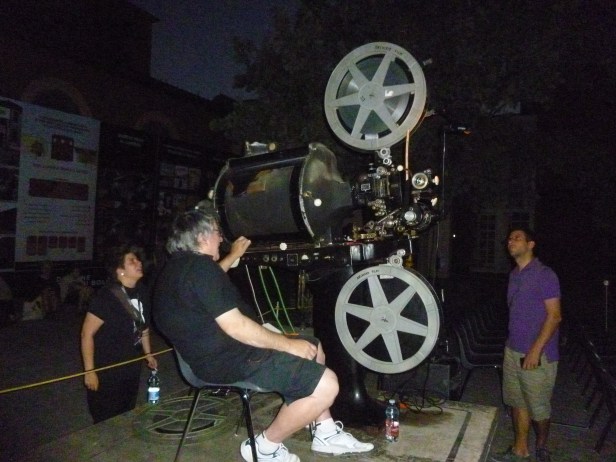
My favourites are the screenings in the Piazzetta. This is smaller but a atmospheric venue. Two of the events feature 35mm films projected on a carbon arc machine; an experience which is a must for cinephiles. Also this year there will be a 16mm event.
A featured film director is Reuben Mamoulian. He started on Broadway and then worked in Hollywood from 1929 until 1957, mainly at Paramount but also with M.G.M. and C20th Fox. He worked with stars like Cary Cooper, Marlene Dietrich, Frederic March and Great Garbo. He was notable for his stylish work in early sound films. Whilst many other movies suffered a camera bound to a sound box, Mamoulian was able to produce fine mobile camera work. Nearly all the titles in this programme are screening from 35mm prints.
The Italian film star Anna Magnani enjoys a programme of her films. This includes the defining performance in Rosselini’s Roma, cittá aperta (1945); but also a number of her fine later films by directors as talented as Jean Renoir and playing opposite stars including Vittorio de Sica, Giuletta Masina, Burt Lancaster and Marlon Brando.
There is a programme of films from the Japanese early avant-garde artist Kinugasa Teinusuke. There will be his most famous work, A Page of Madness / Kurutta ippêji (1926), but also some of his lesser known works.
The British film-maker Michael Powell is featured with the films that he directed before beginning his famous partnership with Emeric Pressburger. Whilst that duo produced work finer than their other solo titles, there are interesting examples from the 1930s, like Red Ensign (1934).

Cinema libero has become an important strand in the Festival, bringing forward films from outside the dominant cinema and often little seen in the West. The strand also features titles restored by the Film Foundation. There is Pan-African Cinema including an important film addressing the struggle of the Palestinian people, The Dupes / Al-Makhdo’un, Tewfik Saleh, (Syria 1972). There is A West Africa celebration marking the centenary of Ousmane Sembéne, known as the father of African Cinema. There is a screening of a digital restoration of Ceddo, (Senegal 1977); this is for my money the finest work among an outstanding series of films between 1963 and 2004.
The Festival is also a fine venue for lovers of Silent Cinema, with numerous screenings on 35mm prints and accompanying music from a fine team of musicians. One theme is films from 1903. There will be titles from Georges Mêlées, examples from the Pathé Frères company and also from early British cinema. The series that celebrate films made one hundred years ago presents 1923. One key film will be Schatten – Eine nächtliche Halluzination / Shadows – a Nocturnal Hallucination“, known in English as Warning Shadows) which is one of the finest examples of German expressionism. This programme will including the intriguing study of Russian divas working in film in Italy. Vittoria o Morte (1913) has Berta Nelson directed by Segundo de Chomón.
There are a host of other programmes, intriguing titles and a strand of 16mm prints, this year being the centenary of its inception. The Festival offers popular films, art movies, avant-garde work and documentaries. The Cineteca hosts a book fair of both new and second-hand volumes and some memorabilia. There is a bar and buffet in the Piazzetta and a open-air market a couple of times in the week nearby. Bologna is a great city for eating out and there are, of course, numerous fine coffee bars. And away from the films there are a number of interesting museums and art venues, including a gallery of the work by the fine city’s own painter Giorgio Morandi.
A week of film pleasure that is unrivalled in the world of the history of cinema.
 itp Global Film