

One of my long-term projects is to watch more Westerns and especially those made outside the US. YouTube is a treasure house of neglected titles, some of which offer something slightly different. This film has many titles and a complicated production history. It’s a Dino De Laurentiis picture which was to be directed by the Hollywood director John Sturges in Almeria, Spain from a production base in Rome. Universal France also put money into the film, as did the Spanish company Coral Producciones Cinematográficas. The film stars Charles Bronson – when he was at the peak of his international stardom – and his wife Jill Ireland.

Released in the UK in 1974 by CIC as Valdez the Halfbreed (but submitted to the BBFC as Chino), it didn’t reach the US until 1975, released through IRC, the International Releasing Corporation. The title on the YouTube print is The Valdez Horses and it’s an English language version. I presume that there are Italian, French and Spanish dubs as well. Sturges is credited as both producer and director. How much he did of either role is contested. There seem to be reports that he was ill during the shoot and that his role as director was taken over by Duilio Coletti, an experienced writer and director (but not of Westerns). Wikipedia suggests that there were extensive re-shoots and Sturges didn’t return for these. Only Sturges is credited on the YouTube print. It is the last Western credited to Sturges, although he made two more Hollywood films before retiring.

The narrative is simply structured. A lone rider emerges in the hills during the titles and slowly becomes visible as a teenage boy, Jamie (Vincent Van Patten) who will arrive at a remote ranch house, the home of wild horse breeder/trainer Chino Valdez (Charles Bronson). Chico is at first brusque but eventually thaws and feeds the boy who is looking for work. We realise that Chino is lonely and he appreciates the boy’s company. Respected for the quality of his horses, Chino has only one enemy, Maral (Marcel Bozzuffi), a rancher who claims the whole range where Chino keeps his horses. But Chino then meets Maral’s half-sister who is visiting from England. Catherine (Jill Ireland) is certainly interested in Chino and buys one of his horses as a means of introduction.

Chino and Jamie develop a bond and Jamie learns some of Chino’s skills with horses. When he needs time to think, Chino takes Jamie to visit a Native American band living close by. This was the community who took him in when he arrived in New Mexico after leaving Texas. Apart from this interlude, the only action in the film takes place either in the local town (with its seemingly efficient sheriff) or on the range behind Chino’s ranch house and it always involves Maral and/or Catherine.
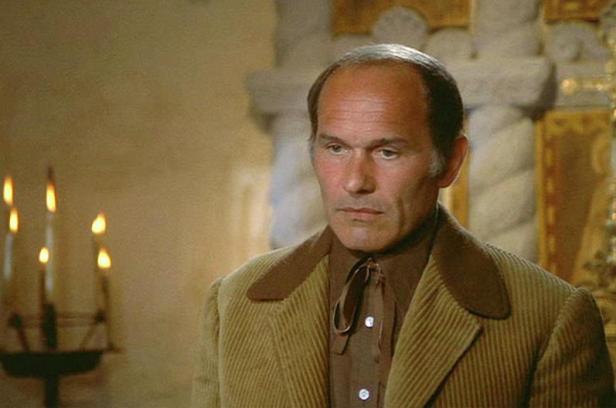
It is a strange film, primarily because it doesn’t feel like a Western, although it exhibits so many familiar genre elements. Jeff Arnold, who publishes his own blog for Western film fans is down on ‘spaghetti Westerns’ and suggests that Chino has:
. . . all the spag elements of bad acting, lousy writing, shocking music, lousy dubbing, Spanish locations and so on, yet it also tries for a family-friendly vibe. It tries to be a schmaltzy heart-warming tale of a young boy and how he bonds with foals and a discriminated-against rancher. Oh, please.
On his general point, I’d have to agree – there is something uneasy about the genre pitch of the film – but I don’t agree with the abuse aimed at European Westerns or the technical credits. I’ll return to them later. But what about the ‘family-friendly vibe’? Partly it’s a casting issue. Vincent Van Patten is quite pretty with straw-blond hair and a clean smiling image. He really could be in a Disney film. He makes a great contrast with some of the cheeky urchins who frequent Italian Westerns. He persuades Chino to find a Christmas tree and he and Chino exchange comic lines about etiquette and how to speak to ‘ladies’. Yet Chino’s attempts at seducing Catherine are primitive to say the least, one scene resembling rape. It’s the shifts of tone as well as the sexism and sexual abuse which is disturbing. There are suggestions that Sturges thought Jill Ireland was miscast, but I think the role could have worked with a better script. As for the ‘shocking music’, I didn’t notice the score as being inappropriate and the songs by Guido and Maurizio de Angelis seemed fine to me. They are in English and fit the tradition of popular songs in Westerns, especially for titles and end credits. The de Angelis brothers also performed as ‘Oliver Onions’ but they were at their peak in producing film soundtracks in the late 1960s and early 1970s, especially for the Bud Spencer/Terence Hill films of the period, massively popular across Europe. The dubbing is not a problem, the four leads all speak English. Bozzuffi was a leading French actor with parts in many big international productions.

The film is most interesting for me in terms of issues of racism. Maral despises Chino because he is mixed race. Early in his Hollywood career Bronson had played Native Americans – Apache (1954) and Drum Beat (1954). Bronson’s own heritage was via his Lithuanian parents and the Lithuanian Tatar community. Bronson had distinctive facial features that allowed him to be cast as various American or Asiatic characters. The Native American band in Chino is mainly played by Italian or Hispanic actors. Their nation is not mentioned as far as I remember, but at least they are not forced to speak English. Chino can converse in their language but Jamie feels uncomfortable not being able to communicate directly, especially with one of the teenage girls. One interesting point for me was that Chino brings the band gifts in the form of fresh meat. Since I don’t remember cattle on Chino’s land, I wondered if this was horsemeat. Shocking though eating horse might be in the UK, it’s not uncommon in Europe and I believe it was the staple diet of Native American nations such as the Apache and Comanche. Finally, when Jamie asks Chino about this group of Indigenous people, Chino tells him that most won’t survive the colonisation of their lands and that like Chino himself their time is passing. This is certainly an unusual observation (or at least unusual in its direct articulation) in a Western genre story and I wondered if this was a European perspective. But the novel the film narrative is adapted from is by Lee Hoffman (Shirley Bell Hoffman) an American writer who won a prize for her novel in 1967. The screenplay was by Clair Walter Huffaker, a noted screenwriter of Western films and TV series. IMDb lists another three writers who might have made a contribution and perhaps this plethora of authorial voices accounts for the confused ‘feel’ and the inconsistencies in the narrative.
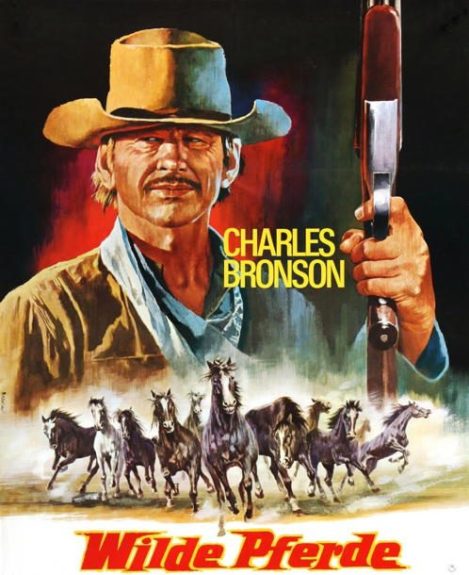
In summary, the narrative attempts to blend a surrogate father/son tale, a story focused on training wild horses, a statement about the ‘end of the West’ and the problems for Native Americans plus a romance and a feud. It isn’t surprising that not all of the narrative aims are met. The last two are in a sense the most familiar but the romance is allowed to die and the feud does not end in a way likely to please Bronson’s fans – even if it does fit in with aspects of the other narrative threads. There are elements of Shane (1953) in the narrative, but the boy is so much older that it doesn’t work in the same way. Maral is a heavy, symbolically evil but without any kind of background – it isn’t clear how he makes a living and how he is able to employ a large number of thugs for Chino to tangle with. As to the presentation, there are some interesting landscape shots, almost Fordian in their use of long shot and the positioning of characters beneath big skies silhouetted against the skyline. I don’t have a problem with Almeria standing in for New Mexico. The film was widely distributed in the international market place and the different posters and promotional images indicate slightly different assumptions about how the film would sell in different territories.
There are several versions of the film online in different languages. The version I watched was close to the longest running time of 98 minutes, but shorter versions are also available at 91 or 92 minutes. This French trailer shows most of the ‘action sequences’ in the film but doesn’t give the flavour of the narrative thread about the horse-breeder and the boy or that of Chino’s relationship with his Native American ‘family’. The film seems to have been released in both 1.37:1 and 1.85:1 ratios. An interesting failure, I think and indicative of ‘international filmmaking’ in the late 1960s/early 1970s.
 itp Global Film