
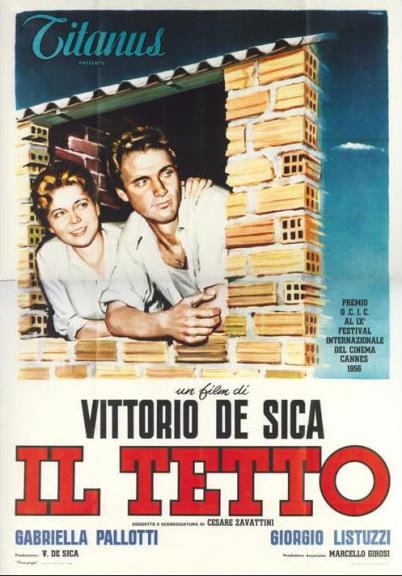
MUBI has turned up trumps with this rarely seen neo-realist film from Cesare Zavattini and Vittorio de Sica. There are going to be two more, one from 1942 which sounds very exciting. De Sica is the director who added his skills as a director and interpreter of Zavattini’s scripts to his already celebrated acting career in popular melodramas. The pair were responsible for Bicycle Thieves (Italy 1948), arguably the most popular of the neo-realist films from Italy and in my view one of the most influential films of all time.
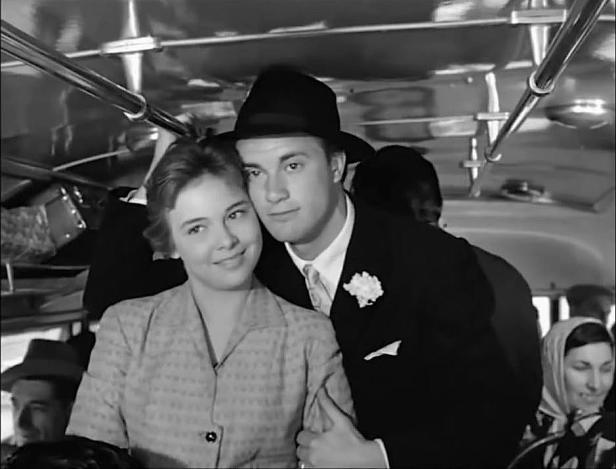

The story, which for a neo-realist film should be ‘taken from the world’ not imposed on it, is very familiar – especially in Southern Europe in the late 1940s and through to the early 1960s. A young couple get married and, with only a little money, have to find somewhere to live. The girl’s family on the coast don’t have room for them and her father, a fisherman, is not very supportive. The boy’s family in an area on the outskirts of Rome, but originally from Veneto (Cavarzere, according to the subtitles) put them up, but it’s crowded and boy’s brother-in-law is brusque with them and has another baby to contend with. They must soon move out. They try to find a flat to rent but they are all too expensive and they have to separate each night finding a bed where they can. The only bright side to their situation is that Natale (Giorgio Listuzzi) is a building labourer who is hoping to train as a bricklayer, his brother-in-law’s trade. So when Luisa (Gabriella Pallotti) falls in with some local people in a shanty-town and gets the idea that Natale could build a tiny house himself, he does at least have a gang of colleagues who could help.

This is the Zavattini node of conflict, the equivalent of the bicycle required for work in Bicycle Thieves. The narrative is a little hazy on the actual legal situation but it appears that the police cannot enter a house with a roof and a door and then knock it down and fine the builders for illegal possession of the land. To build the house, Natale must get as many as ten men and all the building materials to the spot where he intends to build by nightfall and then complete the building by 6 or 7 am – and avoid being spotted by police patrols. It’s a tall order. It’s a neo-realist film rooted in a community which includes migrants from the South and East of Italy as well as from overseas. Rome was a building site for many years after 1945 and the same scenario might be found in Madrid, Marseille or other Italian cities. Housing policies, politics and corruption were rife. There are several well-known films influenced by neo-realism with similarplot elements. In 1963 De Sica’s Yesterday, Today and Tomorrow, uses the story of a poor Italian couple in Naples who are always in danger of losing their rented rooms, but a Neapolitan regulation says they cannot be evicted if the wife is pregnant. In this social comedy Sophia Loren has to continually press Marcello Mastroianni to impregnate her. De Sica’s neo-realist colleague Luchino Visconti made Rocco and His Brothers in 1960, a film in which the first migrants from a Southern family have to establish themselves and then support the next migrant brother and his family. The social issue about housing and employment/opportunity is there but not the specific concept of a local law. This can be found, however, in the Spanish film The Executioner (1963) by Luis García Berlanga. In this case the lure of a flat provided by the local authority to the man who is appointed Executioner in Franco’s Spain is too great and the protagonist has a heavily pregnant wife. He doesn’t want to be an executioner but then, of course, the time comes. This makes the film a black comedy. The Roof is also listed as a ‘comedy’ as well as a ‘drama’ by MUBI. Certainly it has comic moments but I think announcing it as a comedy undermines the story’s progressive edge.
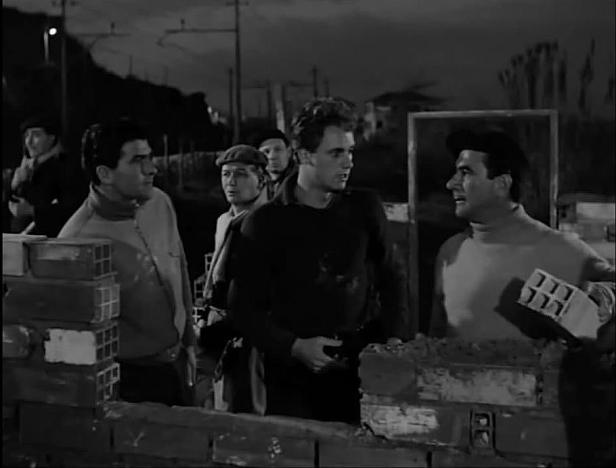
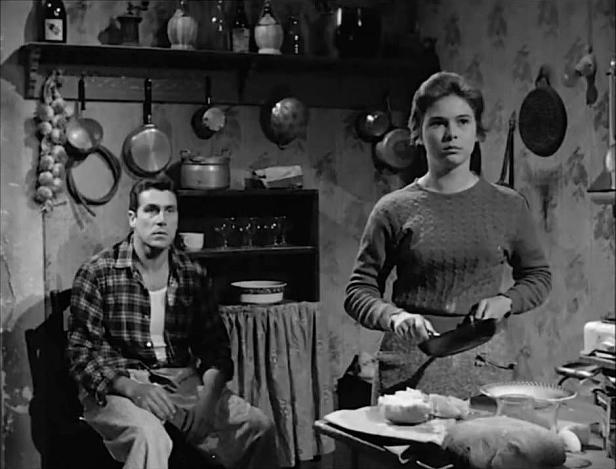
De Sica tends to be the least celebrated of the four great Italian neorealist directors. Everyone tends to celebrate the films but not the directors. True, much of the credit must go to Zavattini’s scripts but De Sica’s work with actors and with his collaborations with cinematographers (in this case, Carlo Montuori), music composers (here Alessandro Cicognini) and the other creatives made him a master ‘metteur en scène’. Bazin discusses his work under that title in What Is Cinema, Vol 2 (University of California Press, 1971). He makes a contrast between Rossellini and De Sica, which broadly suggests that Rossellini’s techniques and aesthetics come between the audience and the characters as the director observes their situation and perhaps analyses it. De Sica, by contrast ‘loves’ his characters and his love and support for them politically (both he and Zavattini were Communists) is visible on screen inviting us in rather than distancing us. Of course, there are critics who then find De Sica too ‘sentimental’. This is often said because he uses many children in his films and The Roof is no exception. But he directs the children very well. He and Zavattini have also been praised for the details of everyday lives in their films. This is enhanced by the casting of non-professionals. For the 17 year-old Gabriella Pallotti this was her first film as it was for most of the cast – and in many cases their only film. I read somewhere that Giorgio Listuzzi had been a footballer. I found them an attractive couple full of vitality and completely believable. The story isn’t a fantasy. There are good people in the community as well as police informers and those out to benefit themselves first. A 2015 piece in The Village Voice describes the film as “Unemphatically affecting, it’s also remorselessly cynical”. I’m struggling to understand that take. It is certainly affecting but its triumph is in its presentation of working class solidarity and what can be achieved. In the political context of much of the world today, this is an uplifting story.

The print on MUBI is the 1996 restoration, also available on Arrow disc and currently on various streamers. The MUBI print looks good with what appears to be the original running time of 98 minutes. IMDb lists 91 minutes so there might be cuts in some other prints. The film premiered at Cannes but didn’t get to the UK until 1960. Here’s an Italian trailer. No English subs but you do get to see Rome in 1956 as presented by De Sica, Zavattini, Montuori and the non-professional actors.
 itp Global Film