
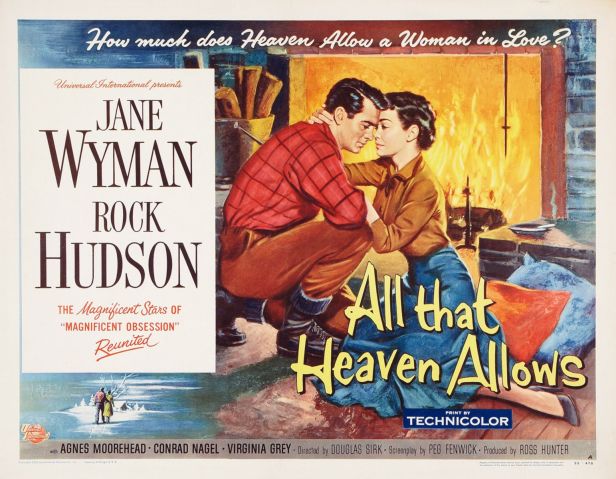
The following notes were originally written for a film studies project on Melodrama for A Level students in the UK in 1998. As a consequence, they assume that students would have watched the whole film and they include a Full Synopsis and discussion of key sequences in the film. The notes have since been re-worked for a general audience. Nick Lacey was the co-author of much of this material. You can see how the project discussed Melodrama as a concept in this blog posting.
(Please also see the extended notes on Sirk and All That Heaven Allows on the FREE Downloads page.)
Following his big success with Magnificent Obsession (1954), produced by Ross Hunter and starring Jane Wyman and Rock Hudson, Douglas Sirk found himself able to have much more control over his next picture for Universal-International. All That Heaven Allows (1955) was equally successful with audiences and would later become the focal point in the surge of interest by film scholars in what was seen as Sirk’s ‘subversive’ use of mise en scène, camerawork and music in his development of the American film melodrama.
All That Heaven Allows – Synopsis
Forty-something Cary Scott (Jane Wyman), whose husband died a few years ago, is bored with her passionless life but finds the attentions of the staid, and much older, Harvey unappealing. She finds herself falling in love with her gardener Ron Kirby (Rock Hudson) several years younger. Ron lives a ‘natural’ life, growing trees, away from the hypocrisy of bourgeois (middle-class) society. At first, their relationship is secretive, but when they decide to marry she immediately runs into the opposition of her snobby friends, ‘the country club set’, and her children who are studying at college. A cocktail party, where Ron was to be introduced to Cary’s friends, degenerates into a confrontation between Ron and Howard who had previously attempted to seduce Cary. Returning home, Cary is greeted with an ultimatum by her children who cannot bear the thought of their mother marrying a social ‘inferior’, particularly one much younger than herself. In guilt-ridden desperation, Cary asks Ron for a delay in their marriage, he refuses on the grounds that she shouldn’t bow to peer and offspring pressure. Cary breaks their relationship in a self-sacrificial gesture.
Not long after, at Christmas, Cary learns her daughter is engaged to be married in February and her son plans to move abroad. To compensate for her loneliness they have bought her a television, a symbol of her isolation. Cary also feels ill and is advised by her doctor to go back to Ron. She drives out to the old mill he had converted for them to live in but he isn’t there. As she leaves, Ron sees her from the top of a hill and chases after her across the snow-covered ground, falling off a cliff. He is seriously injured but after Cary watches over him all night he recovers consciousness.
Commentary
Although All That Heaven Allows offers us an apparently happy ending, it is undercut: Ron’s fall is narratively redundant as both he and Cary had independently decided that they wanted each other back, the film could have ended with them reunited when Cary left her doctor’s. Apart from adding drama to the climax, Ron’s serious injury represents the damage done to him by Cary’s rejection.
The film uses images as the prime channel of communication and visual signs are used to carry the narrative conflicts, expressed here as binary oppositions:

Women often feature as central characters in melodramas, especially in relationships with children. However, the narrative disruption is often the absence of a man and the genre’s conservatism is evident because the narrative resolution involves the ‘capture’ of a man so the woman can be integrated into conventional society. Although the central character, who motivates the narrative, is (unusually) female, she is shown not to be complete without a man:
The female-orientated melodrama cannot end with its female protagonist continuing a life independent and alone. (Byars, 1991, p.148)
Here the subversive excessiveness of the genre comes into play: the contortions the plot goes through to produce the ‘happy-ever-after’ fairy tale ending are often so ridiculous that the deus-ex-machina (‘act of god’) endings expose contradictions rather than resolve them. (ibid.)
All That Heaven Allows undercuts the resolution of the woman getting ‘her man’ by focusing on a relationship in which the woman is older and of a different social class to the man. The subject of a sexually attractive older woman is nearly taboo even today; what happens to Hollywood actresses in their late 40s? Yes, in the 2020s some older actresses are offered parts which involve romance and sexual relationships, but usually with men of their own age. Similarly, working class characters do not often appear in romantic roles in contemporary cinema. It is possible that All That Heaven Allows is subversive even by today’s standards.
It may appear, to audiences in the 21st century, that the concerns of the 1950s are of no more than an historical interest because ‘things aren’t like that now’. However, although gender roles have evolved, and attitudes towards racism have changed (at least in terms of public behaviour), the family is still held to be the defining social unit of our society. An analysis of 1950s melodrama gives us an insight into how North American society, and possible western society, has changed – if at all – in the last 50 years. Sirk would turn to another female-orientated melodrama for his last film Imitation of Life in 1959, which features a young woman who ‘passes’ for white.
Bibliography
Martin Auty (1980) ‘Imitation of Life’ Movie No.52, Orbis Publishing
Jackie Byars (1991) All That Hollywood Allows Routledge, London
Thomas Elsaesser (1972) ‘Tales of Sound and Fury – Observations on the Family Melodrama’ in Gledhill (ed) op cit.
Christine Gledhill (ed) (1987) Home Is Where The Heart Is British Film Institute, London
Colin McArthur (1980) ‘Douglas Sirk’s magnificent obsessions’ Movie No.52, Orbis Publishing
Richard Maltby (1995) Hollywood Cinema, Blackwell, London
Laura Mulvey (1977) ‘Notes on Sirk and Melodrama’ in Gledhill (ed) op cit
Robin Wood (1972) ‘Bigger Than Life’ Film Comment, Sept–Oct 1972
There are two sets of notes from later work on Sirk and All That Heaven Allows elsewhere on this blog. Go to the FREE Downloads page.
 itp Global Film