
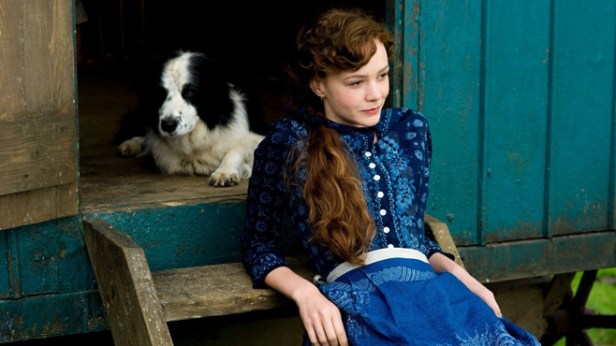
In retrospect it was probably a bad idea to watch the new version of Thomas Hardy’s famous story just a few days after seeing the restoration of the 1967 film. I spent too much time spotting all the events ditched from the script in the new version that runs 119 instead of 169 minutes. That’s quite a chunk of screen time gone. I’ll try to be objective in comparing the two.
The new version is puzzling as a production (from BBC Films and the long-standing UK production company DNA films). I’m guessing that the funding wasn’t there to make something on the epic scale of the original. It was a brave move to hire Thomas Vinterberg whose English language films have so far not matched his Danish successes. I expected something punchy from the director of The Hunt (Denmark/Sweden 2013) with the same cinematographer Charlotte Bruus Christensen. Although the latter conjures up some remarkable visual sequences, this doesn’t feel like a project on which Vinterberg was totally free or properly engaged. I think that Carey Mulligan, cast as Bathsheba Everdene, had a fair amount of clout in choosing Matthias Schoenaerts as her co-star (playing the shepherd Gabriel Oak) and she and Schoenaerts offer the best performances in my view. The other strength is the costume design which is truly wonderful. I wasn’t that keen on Ms Mulligan’s hats but her riding gear and several of her dresses are breathtaking, especially a blue one with white decorative motifs that glow in the evening light. As I predicted, Mulligan matches Julie Christie in terms of performance. They present quite different characters so a direct comparison is not useful. Mulligan is a couple of years older than Christie was in 1967. She presents Bathsheba as more virginal, but also more stylish – still ‘girlish’ but with the strength of an ‘independent woman’. The film is worth seeing for Carey Mulligan alone.
Unfortunately much of the rest of the film is less sure about itself. It begins badly with a strange title suggesting that we are “200 miles from London”. Hardy’s ‘Wessex’ in Dorset is more like 130 miles. It’s not important, but who thought it was a good idea? As I’ve noted there are some stunning visual sequences, mainly of landscapes in mists, or in ‘magic hour’ lighting etc. – but there are some quite ‘flat’ scenes and at least one dreadful edit. The harrowing sequence depicting Fanny Robbins on the way to the workhouse (which includes this edit) is almost thrown away. I think the main problem is a poor script by David Nicholls who was probably asked to aim for the impossible in trying to condense an eventful novel to produce a two-hour film. Michael Sheen as Boldwood and Tom Sturridge as Sergeant Troy both seem like miscastings to me. They are both fine actors but they don’t have the starpower of their counterparts in the 1967 film, Peter Finch and Terence Stamp and the characters seem a little diminished as a result. Sturridge in particular is severely hampered by the script which doesn’t give him enough time to explore the character’s complexities. In 1967, for many female audiences in the UK, Stamp was the sexiest man alive, except, perhaps, for those who fancied Alan Bates (who played Gabriel Oak). What was particularly missing for Sturridge’s Sergeant Troy were key scenes with Fanny and the circus sequence for his return. Instead of being a cad, charming but a little dark, Sturridge’s Troy is reduced to being pretty but brutal.
I looked at a few reviews. Keith has already had a go at Thirza Wakefield in Sight and Sound for a different film and I was intrigued to read her review which on the whole is perceptive and interesting especially about Mulligan’s portrayal of Bathsheba as the ‘modern’ woman the script constructs, though she falls into the autuerist trap of referring to ‘Vinterberg’s camera’ (and its references to Victorian paintings), when surely it’s important that it’s the female perspective of Charlotte Brus Christensen. The ‘best’ review (i.e. the one that agrees with me!) is from Fionnuala Halligan in Screendaily – she’s very good on the production team.
In sum, this new adaptation is very good in parts and Carey Mulligan is excellent throughout. She makes a great romantic heroine, but the project lacks the scope of the novel and the scale of the 1967 adaptation. Nevertheless I hope we see more from Vinterberg and Christensen in a UK context. In the meantime, audiences not making the comparison with the 1967 version will enjoy this adaptation.
Official US trailer (good for showing off the camerawork and Carey Mulligan’s Bathsheba):
 itp Global Film
I am glad Roy posted a picture of Bathsheba and old George, the film’s faithfulness to the books depiction of canine characters is about as close as it gets to Hardy’s novel.
Cary Mulligan is the best thing in the film.
LikeLike
So I revisited the film and it stood up better than I first thought. However, I think Roy is right about the ‘flat’ sequences and the problems of what has been left out. The biggest problem is the score which swamps some rather subtle touches. I noted the credits open with Fox Searchlight, I think that explains a lot.
I also read the review by M/s Wakefield. I think she has got the film wrong. She suggests that the script subverts the ‘period perception of female temperament’. In fact the film relies on the critical views in Hardy’s novel: and where it does not the effect is anachronistic.
She also describes a camera gaze that is ‘deflected elsewhere’ from Bathsheba: as far as I could see the film uses classical shot / reverse shot.
LikeLike