
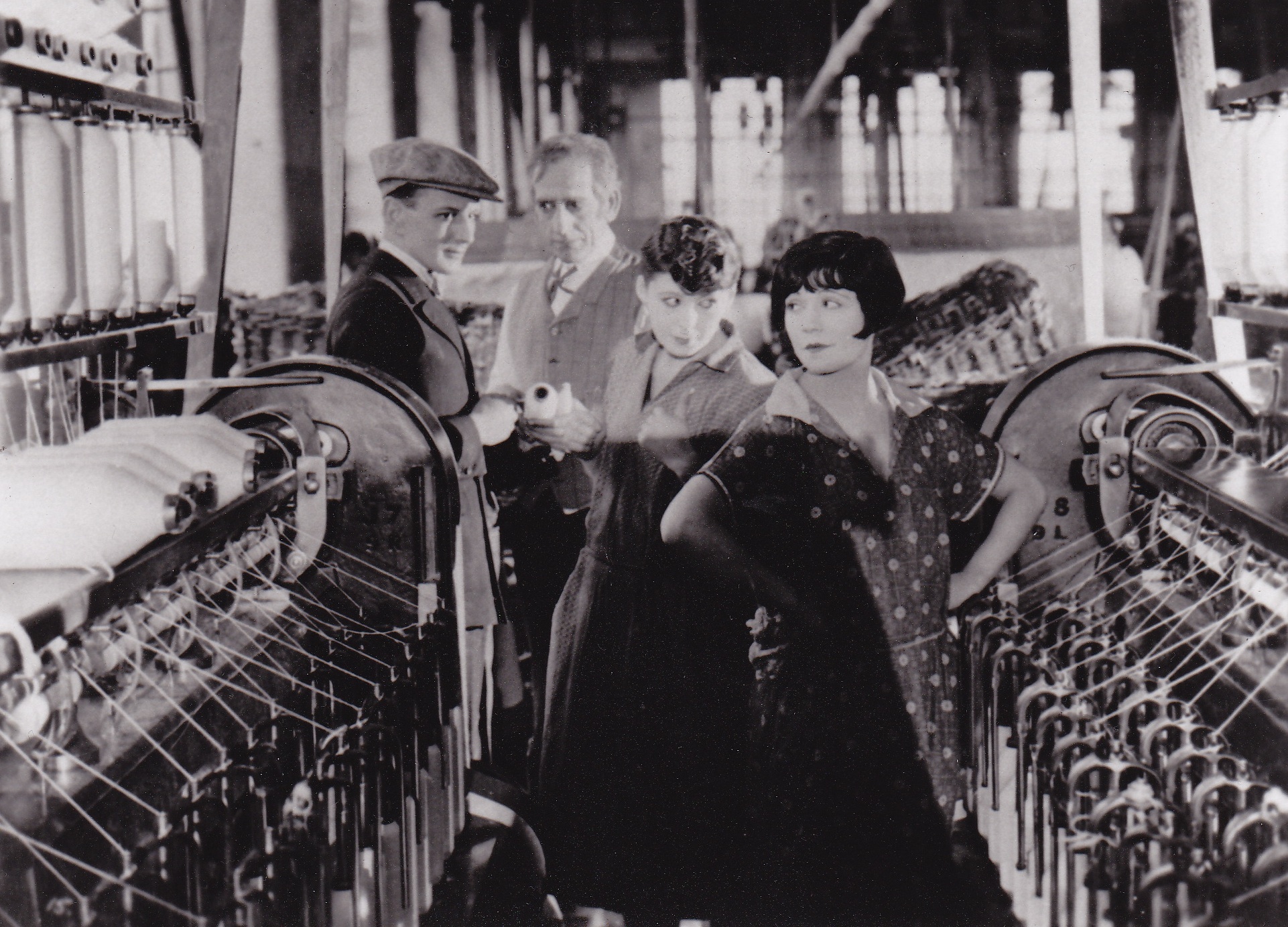
Stanley Houghton’s play was written and produced in Manchester in 1912. It offered a working class heroine, Fanny, who was distinctively modern and liberated for the times. It remains an absorbing and dramatic story, which has been adapted for the cinema four times and for television twice. I think that the second film adaptation, directed by Maurice Elvey in 1927, is the best. Like the other film versions it fills out the original play with additional scenes, including material that is part of the back-story in the play.
The title refers to the week of holiday and pleasure enjoyed by the mill-workers in Lancashire leading up to the August Bank Holiday, (at that time at the beginning rather than the end of the month). Fanny and her fellow mill workers train off to Blackpool to enjoy the funfairs, the sunshine and the opportunities of the seaside resort. This includes a holiday affair with Allan, son of the owner of the mill where Fanny works. The original play is wholly concerned with the aftershock of this romance, and the responses of the traditionally minded families of Fanny and Allan. But it is the response of Fanny in particular, and her expression of her attitudes that made the play memorable.
This remains the climax of the film version. However, film is able to recreate place and space in a more realistic and detailed manner than theatre. And Elvey does this both with sequences inside the mill in Hindley, and more notably, in the resort of Blackpool. Rachel Low, in her magisterial History of British Film, suggests that these sequences were shot by Basil Emmott, who went on to film John Grierson’s Drifters (1929). And a short sequence in the Blackpool Tower Ballroom seems to point forward to work later work of Humphrey Jennings.
Elvey also elicits strong performances, both from the lead characters and from the supporting cast. Estelle Brody as Fanny is particularly good. And many of the intertitles recreate the Lancashire dialect that was a noted aspect of the original play.
Hindle Wakes is one of the outstanding British films of the late 1920s. Produced at a time when there was a sense of buoyancy in the Film Industry as the Government took action (which turned out to be ineffective) against the dominance of Hollywood in the UK film market.
The film has been restored by the British Film Institute and there is a screening at the National Media Museum in Bradford this coming Sunday, July 8th. As always in the Museum’s series of Silent Screenings there will be live piano accompaniment by Darius Battiwalla.
Note there is a longer and more detailed discussion of the film on Early and Silent Cinema.
 itp Global Film