
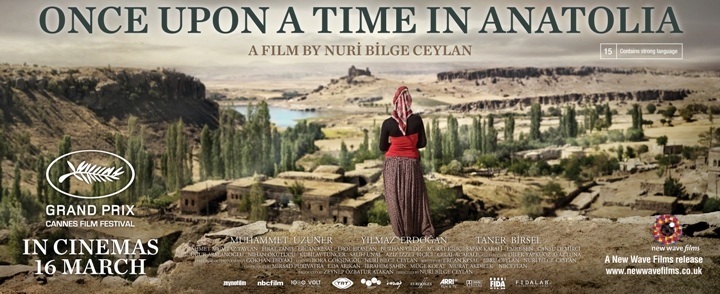
The above film, directed by Nuri Bilge Ceylan may have presented difficulties for some viewers with its allusive and at times ambiguous narrative. My difficulty was rather different: this film won the Grand Prix at the 2011 Cannes Film Festival whilst Terence Malik’s The Tree of Life won the Palme D’Or (higher up the pecking order of the Festival Awards). This was a decision that I found difficult to understand. So I looked up the membership of the 2011 Jury on the Internet. It consisted of Robert De Niro (President), Olivier Assayas, Martina Gusman, Mahamat Saleh Haroun, Jude Law, Nansun Shi, Uma Thurman, Johnnie To, Linn Ullmann. I suppose I could imagine the President, Jude Law, Una Thurman and Johnnie To preferring the US epic. I was uncertain about Nansun Shi, Linn Ullmann and Oliver Assayas, but the last is attending the forthcoming Bradford Film Festival so I may get an opportunity to ask him. But, based on my viewing of their own film works, I did think that Martina Gusman and Mahamat Saleh Haroun would have recognised the outstanding quality of the Turkish film.
Certainly when I saw it at my local independent cinema the staff remarked that many people had expressed admiration after seeing the film. After a pre-credit scene which turns out to be important in plot terms we see cars travelling along a country road by night. Such scenes appear in Ceylan’s earlier films, as do thunderstorms; here one threatens ominously through a large part of this film. The car sequence, which recurs several times in the film, is visually stunning. Ceylan and his cinematographer Gökhan Tiryaki are able to produce mesmerising images with their digital photography. And the sound, edited by Thomas Robert, is an equally impressive design.
Ceylan has also expressed his liking for the Russian writer Anton Chekhov in interviews. Ceylan is also able to present characters and their inner thoughts as they struggle with the deeper meanings of the everyday: lives circumscribed by their character, circumstances and sometime the intractability of the world they inhabit. Whilst the film offers a very different story, set in a vastly different land and society, the parallels strike one: in my case with Chekhov’s masterpiece The Seagull. Gilbert Phelps’ comments on that writer, (The World Novel, 1988) seem quite apt: the “story ends in a struggle of dots, leaving it open-ended, with reverberations echoing beyond the limit” (of the cinema screen).
In keeping with the influence of Chekhov, the key character in the central group of men in Once upon a Time in Anatolia (Bir zamanlar Anadolu’da) turns out to be the doctor. But in many ways, equally significant are the women. One is the daughter of the mayor of a village where a meal is taken. We never hear her speak, and only see her by candlelight. Another is the wife of a murdered man, again seen watching and passively waiting. The third we never see, she is only a character in tale recounted by one man to another. The fourth only appears in a couple of photographs. Yet I was keenly aware of how they affected the men, and how their enforced silence was itself a factor in the playing out of the story. Ceylan’s wife Ebru worked with him on the script for the film. I was left wondering if (as with many critics’ favourite auteurs) there is another untold angle on the world with which we are presented.
There are telling small incidents – like an apple rolling into a stream – a policeman lighting up two cigarettes and offering one to his prisoner – a drop of blood splashing on the face of the doctor – which offer enormous resonance. The style re-inforces this – at one point we see the a close-up of the prisoner Kenan, later in the film identical framing and lighting is used on a close-up of the Prosecutor Nusret.
This is a marvellous film: see it at the cinema, it will never be the same on DVD or even Blu-Ray. I expect it to be in my top five favourite films for 2012. If it is not, it will have been a wonderful year for World Cinema.
 itp Global Film
I approached it with trepidation – and agree it is an overall triumph. Some critical reviews have suggested that the narrative drops at times – I’m not sure that I experienced that. In fact, its sustaining of tension through its episodic form was part of Ceylan’s mastery – the introduction of new situations and characters (the meal at a local settlement and the overt machinations of its mayor balances the humour with more spectral and surreal elements brilliantly). The film wears its symbolism on its sleeve but gives great pleasure in the way the story is told – exactly as its title promises it is all about stories, both those buried within people or shared – as well as demonstrating Ceylan’s confidence in using visual imagery to comment on the feelings of its characters, in other words a particularly filmic mode of storytelling. I agree its sympathy with Chekhov is vivid – and informs its universality. A story which is so specific – the title, on reflection, comes off is a ‘tease’ with its myriad references (are we in the frontiers’ land of ‘Once Upon a Time in the West’?) but also because it draws attention to a particular landscape whilst creating a tale about emotions and tensions which are so recognisable. The shots of the cars snaking through that no-man’s-land were stunning when they shouldn’t have been – as a viewer you were surprised and captivated by so many of the film’s shots and sequences. Ceylan and Gökhan Tiryaki (cinematographer) caught the way the world is estranged when we are up all night and is also strangely lovely or disturbing (there’s a great Gothic illumination in the middle of an ordinary scene to emphasise this).
Doctor Cemal is more obviously sympathetic Ceylan leading man, if we refer back to ‘Uzak’ or ‘Climates’ (the director has commented on his exploration of his own psyche through his characters and their status as surrogates to some degree) but there is a separateness from others and a ruthlessness, especially in his analysis of the Prosecutor’s story, that may make him more complex. Elsewhere the stock characters were funnier as they remained more discernable types than the earlier films – the comedy being broader as a result as if we were being told a great ‘shaggy dog story’ and didn’t mind being taken for the ride. Its ability to meander and its episodic form recalled some Bela Tarr (e.g. ‘Werckmeister Harmonies’) for me – that focus on human faces in long, extended sequences without explanatory (movie) dialogue to explain their motivations (instead just the banal words we use everyday even where we are in the strangest situation).
Re ‘The Tree of Life’ – beat me with a Anatolian branch, but I think the Malick film deserved to win. Ceylan’s film is masterful and more cohesive. Malick deliberately interrupted narrative and yoked disparate sequences without disturbing its core emotion and its meditation on grief and loss and how we live our lives with those things. The story of Brad Pitt and Jessica Chastain’s family could have stood on its own, but was not allowed to – and I think that’s brave filmmaking.
LikeLike
Interesting comments. I think what distinguishes Ceylan from Tarr is that the latter is ‘miserabilist’, whereas the Turkish filmmaker is positive if not optimistic. I suspect this is mainly due to their cultural situations.
I think the ‘meandering’ in Tarr is deceptive, whereas I don’t think Ceylan either ‘meanders’ or is episodic. In that sense he is very close to Chekhov, as both require the reader/viewer to fill in a much larger context than is usual.
I know quite few people prefer the Malick film. I find Malick’s work increasingly portentous, rather like later Kubrick. Ceylan seems to me to be closer to the impressive work of the best Iranian filmmakers.
I have now seen the film twice. It seems the best new release since last year’s Nader and Simin A Separation.
LikeLike
I thoroughly enjoyed the film, though I must confess that I found it hard to concentrate in the first third. I know that Ceylan discusses his use of quotes from Chekhov and he maintains that the whole story is based on characters and actions that he and his co-scriptwriters experienced in small towns in Anatolia. However, for me the film is primarily a police procedural, skewed slightly by the central role that develops for the doctor. I don’t know Chekhov that well but I do read a lot of police procedurals and this is a very good one – up there with the very best of the Nordic crime fiction of the last ten years. It’s also deeply humanistic in its interest in all the characters – save the suspect’s brother.
At one point I started thinking about John Ford’s Stagecoach and later when they are digging up the body, Hitchcock’s The Trouble With Harry.
I’m surprised that critics have suggested that the film is ‘difficult’ or ‘challenging’. It seems fairly straightforward to me, at least after the conversations really get going.
LikeLike
I can see Roy’s interest in its generic aspects. I was really caught by what they protagonists say or leave unsaid. The Chekhov angle is very much to do with memory.
As for difficulty, the film fits into what people are starting to call ‘slow cinema’: a rather anachronistic phrase. However, what is clear is that the tempo is far from the mainstream and even some way from many art films.
I noticed Rona mentioned ‘meanders’. In fact I think, [like A Separation] it is a very tightly constructed narrative. However, the angle on the plot and characters is often oblique [Chekhov again] which may create that impression.
LikeLike
Yes, I agree that the narrative is tightly structured. The last two Ceylan films have employed generic narrative structures but 3 Monkeys was a form of film noir and consequently the narrative structure was more blurred. The procedural has a much tighter structure and one thing, by definition, must try to follow another in the procedure. I think perhaps because I saw the film as related to literary crime fiction I wasn’t at all bothered by the pacing of events.
By the way, I meant to say how intrigued I was that the landscapes of Anatolia were so similar to much of the hill country of North Lancashire and North Yorkshire.
LikeLike
To clarify, I wouldn’t want to imply the narrative isn’t anything but tightly structured. Instead, that it created a feeling of possibility rather than schematic inevitability. This was my sense of the ‘meandering’ – that it was structured with satisfying ambiguities and loose ends to the extent that, I think the film could have dispensed with the police procedural aspect of ever even finding the body. Therefore, Ceylan (and his writing partners) had and didn’t have genre because the central plot focus entertained us but was not the meaningful thematic focus of the film. I liked this this shift and mismatch because it mirrors the oblique relationship the central character of the doctor had to his world. HIs ‘non-engagement’ with aspects of life such as marriage or children (the threads that conventionally tie people into society) is commented upon by other characters as representative of these conventions and there is an intriguing question as to why he appears unlikely to follow the possibilities of ‘romance’ with the mayor’s beautiful daughter. The doctor is in the world but not engaged in it – his room back at the hospital was a marginal, half-inhabited space not a comfortable den for him to return to after a night on the road. The stories told within the film seem to hint at why – the prosecutor’s case and the real feelings of the grieving widow are not totally to be relied on – and I enjoyed the way the audience were drawn into an uncertainty (paralleling the doctor’s?) about people’s appearances vs their reality.
I think this helped, for me, to make the close-ups on the human faces powerful – in the same way I feel that Tarr uses the human face to emphasise enigma and emphasise his refusal, as film-maker, to make human emotion and motivation explainable. I agree that in Tarr this can be for very different narrative effect or tone from Ceylan.
LikeLike
I’ve just noticed that you refer to ‘digital cinematography’ Keith. On Ceylan’s rather wonderful blog he lists the shooting format as 35mm. The film is available for distribution on 35mm, DCP, HDCam and Digi-Beta to cope with all the standard projection formats worldwide presumably.
LikeLike
The above demonstrates what a rich and complex film this is. Re the cinematography, I see what is on the Blog. I did think the film looked very good for digital, it had a depth of field and a luminosity unsual for that format. However, the cameraman on Nine Intervals was using a new 4k Red camera, and he told me that it was the first one to have a dynamic range akin to 35mm. The copying back and forth now between 35mm and digital in post-production means that the different characteristics seem to be getting blurred. Anyway, this film looks great and the 35mm cinematography is obviously first class.
I have also seen the UK trailer again and intriguingly it seems to suggest that the story is a flashback from the point-of-view of the Chief of Police. I think the film is clear that this is not just one person’s point-of-view. Moreover, whilst the narrative stems from some sort of actual events in the past the settings and especially the props [e.g. the laptops] seem quite contemporary.
LikeLike
Screendaily reports today from a masterclass held by Ceylan at the Istanbul International Film Festival. Here’s a quote:
In response to a question about what it takes to be a director, Ceylan said: “Artists need to step beyond expectations.” And of structure, he said: “Form makes a story credible.”
Ceylan cited Antonioni as an influence, but singled out Russian writer Chekhov for particular praise and impact on his career. He described Chekhov’s short stories as “superhuman”: “The way I look at detail is influenced by Chekhov. The banality of the everyday can become important.”
He also stressed the importance for the director to understand every technical element of the filmmaking process and to be as informed as his crew about the many moving parts that go into getting a film made: “I wish I wasn’t so curious. But I am. I need to know. The director needs to understand all technical elements. He controls everything.”
LikeLike