

The 2011 Festival in this regional capital appears to have had another successful year. It offered a large and varied programme of films in a variety of format and venues. The size of audiences varied but the popular events were usually sell-outs. And audience members frequently showed enthusiasm, detailed knowledge and a strong critical eye to the artworks on offer.
As usual there were the jury prizes and awards across the range of categories in the programme.
LIFF 25 Golden Owl Award [The bird is the city’s logo] went to 22nd May (dir. Koen Mortier, Belgium, 2010).
The Golden Owl Jury said:
“The film is a powerful and evocative tale of guilt and redemption told through the eyes of a security guard who blames himself for not preventing a bombing. Blurring the lines between fantasy and reality, Mortier mixes stark realism with pop video aesthetics to create a unique and intense film.”
Méliès d’Argent (feature film Winner): The Divide (dir. Xavier Gens, Germany/USA/Canada, 2011)
Méliès d’Argent (short film) Winner: Decapoda Shock (dir. Javier Chillón, Spain).
The Méliès Jury said:
“Gens’ film delivered a number of factors so often lacking in contemporary horror; intelligent and multi-layered narrative, visually stunning, symbolic imagery and brave, outstanding performances.
The standard of the short films in competition was very high and the jury were divided. However, Decapoda Shock was very creative and achieved a lot in a short space of time – hilarious storytelling, strong pastiche techniques, multi-media visualisation and displayed a passion for the genre.”
Both The Divide and Decapoda Shock will now go forward to compete for the coveted Méliès d’Or at Sitges International Festival of Fantastic Film in Spain in 2012.
The Augustin Awards (short film)
World Animation: The Gloaming (dir. Nicholas Schmerkin, France, 2010)
Louis le Prince International Short Film: Bear (dir. Nash Edgerton, Australia, 2011)
British Shorts: Grandmothers (dir. Afarin Eghbal, UK, 2011)
Yorkshire Short Film – (We are Poets) ‘I Come From…’ (dirs. Alex Ramseyer-Bache, Daniel Lucchesi, UK, 2011).
Aspiring filmmakers eyeing the festival for 2012 will be excited by the news that LIFF has been accepted as a qualifying event by the Academy of Motion Picture Arts and Sciences [Hollywood’s club and responsible for the Oscars] for the category of Short Film. So presumably some lucky members of the Festival team will be winging it to Los Angeles in 2012.
The Audience awards, members are asked to indicate their response on a scale of 1 to 5 stars, were as follows:
Official Selection Audience Award: The Artist (dir. Michael Hazanavicius, France, 2011)
Fanomenon Audience Award: Juan of the Dead (dir. Alejandro Brugues, Cuba, 2011)
Cinema Versa Audience Award: Sound It Out (dir. Jeanie Finlay, UK, 2011)
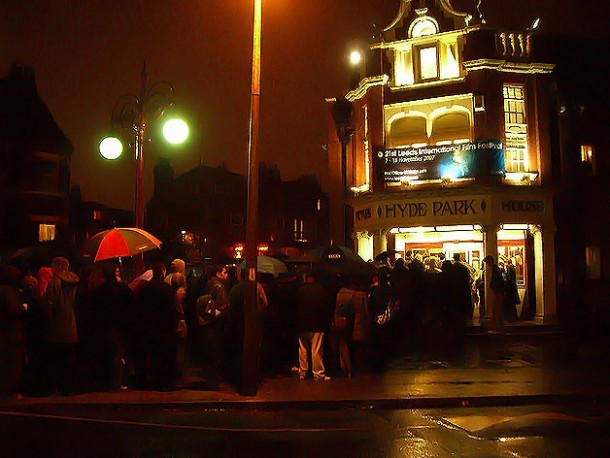
The Artist’s win was predictable and is reasonable in the sense that the Hyde Park screening was packed and so represented a substantial audience. You will see from the ITP review that the film did not get this audience members’ vote. Juan of the Dead has the distinction of being set in Cuba, offering the possibility of a satire on the USA’s fifty-year-old boycott [unfortunately not realised]. Sound it Out offers a portrait of an independent record shop in Stockton-on-Tees.
My own award would go to the programming for the Magyar Masterpieces retrospective. This is the best programming at the festival since their inspiring retrospective of Francesco Rosi. There were well-known films like those of Miklós Jancsó and surprises like Love (Szerelem, 1972) which offered cinema of the highest quality. There should be particular praise for the Festival organisers and the staff at the Hyde Park Cinema for exhibiting Béla Tarr’s 1994 Sátántangó, a tour de force running for eight hours including intervals. This is the sort of rare cinematic event that stands out, even in a year of quality releases. I should add a word of praise for the audience, nearly all of whom lasted the whole day. [The review of this film is taking a little longer than usual to write].
However, these Hungarian films also demonstrated some of the limitations of current cinema technology. Several of them were screened at The Vue Light multiplex. It would appear that there is a lack of specific technology and knowledge as several of these films were exhibited in the wrong aspect ratio. My Twentieth Century (Az en XX. Századom 1989) looked to be visually impressive and involving a complex and surrealist narrative: however, the film which should be in 1.37:1 was projected in what appeared to be about 1.80:1. This was the most extreme example of wrong ratios: Kieslowski also suffered, but slightly less. Really these films should have been programmed into the Hyde Park Cinema where they have both the equipment and the expertise in different film formats. Things should improve in 2012 as the Vue is going all digital: the Hyde Park will presumably be the only 35mm venue as the Town Hall this year was also only digital.
It is not just down to Festival programming, Red Psalm (Még kér a nép. 1972) was exhibited from a DVD as the surviving 35 print is not viewable. Unfortunately the convenience of DVD and Blu-Ray is encouraging distributors to use cheaper options even though these are not theatrical formats.
Still the Festival offered enough of quality to make it a very enjoyable if somewhat demanding fortnight. The highs and lows, for me, of these 18 days were seeing the new Wuthering Heights [one of my five favourite films of the year] and sitting through Flowers of Evil [Fleurs du Mal, 2010 – competing with one other for my least favourite].
 itp Global Film