
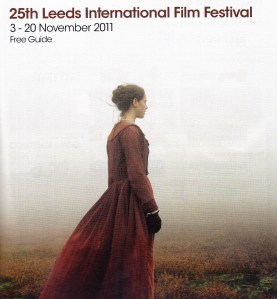
The Festival opens this Thursday with a screening of the new adaptation of the classic novel, Wuthering Heights. This has excited so much interest that there is already an extra screening programmed. The prospect of Andrea Arnold’s interpretation, whose earlier films focus on agonies and frustrations of passion and loss, are very promising. The rest of the Festival has a large and varied selection of films eighteen days in a variety of venues. There is a free printed brochure and an online version at www.leedsfilm.com. There is not at present any information about formats, though this should be contained in the official catalogue, due out this week. However, the three main venues – The Leeds Town hall, The Hyde Park Picture House and The Vue Light multiplex – all have 35mm and digital projection. The organisation of films is the same as in the last couple of years with an Official selection, Fanomenon, Cinema Verso, Cherry Kino, a Short Film section and the event programme of Thought Bubble. The Official Selection has a particularly strong representation of new European films. There is also a strong retrospective element, especially with a series of screenings of Magyar Masterpieces. This last includes films by several Hungarian directors, notably Béla Tarr and Miklós Jancsó. The former’s Sátántangó a seven hour plus epic, though it is not quite the marathon to watch that it might seem. The later director is represented by two classics, The Round Up (Szegénylegények, 1966) and Red Psalm (Még kér a nép, 1972). All three films are rarely seen on a big screen, so their appearance is really welcome. In addition there are films from Krzysztof Kieslowski’s Dekalog and Ken Loach’s early masterwork Family Life (1971). And, if you have never seen it on the big screen, Alfred Hitchcock’s trail blazing Psycho (1960). The Leeds festival also always features films from early cinema. This year this includes the 1925 Lon Chaney version of The Phantom of the Opera, with a live organ accompaniment. And Paul Merton, accompanied by pianist Neil brand, is presenting his Silent Clowns show, which this time includes a full-length Harold Lloyd comedy, Safety Last (1923). Other sections contain documentaries, campaign films and videos, experimental work and live performances married with film. As with such events the main headache will be the choices that inevitably have to be made between competing events. One other must be the Festival’s closing gala film, Shame, the new work by artist and director Steve McQueen, which features Michael Fassbender. In between there are opportunities for works by Roman Polanski, Park Chan Wook and Richard Tuohy, the last an artist in 16mm film.
 itp Global Film