
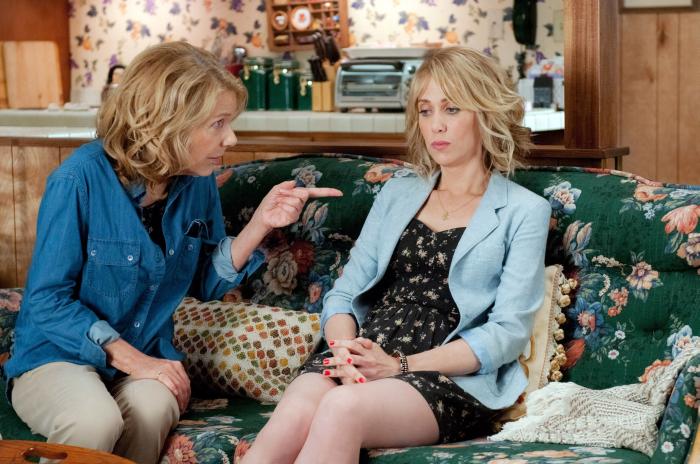
I watched Bridesmaids partly out of a genuine attempt to research what is popular with contemporary audiences and partly because my partner was intrigued enough to want to see it. We were part of a mainly female audience in a small auditorium (100 seats half full). The audience appeared to have a good time. I laughed out loud a couple of times but I’m obviously not the target audience. I never got completely bored but I did close my eyes and wish some scenes would end sooner than they did.
I haven’t seen many (perhaps even any) truly ‘gross out’ comedies before and I’ve avoided Judd Apatow comedies and so-called ‘bromance’ movies so that probably gives me a different perspective on this (Apatow-produced) film. Let me first put aside the silly debate that the film has generated among some journalists. To even ask a question like “Can women be as funny as men?” is baffling given that two of the funniest shows ever on US TV were the Lucille Ball shows in the 1950s-70s and Roseanne in the 1980s and 1990s. A more pertinent question is how do US film and TV get to remain such sexist institutions in which women have far less clout than men? Bridesmaids is written by two women but directed and produced by men – why? (This extends to all the other creatives on the film – i.e. all men except for the usual female costume designer.)
The film is long for a comedy at 125 minutes. I’m not sure why it has been extended like this. I suspect that the narrative is caught between the demands of a short gag-packed comedy and a longer comedy drama. I enjoyed the drama elements but I was surprised at how sentimental the film was. Even the villain of the film was redeemed in the final reel alongside the conventional happy ending of a traditional romcom. I had been looking forward to the final humiliation of the villain and/or a more realistic ending for the central protagonist. I know that was expecting the impossible but there you go. As for the vomit jokes etc., the first time they were funny but then it got boring (one reviewer I read suggested that these were additions by Apatow et al).
Kristen Wiig is the standout figure in a film in which she starred and co-wrote the script (with Annie Mumolo). I remembered her from Whip It and she created an interesting character I could have followed through a more streamlined comedy drama. It was great but rather sad to see Jill Clayburgh as her mother in her last film. (Clayburgh was in some ways an iconic figure in the 1970s for her performance as An Unmarried Woman.) I also enjoyed seeing Chris O’Dowd though I couldn’t figure out why he was cast or how the narrative justified the inclusion of an Irish character. On the other hand, I was less happy to be confronted by Matt Lucas. Presumably there is some kind of mutual appreciation society involving US comedians from Saturday Night Live and UK comedy performers? Overall I thought that the SNL-style sketches in some scenes weren’t fully integrated with the larger narrative and I would have liked more exploration of the whole cake-making narrative thread
The film is shot in CinemaScope and the opening credits promise a specific location – Milwaukee or possibly Chicago. Yet the whole film appears to have been shot in California. Again, why? Comedies always work better for me when they are rooted in a recognisable community. I think that the producers missed a trick here.
Can we now have Ms Wiig as the star of a film directed and produced/photographed/scored by women? Drew Barrymore has shown she can do two of those roles.
 itp Global Film
An interesting distinction between the relative power positions of Wiig and Barrymore, the latter able to work out of her performing star power and fly the flag more confidently inside Hollywood. I agree about the myriad changes in tone throughout the film and I enjoyed the dramatic aspects. Given that the relationship between Wiig and O’ Dowd worked well enough to have been the lead, it was a perhaps a creative victory that the relationships between the women stayed at the centre of the film. I guess the gross-out scenes have to work for younger female audiences used to Superbad etc and for the small number of boyfriends in the cinema where I saw it. Is it another victory that women can throw up and shit like men? Leave that one with me – and I’m not totally convinced by feminist embracing of this film – often by comparing it favourably to Bad Teacher. To pick up on the Roseanne reference – there was a drama (within the time allowed of a TV series) which established real women’s lives within the context of a community (whilst Roseanne Barr herself did not a little to establish the rights of women behind the camera, not exactly easy by her own account).
It’s funny, Roy, that you mention the bakery strand of the drama – it reminds me of the themes of a real, in the slot Hollywood product – The Runaway Bride – a clear rom-com (rather than a hybrid) where there was an underlying message about finding her own talent. I liked that Bridesmaids didn’t focus on that so much as the realities of female friendship and why some women behave like they do (it didn’t need quite the exaggeration into villainess in Rose Byrne’s character for it to work, but hey ho). By the way, was she your villain reference? Or was it Jon Hamm’s superb fuck-buddy? That was how to make something outrageous and yes, still recognisable! And I think it should make a star of Melissa McCarthy (Megan) – as well as the performance I’d give an honourable mention to Wiig and Annie Mumolo for not making her the typical fat girl side-kick but turning her into a true one-off. After all the above, the fact is – I laughed, a lot.
LikeLike
Lots of interesting points, Rona. You enjoyed the exploration of female relationships. The film is after all called ‘Bridesmaids’. I guess I’m a typical male viewer in not picking up the cues in the group relationship discourse. I thought that we only really learned about the central pairing of (Annie) Wiig and Lillian (Maya Rudolph) and I could have done with more of that. I agree with you about Melissa McCarthy but the other three characters were only briefly sketched in for me. The villain is indeed Helen but I hated her most for trying to use wealth and privilege. I didn’t have a problem with the fuck-buddy – he was just like a cartoon insert (perhaps he should have been just an animation?). It would have been good if Rhodes (O’Dowd) had booked him and had his car towed away – but that would have bolstered the romcom?
My cake-shop reference was prompted by the other film that for some reason popped into my brain – Ghost Town. The shop with its graffiti (and the guy in the body-shop) made me think of Ghost Town‘s mise en scene. When you think about it, Annie is not unlike Enid and what is great about Ghost Town is how cruel and desperate Enid is. I think I was suggesting that we could find out more about why Annie’s shop failed. I did watch Runaway Bride but I can barely remember it now. Overall, I think my feeling is that the film talks down to its audience. I also think the direction and editing are too flabby. It could have been tightened up and become a sharper, pacier comedy or had more characterisation and made into an interesting comedy drama.
LikeLike