
In 2.35:1 colour, with English subtitles.
Screened at the Leeds International Film Festival, 2010.
This is another fine Turkish film. After years of being practically invisible, the last decade has seen Turkish cinema producing a series of beautifully crafted and fascinating features. Notable among these have been the films of Nuri Bilge Ceylan. The terrain in this film reminded me of the winter sequence in Ceylan’s Climates (2007), though that was set in Eastern Turkey and this film is set in the North West border territories.
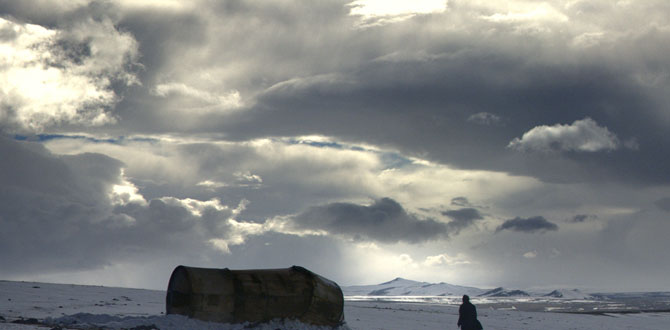
It is from that border wilderness that the central protagonist of the film emerges. This is a great opening shot as a small figure gradually emerges from the wintry wasteland. He is called Kosmos He arrives at a border town. Whilst washing in the river he spies and saves a drowning boy. The boys sister Neptün believes Kosmos has bought the boy back from death. As this news spreads in the close-knit town community Kosmos is made welcome.
Attempts are made to provide him with accommodation and work. But Kosmos is a wayward spirit. He is taciturn, and his occasional utterances sound like quotations from sacred volumes, most likely the Koran. Moreover, as he tells the townsmen, he is looking for love. He finds this with Neptün, a kindred spirit. They often communicate by shrill, laughing cries.
Kosmos’ search for love crosses the cultural taboos about sexuality. And his attempts at other good deeds, including procuring medicine for a desperate and lame young woman, capture the attention of the army: the actual law enforcing agency in the town. By the film’s end Kosmos is sought by both hopeful townspeople seeking miracles, and by an army officer and his squad. The film ends as he disappears back into the wintry wilderness. However, Neptun’s own screeching at the captain suggest the possibility that she now also possesses Kosmos’ unusual powers.
The film treads an uneasy but successful line between drama and farce. The recurring cries of greeting between Kosmos and Neptün are bizarre by conventional film standards. But the film manages to evoke both a magical world and the staid everyday world into which it collides. This is partly done by effective characterisation and a remarkable mise en scène. The film makes fine use of the widescreen imagery, and snow, mist and shadows contribute powerfully to this. An atmospheric soundtrack accompanies the visuals. One set of the recurring sounds on this are distant or not-so-distant explosion, as the army conduct manouvres near the border.
There are also suitably bizarre episodes to match the wayward world of Kosmos. So a Russian space capsule crashes nearby one night and provides a notable distraction in town life.
The film also manages to retain some ambiguity about Kosmos’ powers. His ‘miracles’ are not uniformly beneficial. There is a young boy who has been dumb for a year after a traumatic experience. Kosmos restores his powers of speech, but the boy is then struck down by a fatal illness. This adds to the antagonisms that develop towards Kosmos.
The background to the story and main characters are sketched in with detail and frequent eccentricity. One recurring scene shows a band of four feuding brothers, driving round with their fathers coprse and coffin whilst they struggle over his inheritance. Some of the recurring motifs are clearly symbolic, and a little over emphasised. Thus there are frequent shots of cows being led to an abattoir: and also a flock of geese waddling down a street. But most of the motifs add to the atmosphere of the film and story: the recurring thefts from the shops: the café where only men drink their tea and talk: the scenes by the river, a fast-flowing icy torrent; a mist-laden square dominated by a statue, presumably Ataturk: all help to build up the enclosed world of the town.
Definitely a film to be seen and enjoyed: though it may take a little time to adjust to the film’s oddball flavour.
 itp Global Film