
(Trying to avoid spoilers, but be aware some narrative revealed).
Todd Solondz’s follow-up to Happiness (1998) both confounds and confirms expectations. Strictly, it’s a sequel but it takes the tone and the action in a completely different direction. In it, with the re-mastering of the characters from the original film, we recognise and don’t recognise them. An appropriate feeling with meeting people ten years on – casting different actors seems to have wrought the implied inner changes in people (that happen in real life) visibly on the surface. A clever trope that prepares us to respond differently, but finds us also recognising some essential parts that have remained the same. Thus, it will go on to establish different expectations with us as its audience. However, it begins exactly as Happiness began – in the restaurant with the presentation of the engraved ashtray (this time, found on eBay) by the excited lover. This is the first of the in-jokes for those of us who knew the earlier film – a device that is more inclusive, contrasting with the way the earlier film dared us to engage – with the unattractive and self-absorption of its protagonists. This did not refer as overtly to the irony between the characters superficial behaviour and the emotions they hide underneath. Here it is more strongly pointed up in the dialogue between characters – the idea of “villains” and “monsters” being examined by the older Bill and his pick-up in the bar (a brilliant Charlotte Rampling in a difficult, deliberately jarring performance). And our responses to characters, such as the paedophile, are not the reluctant, uncomfortable understanding that the director so masterfully worked in us before.
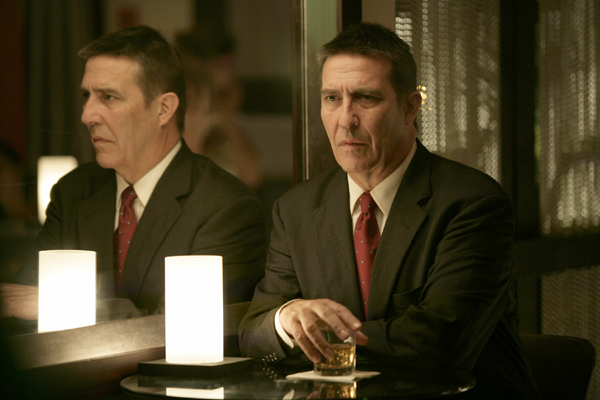
The shift in tone and feeling is marked in this second, but new, film. If you want to see that uncompromising, piercing view of the misery of suburban America that Solondz became associated with in the 1990s, it has altered. I avoid using the word mellowed – because there isn’t a kind of capitulation or acceptance in Solondz’s perspective necessarily (and for some reason, I want to kick against those reviews that point to him becoming a father himself as a catch-all reason for the change. It’s subtler and more complex that that). But it is humane and deeply affecting. And there is a focus on fathers and sons. The central (for me), resonating presence is Ciaran Hinds’ Bill (in a performance that is largely silent), just released from prison and returning to find out the impact his actions had on his family. The scene between him and Billy is powerful and believable and sits at the heart of the film – a moment of contact that demonstrates how there can never be reconciliation or reconnection but which intensely communicates how much that is desired on both sides.
Joy’s development is similarly rendered as entirely possible – she continues to blow through her own life with childlike misunderstanding as a piece of flotsam and jetsam. Where the cinematography for her scenes drifts into sepia, she seems fading into the old movie she was part of in the opening sequence. Trish has become substantially more rounded, if no more insightful whilst Helen is marginalised and caricatured.
Solondz (and his cinematographer Edward Lachman) blend very disparate styles of cinematography that create a heightened reality and lend melodramatic cues to character states for the audience. The Florida real estate is shot as garishly as before – its unforgiving and blank uniformity (emphasised by its bright colours) making it a place truly to be frightened of. The title? We are living in a time of warfare, but far removed from the realities of that. Leading lives of – what? It seems to be comfortable emptiness not yet recognised (except by Harvey) or outright despair and hopelessness (like Bill) – but Solondz, again, has fashioned such believable-extremes I hesitate to stereotype their ‘thoughts.’ Thematically, this film is more obviously uplifting and affirming – love does exist, even if it doesn’t have the power to change things.
 itp Global Film