

This year’s Festival ran from November 4th to the 22nd. There was a wide range of films and, for me, the content was stronger than it has been for at least a couple of years. There were all sorts of attractive titles in the programme that I could not manage to see – choice on some days was the biggest hurdle. Judging by comments from friends and colleagues the best films that I missed were 199 Tips to be Happy (199 Recetas para sez Feliz, 2008), a Chilean / Spanish ‘interior’ drama: and My Girlfriend is an Agent (Chilgeup gangmuwan, 2009), a comedy with recent box offcie success in Korea. I have to confess I also missed the Leeds Brewery’s contribution, ‘reel ale’.
One very positive aspect of the festivals was the size of audiences. Many of the screenings that I went to were fairly full and the Festival reports an increase in total attendances on the previous year. This continues a rising curve in numbers over the last few years. And the audiences are keen, apparently knowledgeable, and would appear to appreciate quality. [There were few disruptions from mobile phone users]. The Festival team is to be congratulated on their publicity and marketing: it certainly appears to pay off. One of the seminar events held during the Festival was on Open Cinema: ways of developing audiences for the ‘less than mainstream cinema’. This is needed as the buoyant attendance’s during the Festival do not seem to last throughout the year. In fact the Festival did experiment with a regular screening slot a between annual events. This was several years ago and finally expired from lack of support. There is still the Leeds Young Persons’ Film Festival to come over Easter 2010.
One of the ways the Festival gained interest was in big name films and directors. This year’s programme included Jane Campion’s Bright Star; Grant Heslov’s The Men Who Stare at Goats; and the new Coen Brothers’ film. Bright Star I thought pretty good. Certainly an improvement on earlier films treating of romantic poets. Abbie Cornish as Fanny Brawne is especially impressive. I saw the trailer for The Men Who Stare at Goats – which was enough to make me give the film a miss.
The more typical festival films, independent, foreign language, alternative cinema, featured in the various sections and many of them under consideration for the various Festival prizes. There is a ‘starring’ system for audiences after screenings; and lots of people seem to participate. The winner this year was Ponyo (Japan, 2008) by the much acclaimed animator Hayao Miyazaki. Audiences described it as both ‘funny and charming’. Given Miyazaki’s high profile the film should be easy to see.
The Golden Owl Award is for feature films, enjoying an English premiere and by non-established directors. The winner was La Pivellina, a joint Austrian / Italian production. The directors are Tizza Covi [also the scriptwriter] and Rainer Frimmel. The jury commented, “We were moved by the honesty, humanity and detail of this film. It is a delicate lesson in the fundamentals of life.” Set amongst outsiders, and with a documentary feel, the film deals with the circus family and its discovery of an ‘abandoned’ child. Previous winners have fared unevenly in the UK, so it is wait and see if it makes it to UK screens.
One award is named after the great French pioneer, Georges Méliès. The Silver Melies award went to an UK film Heartless, a genre hybrid blending fantasy and reality. [The Silver Méliès are sited across five Festivals, with a Golden Méliès to top all five].
There were also Jury Awards for short films: there is an extensive programme of these in the Festival. And they come in a variety of genres, styles and formats. There are Augustin Awards, named after the less-well-known Leeds base pioneer, Louis Aime’ Augustin le Prince. He shot a short strip of moving film on Leeds Bridge in 1888: the frames can still be seen at the University-based Film School.
The Higher Education Institutions feed into the Festival. One supported venture was a programme of German films that in some way related to the anniversary this year of 1989, 20 Years of German Reunification. The films are part of a touring package, which will hopefully turn up on many screens. My favourite was a wry romantic comedy set in an East German street running alongside The Wall, Sun Alley (Sonnenallee, 1999). There will be individual reviews of this and some of the other German films: also a Palestinian, a Korean and an Argentinean film].
As the festival programme has developed the venues have changed. So the big name titles for this year were screened in the Leeds Town Hall, an innovation from 2008. This is clearly a prestige venue, but not completely ideal for films. The acoustics rather muffle the soundtrack. Also, as there is no rake the audience in front of one can obscure part of the screen. This can be a real problem when the film is subtitled.
Right in the city centre is the Vue Multiplex, and two screens are provided for the festival. This is a good venue for 35mm features, the preference of this reviewer. The cinema is very comfortable, the screens are large, and there is a good rake. The projection does vary a little. Focus could have been tighter on some films and the image a little underlit.
Much of the programme takes place in the Carriageworks, a new performance complex near the Millennium Square. This has multiple rooms, convenient for the varied formats featured by the Festival. It is also used for 35mm screenings, which I don’t think it flatters. And the largest auditorium has a resounding floor and less than brilliant acoustics.
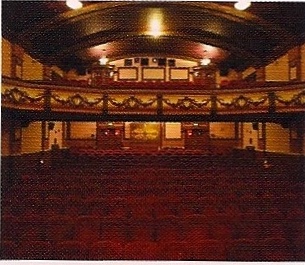
My favourite venue remains the Hyde Park, which was the original home of the Festival in 1987. I assume that it being a couple of miles from the centre is the reason why it is no longer the festival centre. It was converted to a cinema in 1914 and has a traditional ambience, which is great. It is fine venue for 35mm and the standards of projection are fairly high.
Unfortunately one of the films by Germane Dulac films [in a prestige screening] had to be screened on digital video. This was actually due to there not being a 16mm projector that could run the print of The Smiling Madame Beudet (La souriante Madame Beudet, 1922) at the silent projection speed. Anyway we viewed a DVD which apparently did not have English subtitles. Audiences unfamiliar with the film or with the French language were rather bemused. I was disappointed as I think the film is actually better than her later The Seashell and the Clergyman (La Coquille et le clergyman, 1927), which was shown on 35mm. Both had live accompanying music: by Leeds Improvised Music Association and Inecto School respectively. The music was atmospheric and fairly appropriate. I did find LIMA added rather too many sound effects and Inecto were overly loud at times: but it was a rare treat and worth attending.
These new digital formats are creating problems as they replace 35mm screenings. High definition digital is great for contemporary films, not always so kind to older films. The more serious problem is the substitution of digital video for high definition or celluloid. This seems mainly down to the distributors. One of the German prints listed as 35mm also turned up on DVD; and it showed. It is worth noting that the celluloid prints from the Goethe Institute have all been returned to Germany. So in that case too we are less with inferior digital video versions.
To be fair all festivals have such problems and mishaps. I think from memory there were fewer this year in Leeds than in some previous ones. Generally the Festival has been a success which bodes well for 2010.
 itp Global Film