
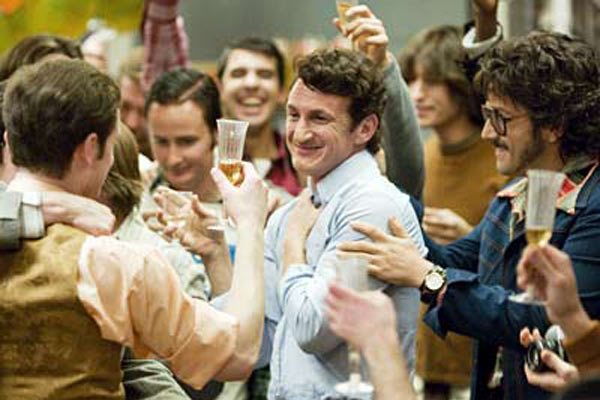
I’m ambivalent about this film: Sean Penn is fabulous (but then he normally is) but I almost fell asleep at one point. It might have been Gus van Sant’s functional direction that made me soporific or it could be the constraints of the biopic genre. To portray a life in two hours you obviously have to focus on key moments. Anyone with knowledge of Milk’s life would know what should be included; this immediately limits scriptwriters: events must be included regardless of their dramatic potential or cohesiveness. For me the story wasn’t gripping until Milk took on the Religious Right.
That said, Milk’s is an important tale as he fought successfully against bigotry. He seemed the ideal politician in that he decided to get elected to San Francisco’s Board of Representatives for a reason (Gay rights) and not for power. But Gus van Sant can’t resist sentimentalising Milk’s death (I haven’t given that away, that’s obvious from the start) with a long drawn out scene that even Penn struggles to make convincing.
It’s great to see ‘pretty boy’ James Franco embracing the role as Milk’s lover. It wasn’t long ago that Will Smith was advised (for Six Degrees of Separation, 1993, I think) not to engage in a ‘gay kiss’ as it would ruin his career. Hollywood remains homophobic but progress has been made.
 itp Global Film
I’m repeating a comment I made earlier elsewhere: (POSSIBLE SPOILERS)
“Yes I accept that Van Sant’ depiction of gay people without any “attention” and treating them as any lead pair. As for the detached observation of events, I am skeptical.
This was the same problem I had with Elephant. I never understood what was so great about it. They say that he shows us the events dispassionately, yet he dramatizes using multiple POVs and hand cams (inherently dramatic). They say he does not claim to give a psychological understanding, yet he shows us the kids kissing in the shower. I felts it was the classic Emperor without his clothes
Again, in MILK, I respect his idea of the film being driven by events rather than characters and the last 8 years alone being focussed. I liked it. And I liked the way it started. Depicting major turning points using news reels and filming only the seemingly banal and comic conversations during the creation of the process. It was nice to see Van Sant depict a revolution without actually creating large scale mise-en-scene and filming the entire movement inside 4 walls. But as the halfway mark approaches, this idea seemed lost completely. He gets onto the roads. He actually starts riots, creates external drama during the election sequences. What he did effortlessly in the first half, keeping all the drama in the newsreels and footages, he sacrifices in the second. I mean, I never felt it Van Sant would actually show us the murders. There is the typical final shot of the opera house with the American Flag juxtaposed on his dying image. This is followed by the cutback to his stint with Franco 8 years ago reminding us that Harvey never thought he will live. Also, he follows it up with filmed sequence of the candlelight procession instead of just giving us newsreels. All this drama is so forced and prevents the audience to concoct the measure of the movement by themselves. I felt this change of tone hurt the film.
The credit sequences made me expect a masterpiece. atrocities being shown instead of verbalizing the situations. The names of the characters appearing on the edge of the frame like the marginal characters themselves – all this was great. But somehow, I feel it got lost midway.
P.S: Another great performance by Hirsch is going to go unnoticed.”
LikeLike